Advances in Engineering Advances in Engineering features breaking research judged by Advances in Engineering advisory team to be of key importance in the Engineering field. Papers are selected from over 10,000 published each week from most peer reviewed journals.

Significance Statement
If there is a continuous casting machine component that stands out for being controllable in real-time and for having the ability to regulate locally the heat extraction conditions from the strand surface is the array of spray nozzles of the secondary cooling system.
Specification of spray nozzle types and of their spatial distribution with respect to the strand surface is of primary importance when a new casting machine is designed or when an existing one undergoes a major revamping. In machines in operation the degrees of freedom left to the operator for controlling the strand coolling rate are the nozzle operating conditions, i.e., water flow rate, in case of hydraulic nozzles, and additionally, air flow rate and pressure in pneumatic nozzles. The choice of these variables should arise from specification of the strand thermal conditions that balance quality and productivity.
The key for achieving the desired strand heat extraction and temperature field is the local boiling heat extraction resulting from the way drops in the spray contact the strand surface. The interaction modes of individual drops in the spray with the surface depends on drop size, d, normal velocity, vz, and density of the parcel in which it moves towards the surface, as well as, on surface temperature, roughness and wetting state.
From the literature is evident that empirical correlations to predict heat transfer by convection boiling of sprays and air-mists still govern the field. Unfortunately most correlations are only reliable for conditions very close to those used in the experiments from where they were obtained. Also, commonly the experimental conditions are far apart from actual plant conditions and hence the laboratory correlations are adjusted to fit the temperature predictions of computational models with plant measurements. This fitting narrows even more the applicability of the correlations since they are modified by introducing machine dependent calibration factors that may not have any direct relation to the sprays in the machine. In this calibration process correlations that may have been intended to predict local heat fluxes are averaged over the whole area of machine cooling zones to include diverse heat extraction modes.
A more suitable knowledge of spray cooling would be gained by testing in plant laboratory heat flux correlations without subjecting them to any computational calibration. A significant reduction in the number of the experiments could be expected by identifying the local average characteristics of the spray (e.g., water impact flux, w, volume mean diameter, d30, and normal volume weighted mean velocity, vz,v) influencing heat flux, so that the correlations gain generality. Additionally, the literature is plenteous with single-droplet-wall interaction experiments, involving relatively large drops, low normal Weber numbers (Wez= ) and low temperatures, which have provided beautiful images and useful data and correlations, but that keep little resemblance with the interaction of real sprays with surfaces at temperatures relevant to continuous casting. Thus, it is indispensable to understand how spray characteristics and spray collision dynamics depend on the operating conditions of nozzles and how they ultimately affect the spray/mist cooling heat transfer.
This work is a step in the attempt to unveil the relation between free spray characteristics with spray collision dynamics and boiling heat transfer. For this purpose an experimental set-up was designed and built to measure the heat extracted during air-mist cooling and simultaneously visualize the approach and interaction of droplets with a surface at temperatures of interest to continuous casting. The aim is to advance the ability to specify the spray characteristics required to achieve a desired end result, e.g., a given heat flux distribution.
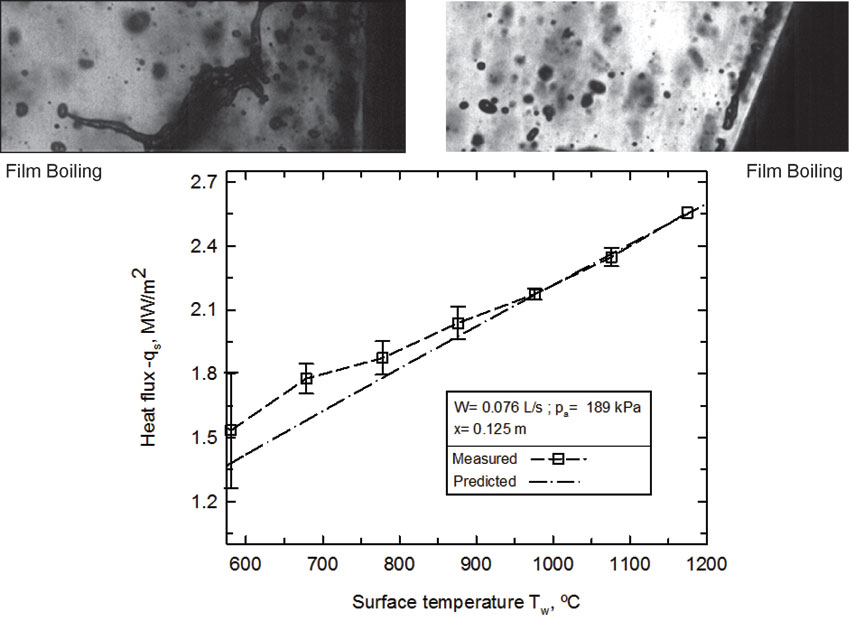
The combination of mist characteristics and steady-state surface temperatures used in this investigation gave rise to film boiling. The observed modes of interaction between the droplets and the surface show little resemblance with the idealized film boiling that has been based on observations of relatively large and slow drops interacting with a surface at relatively low temperature. With real mists visualization of the events happening onto the surface reveals that the contact time of the liquid with the surface takes place over a much shorter time scale than that found in single droplet studies, i.e., in a few tenths of a millisecond or less instead that in several milliseconds. Nonetheless, the interaction during this brief period of time is quite intensive at large Wez. At the center of the mist footprint where drops impinge nearly normal to the surface small drops with large Wez establish intimate contact with the surface, generating vapor blows that break through the spread liquid film forming many secondary drops that are removed by the flowing air, clearing the surface for new arrivals.
Observation of the impingement of large drops with very high Wez suggests that upon contact a very rapid vaporization occurs, causing a high pressure build up between the liquid and the surface that leads to formation of long liquid jets and/or sheets. Additionally, despite the high temperatures liquid films appear randomly touching the surface while drifting upon it, and as expected they evaporate very quickly. At the center of the mist footprint drops are also observed sliding upon the surface or levitating close to it, but this kind of behaviors are much more frequent at positions where drops tend to impinge oblique to the surface and direct impingement is less frequent. The vapor cushion which forms below sliding drops causes their intermittent levitation.
Thus, it is seen that the impingement position, relative to the nozzle axis, has a very important influence on the motion and interaction of the drops with the surface, causing a substantial effect on heat extraction. Drops with Wez < 80 may not reach the surface or interact very slightly with it, explaining the low mist efficiency obtained.
As the droplet interaction modes depend on the characteristics of the impinging drops the boiling heat flux depends on the average characteristics of the drops in free mists, i.e., on w, d30, and vz,v.
The paper of Huerta, Mejía and Castillejos that was recently published in Metallurgical and Materials Transactions B is the first investigation to achieve visualization of the complex interactions occurring between a real mist and a surface at temperatures of interest to continuous casting.

Journal Reference
Mario E. Huerta L., M. Esther Mejía G., A. Humberto Castillejos E. Heat Transfer and Observation of Droplet-Surface Interactions During Air-Mist Cooling at CSP Secondary System Temperatures. Metallurgical and Materials Transactions B, 2016, Volume 47, Issue 2, pp 1409–1426.
Laboratory of Process Metallurgy, Department of Metallurgical Engineering, Centro de Investigación y de Estudios AvanzadosCINVESTAV – Unidad SaltilloRamos ArizpeMéxico.
Go To Metallurgical and Materials Transactions B