Advances in Engineering Advances in Engineering features breaking research judged by Advances in Engineering advisory team to be of key importance in the Engineering field. Papers are selected from over 10,000 published each week from most peer reviewed journals.

Significance Statement
Researchers from North Carolina A & T State University evaluated the feasibility of ethanol production from miscanthus growth with different fertilizer treatments through wet processing. The paper by Boakye-Boaten et al. (2016) appeared in Bioresource Technology.
Conventional production of ethanol from starch–based and lignocellulosic biomass feedstock requires external energy source from heat and power. Hence, favorable energy balance of biofuel production is of great concern in order to minimize energy usage making the process more energy efficient.
Although fairly high efficiency have been recorded in drying of biomass material before fermentation process, it’s important to improve energy efficiency of ethanol production process by creating new inventions that allows use of lignocellulosic biomass materials without undergoing physical or thermal processing such as drying. Another important consideration in energy efficiency production of ethanol is water balance which requires distillation depending on moisture content in the feedstock.
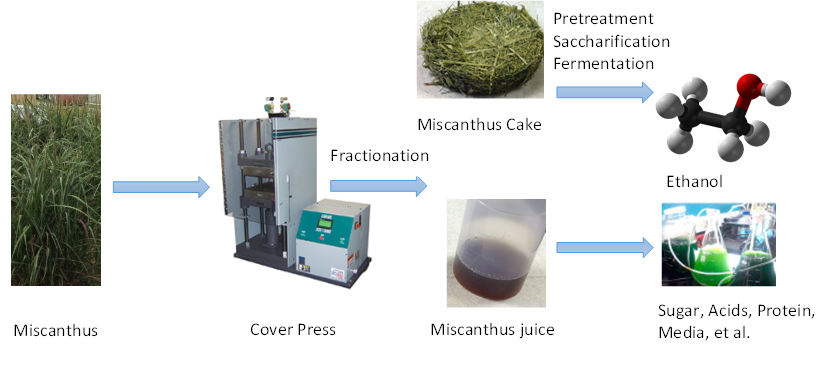
Boakye-Boaten et al., (2016), harvested Miscanthus X giganteus, a lignocellulosic biomass feedstock for examining different methods of bioethanol production. The samples were passed into solid cakes and two methods were considered; the dry process method and wet process method. Composition of biomass analysis was determined by Laboratory Analytical Procedures (LAPs) of National Renewable Energy Technology (NREL). Dilute Sulfuric Acid Pretreatment (DSAP) followed using 1%(v/v) sulfuric acid solution in temperature of 1600C for 10min. Scanning Electron Microscopy (SEM) and Fourier-Transform Infrared Spectroscopy (FTIR) were employed to analyze the morphological images and chemical composition of untreated and pretreated samples of Miscanthus X giganteus. In addition to this, pretreated biomass of both dry and wet processed biomass was employed for fermentation in Simultaneous Saccharification and Fermentation (SFF) using saccharomyces cerevisiae as yeast.
From the results obtained, there was an increase in Carbon to Nitrogen ratio (C/N) from dry processing to wet processing method as increase in C/N ratio relates to an increase in concentration of ethanol.
Composition of cellulose and lignin increased after Dilute Sulfuric Acid Pretreatment with a decrease in hemicellulose content for the three samples. The pretreated wet processed biomass showed significant higher increase in cellulose content than the dry processed biomass but the two process were still higher than the untreated biomass. It was also seen that Miscanthus samples grown with swine manure showed most cellulose and least lignin content after pretreatment.
Results on morphological features of untreated and Dilute Sulfuric Acid Pretreated samples showed that untreated samples had more robust structure due to exposure of internal structure and fibers of the biomass. The pretreated wet samples show a greater degree of distortion than the pretreated dry processing samples which may be due to higher amount of cellulose presence.
The chemical composition using FTIR analysis indicated an increase in polysaccharides especially cellulose increment and drastic decrease in hemicellulose after pretreatment.
Simultaneous Saccharification and Fermentation (SIFF) results showed that ethanol concentration was higher for wet processed samples than dry process samples with sample of swine manures having the highest concentration of ethanol concentration.
Boakye-Boaten et al. (2016), concluded that “Just as the cellulose fraction in the biomass after pretreatment was higher in wet processed samples than dry processed samples and just as ethanol concentration measured during Simultaneous Saccharification and Fermentation were also higher for wet samples than dry samples, the theoretical ethanol yield was higher for wet processed pretreated samples with the highest theoretical yield of 84.4% recorded for Miscanthus fertilized with swine manure”.
Boakye-Boaten et al. (2016) ability to produce high concentration of ethanol without drying biomass definitely improves the energy efficiency process which is needed for commercial considerations.
This work is supported by the USDA-NIFA-Evans-Allen Project under Grant No. NCX-272-5-13-130-1.



Journal Reference
Nana Abayie Boakye-Boaten1,2, Shuangning Xiu2 , Abolghasem Shahbazi2, Lijun Wang2, Rui Li3,2, Michelle Mims2, Keith Schimmel1. Effects of fertilizer application and dry/wet processing of Miscanthus x giganteus on bioethanol production. Bioresource Technology, Volume 204, 2016, Pages 98-105.
[expand title=”Show Affiliations”]- Energy and Environmental Systems Program, College of Arts and Science, North Carolina A & T State University, 1601 East Market Street, Greensboro, NC 27411, United States.
- Biological Engineering Program, Department of Natural Resources and Environmental Design, North Carolina A & T State University, 1601 East Market Street, Greensboro, NC 27411, United States.
- Joint School of Nanoscience and Nanoengineering, North Carolina A & T State University, 2907 E. Gate City Blvd, Greensboro, NC 27401, United States [/expand]
Go To Bioresource Technology