Advances in Engineering Advances in Engineering features breaking research judged by Advances in Engineering advisory team to be of key importance in the Engineering field. Papers are selected from over 10,000 published each week from most peer reviewed journals.

Significance Statement
An agglomeration of metal nanoparticles when forming nanocatalysts remains a big challenge due to thermodynamic instability caused by their large surface areas and high surface energies. Even in presence of best stabilizing agents, this phenomena needs to be conquered in their catalytic applications coupled with measures on how to obtain pure active metal surfaces which aids catalytic performance.
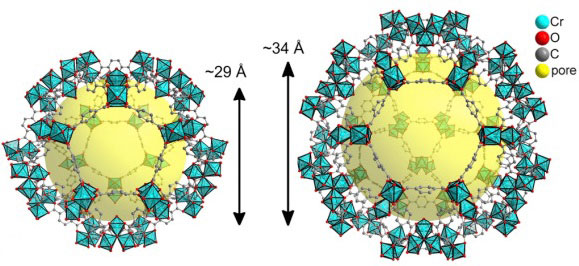
Metal-organic frameworks MOFs can also be considered as a suitable host material which stabilizes guest metal nanoparticles. They enhance flexibility and systematic modification of pore structure leading to stabilization of metal nanoparticles within its structure producing solid catalytic materials which can be of help in kinetic control of catalytic reactions. A metal-organic framework, MIL-101has been used in various researches and it has yielded positive results along with its special properties.
Researchers led by Dr. Mehmet Zahmakiran from Nanomaterials and Catalysis Research Group (www.nanomatcat.com) at Yüzüncü Yıl University in Turkey reported the synthesis, characterization and catalytic application of ruthenium (0) nanoparticles stabilized by MIL-101 metal-organic framework (Ru/MIL-101) which was prepared via gas phase infiltration of Ru(cod)(cot)(cod=1,5-cyclooctadiene, cot=1,3,5-cyclooctatriene) followed by hydrogenolysis of Ru(cod)(cot)@MIL-101 at 3 bar H2 and temperature of 323 k. The study appeared in Microporous and Mesoporous Materials.
When observing catalytic performance of Ru/MIL-101 in hydrogenation of phenol to cyclohexane, the Ru/MIL-101 fulfilled majority of green chemistry requirements as it used water as solvent, highly selective in preventing formation of by-products, maximizes incorporation of reactants into products, needed relatively low energy, not stoichiometric and its real time monitoring was easy by measuring hydrogen uptake or gas chromatography analysis.
When Ru/MIL-101 catalyst was reused, it was still active in hydrogenation of phenol to cyclohexane, retaining >85% and >85% of initial catalytic activity and selectivity respectively. The drop was due to decrease in number of active ruthenium atoms due to increase in size of ruthenium (0) nanoparticles from 4.2±1.2nm to 4.9±1.6nm. CO chemisorption analysis showed that 39% of total ruthenium metal atoms were exposed after fifth catalytic reuse when compared to fresh Ru/MIL-101 with ca. 33% only.
The high activity, selectivity and reusability performance of Ru/MIL-101 catalyst reported by the authors makes it an attractive one for performing other organic and inorganic transformations which occur in the liquid phase.

Journal Reference
Ilknur Efecan Ertas, Mehmet Gulcan, Ahmet Bulut, Mehmet Yurderi, Mehmet Zahmakiran. Metal-Organic Framework (MIL-101) Stabilized Ruthenium Nanoparticles: Highly Efficient Catalytic Material in the Phenol Hydrogenation. Microporous and Mesoporous Materials, Volume 226, 2016, Pages 94–103.
Nanomaterials and Catalysis (NanoMatCat) Research Laboratory, Department of Chemistry, Yüzüncü Yıl University, 65080, Van, Turkey.
Go To Microporous and Mesoporous Materials