Advances in Engineering Advances in Engineering features breaking research judged by Advances in Engineering advisory team to be of key importance in the Engineering field. Papers are selected from over 10,000 published each week from most peer reviewed journals.

Significance Statement
Toe berm stability depends mainly on design wave storm characteristics, water depth and sea bottom slope existing at the construction site. The design of rock toe berms is almost always valid for emerged toe berms and very submerged toe berms. However, there is a range of water depths at the toe (hs) in which the required rock size is so large that there is no available material. In these situations, it may be possible to either move the toe position in order to reduce the damaging effects of water depth or increase the width of the toe berm (Bt).
Popular formulas to predict damage to rock toe berms have been obtained from small-scale tests with different toe berm geometries. Nevertheless, these do not commonly consider the effects of toe berm widths (Bt) or thicknesses (tt) as explicative variables of toe berm damage.
Researchers from the Department of Transportation at the Universitat Politècnica de València (UPV) in Spain analyzed the influence of the nominal diameter (Dn50) and the toe berm width (Bt=nDn50) on the hydraulic stability of rock toe berms, where n is number of rock rows placed on the upper layer of the toe berm. Two new concepts were provided to characterize wide toe berms (n>3): (1) the nominal toe berm, considered the most shoreward toe berm area which effectively supports the armor layer, and (2) the sacrificial toe berm, considered the most seaward toe berm area which serves to protect the nominal toe berm.
This research, published in the journal Coastal Engineering (2016, Vol. 114, pp 361-368.), tested different pairs of (Dn50, Bt) with the still water level (SWL) close to the crest of the toe berms given that the previous model, proposed by Herrera and Medina, (2015), was modified to account for wider toe berms (n>3) based on damage measurement of the nominal toe berm.
The experimental setup involved 2D physical model tests conducted in the wave flume (30m x 1.2m x 1.2m) of the Laboratory of Ports and Coasts at the UPV with a piston-type wave maker and a steep sea bottom (m=1/10). A cube armor was built on a filter layer with Dn50 (cm) =1.78 and Dn85/Dn15=1.64.
Toe berms were tested with three rock sizes, Dn50(cm)=3.04, 3.99 and 5.12 and mass density r(g/cm)=2.7. Three toe berm widths (n=3, 5 and 12) were applied with Dn50(cm)=3.04 and 3.99, while only nominal toe berms (n=3) were tested with Dn50(cm)=5.12. Random wave runs of 500 waves were generated following JONSWAP (ϒ=3.3) Spectrum, and the AWACS Active Absorption System was activated to avoid multi-reflections.
Water surface elevation was measured using eleven capacitive wave gauges; one group of wave gauges (G1, G2 and G3) placed near the wave maker, and ten wave gauges (G4 to G11) placed along the wave flume. The LASA-V method described by Figueres and Medina (2004) was used to estimate incident and reflected waves at the generating zone (G1, G2, G3).
Damage to the total toe berm (Nod) and to the nominal toe berm (Nod*) was measured after each test, considering the cumulative damage in each test series defined by the water depth at the nominal toe berm (hss). Results showed that both Nod and Nod* increased when reducing the rock size (Dn50). However, for a given Dn50, Nod increased with increasing toe berm width (n), while Nod* increased when reducing n. Thus, the total toe berm damage (Nod) was found to be unsuitable to measure the damage to toe berms with different geometries, since a larger Nod was required to damage wider toe berms (Bt>3Dn50).
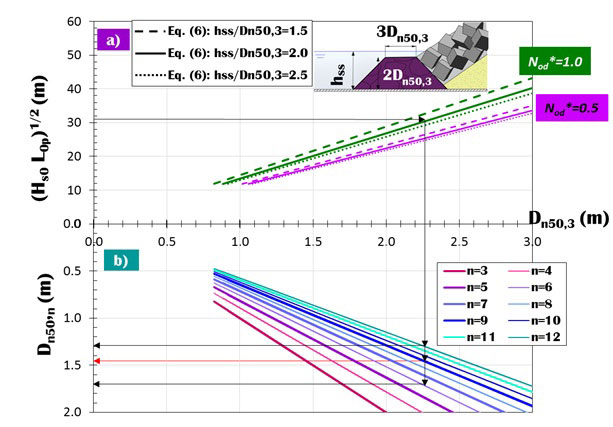
Damage to the nominal toe berm (Nod*) was proposed to describe hydraulic stability of wider toe berms. Based on Nod*, a new method was developed to design rock toe berms with 3Dn50≤Bt≤12Dn50 and tt=2Dn50, placed on steep sea bottoms (m=1/10) when the SWL is close to the crest of the toe berm (1.5≤hss/Dn50≤2.6). For an acceptable level of damage (Nod*≈1), the rock size of the nominal toe berm of three rocks wide (Dn50,3) may be determined first using the equation proposed by Herrera and Medina (2015). If it is not possible to construct a nominal toe berm with Dn50,3, an equivalent toe berm with damage similar to the nominal toe berm may be defined by increasing the berm width (3<n≤12) and decreasing the rock size, following an inverse 0.4-power relation with the relative berm width.
Toe berm stability should be considered together with armor stability. Thus, the damage to the nominal toe berm, which effectively supports the armor layer, should be taken into account when analyzing breakwater hydraulic stability. When using sacrificial toe berms in shallow water combined with steep sea bottoms (m=1/10), it is convenient to regularly monitor the toe berm as it may be partially washed away.
REFERENCES
Herrera, M.P. Molines, J. Medina, J.R. Hydraulic stability of nominal and sacrificial toe berms for mound breakwaters on steep sea bottoms. Coastal Engineering, 2016, Volume 114, pp 361-368.
Herrera, M.P., Medina, J.R. Toe berm design for very shallow waters on steep sea bottoms. Coastal Engineering, 2015, Volume 103, pp 67-77.
Figueres, M., Medina, J.R. Estimation of incident and reflected waves using a fully non-linear wave model. Proc. 29th International Conference on Coastal Engineering, World Scientific, Singapore, 2004, pp 594-603.




Journal Reference
Maria P. Herrera, Jorge Molines , Josep R. Medina. Hydraulic stability of nominal and sacrificial toe berms for mound breakwaters on steep sea bottoms. Coastal Engineering, Volume 114, 2016, Pages 361–368.
Dept. of Transportation, Universitat Politècnica de València, Camino de Vera s/n, 46022 Valencia, Spain
Go To Coastal Engineering