Advances in Engineering Advances in Engineering features breaking research judged by Advances in Engineering advisory team to be of key importance in the Engineering field. Papers are selected from over 10,000 published each week from most peer reviewed journals.

Significance Statement
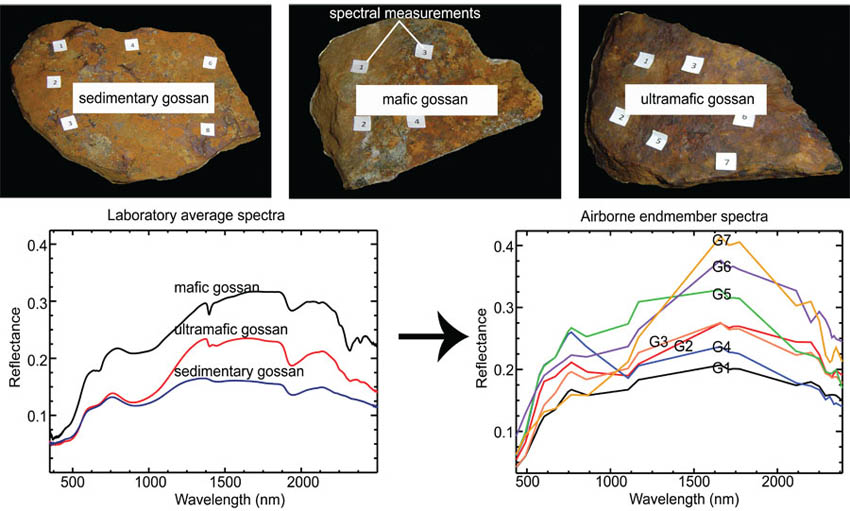
Gossans are rocks that can sometimes be associated with ore deposits. Gossans develop when weathering agents oxidize iron-bearing sulfide minerals. The weathering process leads to the formation of iron oxide-minerals that can make up profiles tens of meters thick. Gossans can be associated with multiple host rock types (sedimentary, mafic or ultramafic rocks in the example below).
Researchers from the University of Alberta (Edmonton, Canada) have presented a novel way to use gossans for mineral exploration. The methodology and results of the investigation were published in ISPRS Journal of Photogrammetry and Remote Sensing. The investigation was conducted using hyperspectral technology that is based on recording light reflected or emitted from geological materials (e.g. rocks). This intensity of light is measured in hundreds of relatively narrow wavelength intervals or bands (e.g. 6nm), enabling a precise detection of the physico-chemical properties of materials.
Due to the link between gossans and ore deposits, gossans have drawn the attention of the geologic community since the advent of remote sensing. Most of the previous hyperspectral studies have been conducted in low latitude regions despite high latitude regions being some of the most prospective areas for mineral exploration. One of the characteristics of the high latitude regions is that gossans sometimes develop as thin (even < 50 µm thick) oxidized surfaces (“thin gossans” from herein). Possibly due to the geographic distribution of the previous studies little attention has been paid to thin gossans and their spectral characteristics.
Aiming to increase our understanding of the spectroscopic characteristics of gossans in northern areas in general, and thin gossans in particular, we conducted our investigation in the Cape Smith Belt, a high latitude Ni-Cu district in Canada. The study area hosts numerous thin and thick gossans, but thin gossans are potentially associated with ore deposits. Moreover, thin gossans that are associated with the ultramafic rock type are more likely to be associated with ore deposits than thin gossans that are associated with other rock types.
To investigate gossans and other rock types of the study area, one hundred and thirty nine hand samples were collected from the Cape Smith Belt. The sample set comprises both gossans and non-gossans (rocks that do not have significant amounts of the iron oxide minerals). Laboratory hyperspectral data were acquired from the samples in the visible-near infrared (VNIR) to short-wave infrared (SWIR) wavelength regions (400-2500 nm) using a PANalytical Boulder Inc. (formerly ASD Inc.) FieldSpec® spectrometer and VNIR and SWIR cameras of Specim (Spectral Imaging Ltd., Oulu, Finland). The mineralogy of the samples was determined using X-ray diffraction analysis (XRD).
The laboratory hyperspectral data were then used to guide the analysis of airborne hyperspectral data. These data were acquired with a two meter spatial resolution in the VNIR and SWIR wavelength regions using the SpecTIR (AisaDual) spectrometer. Spectra of gossan outcrops were extracted from these airborne data using an endmember extraction technique. The mineralogy of the gossan endmember spectra was then inferred by comparing their shapes to the laboratory spectra and the publicly available USGS and ASTER mineral spectral libraries.
The analysis revealed that the gossan endmembers are explained by the presence of iron oxide minerals (predominantly: hematite and goethite) and other minerals associated with the host rocks (e.g. serpentine, amphibole and chlorite group minerals). Specifically, three endmembers (G1, G3 and G4) display spectral features only in the VNIR wavelength region, whereas four endmembers (G2, G5, G6 and G7) display spectral features both in the VNIR and SWIR wavelength regions. Because the iron oxide minerals display spectral features in the VNIR wavelength region and the minerals of the host rocks display spectral features predominantly in the SWIR wavelength region, the endmembers G1, G3 and G4 are thick gossans, and the endmembers G2, G5, G6 and G7 are thin gossans. The thin gossans were further grouped into subclasses (ultramafic and sedimentary) based on their spectral features.
The endmembers extracted from the airborne data were then used to spectrally unmix the airborne imagery providing the spatial distribution of each gossan endmember. The thin gossan endmembers (G2 and G7) are spatially associated with ultramafic rocks. Given that the ore deposits of the study area are linked with such gossans, these endmembers are of particular interest for mineral exploration.
Overall, our results suggest that thin and thick gossans can be discriminated, and thin gossans can be further broken down into several classes using hyperspectral data. The ability to define distinct classes of gossans is significant since the association between gossans with specific rock types can be exploited for exploration.

Journal Reference
K. Laakso1, B. Rivard1, D. Rogge2. Enhanced detection of gossans using hyperspectral data: Example from the Cape Smith Belt of northern Quebec, Canada. ISPRS Journal of Photogrammetry and Remote Sensing, Volume 114, 2016, Pages 137–150.
[expand title=”Show Affiliations”]- Centre for Earth Observation Sciences, Department of Earth and Atmospheric Sciences, University of Alberta, Edmonton, Alberta, Canada
- German Aerospace Center (DLR) Oberpfaffenhofen, Weßling, Germany
Go To ISPRS Journal of Photogrammetry and Remote Sensing