Advances in Engineering Advances in Engineering features breaking research judged by Advances in Engineering advisory team to be of key importance in the Engineering field. Papers are selected from over 10,000 published each week from most peer reviewed journals.

Significance Statement
One dimensional nanomaterials based on p-conjugated molecules are widely used in optical sensors, photonics and in some opto-electronic devices. Organic nanotubes having unique nanostructured architectures find their applications in biometric systems and optically active materials as well. Tubular nanostructures from organic molecules are usually formed via rolling the nanoribbons and sheets or direct stacking of macrocycles, but few examples have reported that simple molecular engineering enables the construction of nanotubes having tunable diameter and wall thickness. The significance of single-handed nanotubes from chiral asymmetric perylene diimide (PDI) molecules in the sensor application, motivated researchers at the Beijing National Laboratory for Molecular Sciences to fabricate high fluorescent nanotubes without the involvement of chiral groups and adjust diameters and wall thicknesses of these nanotubes via simple molecular engineering. The research is now published in the peer-reviewed journal, Small.
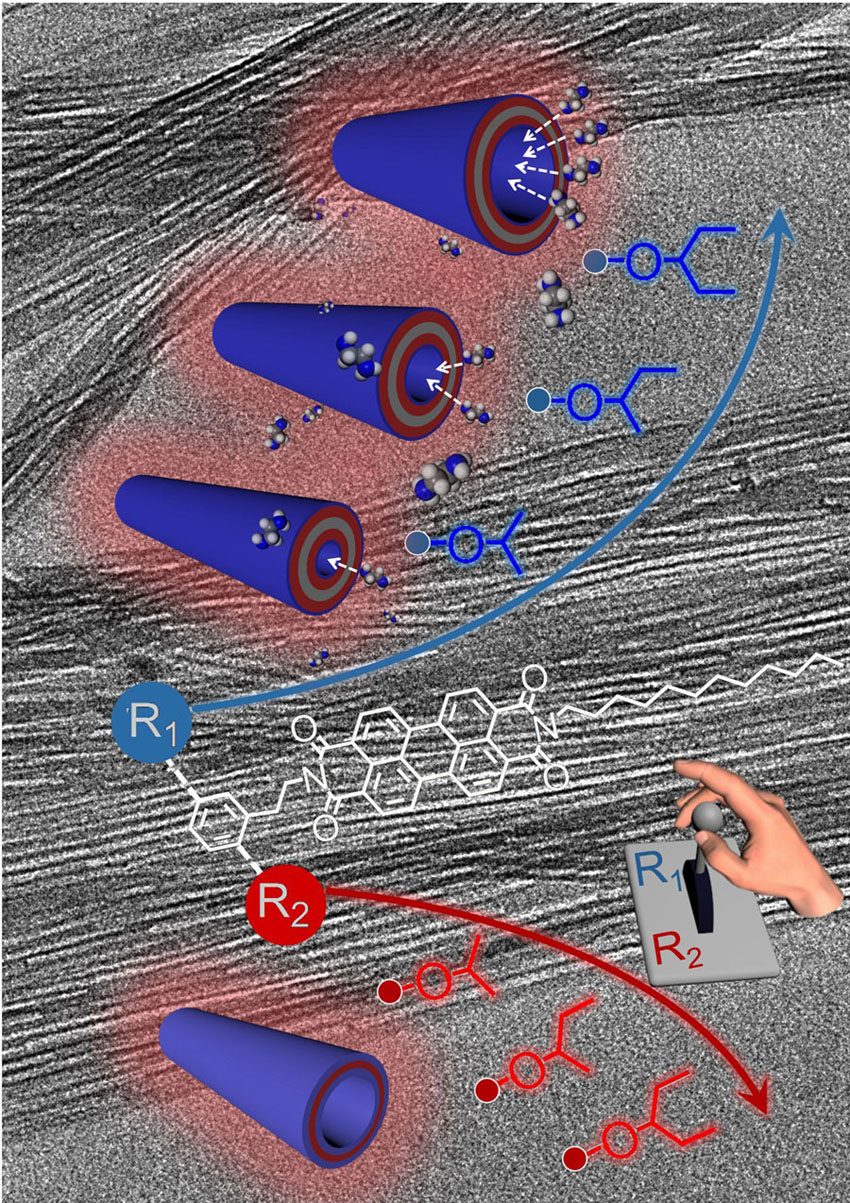
Nanotubes were formed by assembling a significant class of n-type organic semiconductor representation, asymmetric perylene diimide molecules with bulky branched substituents at the meta-position (molecule I) or ortho-position (molecule II) of the phenyl moiety connected to the perylene core via an ethylene linkage. These perylene diimide derivatives form nanotubes with different geometries namely bilayer-walled nanotubes and monolayer-walled nanotubes. Molecules I1–3 constitute bilayer-walled nanotubes whereas monolayer-walled nanotubes are constituted by molecules II1,2. The formation of tubular nanostructures is revealed by the Transmission Electron Microscopy. The structure examined confirms the bilayer structure having inner and outer surfaces. The uniform diameters of nanotubes depends on the molecule from which the nanotubes were obtained. The diameter of bilayer-walled nanotube is found to increase with the size of the branched substituents at the meta-position of the phenyl moiety. Hence tuning of the diameter of bilayer-walled nanotubes is possible by changing these branched substituents.
However, the diameters of monolayer-walled nanotubes remained unchanged when the size of these branch substitutes at the ortho-position of the phenyl moiety decreased. When using 3-isopropoxy in molecule II3, nanocoils were formed initially and then transformed to nanotubes and finally to nanoribbons. Such nanotubes are kinetically trapped aggregates whereas nanotubes obtained from II1 and II2 are very stable and hence undergo no morphological changes.
Nanotubes from molecules I were characterized with high fluorescence quantum yield (exceeding 43%) and photostability that plays vital role in enhancing sensing performance. It was found that the bilayer-walled nanotubes are highly sensitive to vapour emitted from shrimp spoilage as their fluorescent intensity largely decreases within one hour. Specifically, the nanotubes obtained from I2 exhibited the highest fluorescence quenching, likely because of their size-screening effect on the diffusion of the analytes into the nanotube interior nanopores. It was also observed that the relative humidity had no effect on the fluorescent intensity. The nanotubes with high fluorescence and photostability were designed to be capable of tuning its diameter and thickness enabling it to be applicable in various sectors like bio-imaging, optoelectronics and other sensor applications.
This study is validated as an effective approach in tuning the molecular structure and thereby varying the dimensions of the nanotubes and thus widening its applications.
Journal Reference
Cheng Peng, Yibin Zhang, Yifan Zhang, Yanyong Hu, Yanke Che, Jincai Zhao, Highly Fluorescent Nanotubes with Tunable Diameterand Wall Thickness Self-Assembled from Asymmetric Perylene Diimides, Small, Volume 12, 2016, Pages 4363 – 4369.
Beijing National Laboratory for Molecular Sciences, Key Laboratory of Photochemistry, Institute of Chemistry, Chinese Academy of Sciences, Beijing, 100190, China.
Go To Small