Advances in Engineering Advances in Engineering features breaking research judged by Advances in Engineering advisory team to be of key importance in the Engineering field. Papers are selected from over 10,000 published each week from most peer reviewed journals.

Significance Statement
Research on the performance of newly developed cryoprobe, the Joule-Thomson cryoprobe, remains scarce with no data on its cooling power and growth rate of the ice ball formed. The perfect safety margin when utilizing this cryoprobe also needs to be provided for a successful cryosurgery.
In line with this, group of researchers led by Professor Hiroshi Takamatsu from Kyushu University in Japan published an article in International Journal of Refrigeration presenting experimental validation on cooling performances of Joule-Thomson cryoprobe coupled with improvement of pointers for setting the safety margin at the ice periphery.
Following the experimental setup, the authors observed the temperature variation and radial temperature distributions with the use of thermocouples. The authors further investigated the performance of three 1.5-mm dia. cryoprobes at three distinctive gas pressures and the results obtained from the experiments were compared with that of a two-dimensional numerical simulation developed by the authors.
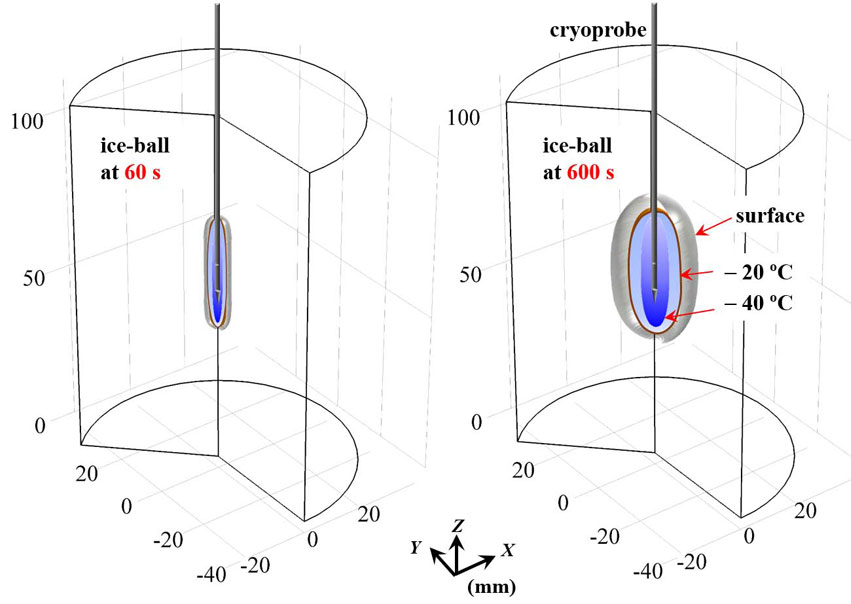
Experimental results indicated that the temperature distribution did not reach a steady state until a period of 10 min. It became found that an increase in gas pressure led to a linear decrease of probe temperature with lowest temperature of -95°C observed at 27.4 MPa while the highest temperature at -75°C was observed at a gas pressure of 22.4 MPa. The probe temperature was considerably higher than that of 2-mm dia. cryoprobes. Although the diameter of the ice ball increased with respect to gas pressure, the diameter was much smaller than that obtained with larger cryoprobes: 21 mm at 22.4MPa and 27 mm at 27.2 MPa. The measured temperature and the size of ice ball correlated well with simulation results.
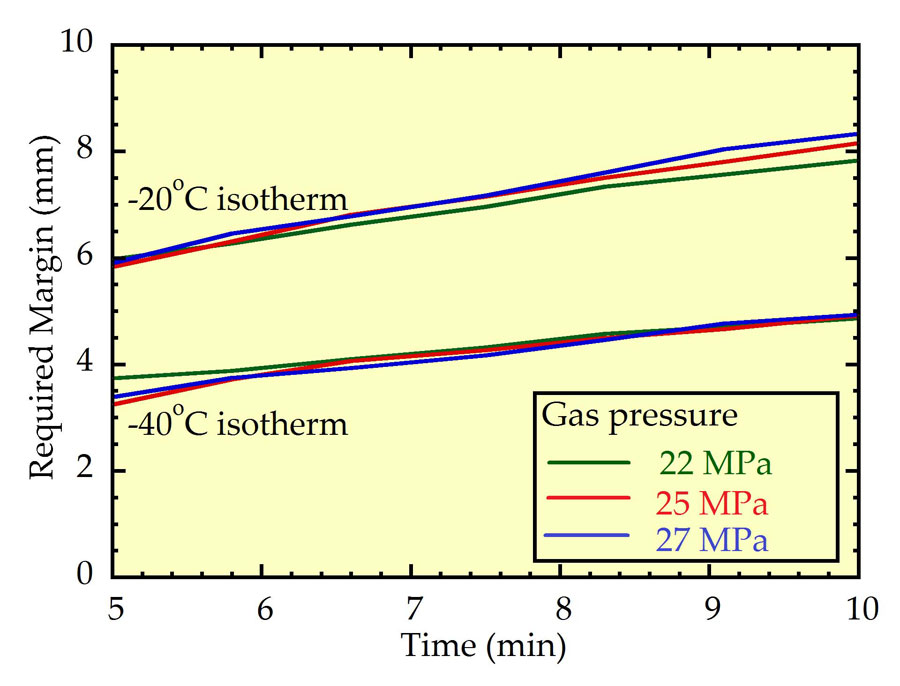
After a period of 10 min, isotherm of lethal temperatures for typical cancer cells, i.e. -20°C and -40°C, were approximately placed at 5 mm and 8 mm inside the ice front respectively which provides the safety margin wanted for the cryosurgical technique. The safety margin was also provided as a function of the radius of ice ball.
From numerical simulations, the authors were capable of deriving cooling power of the cryoprobe which couldn’t be decided experimentally. The maximum power increased with an increase in gas pressure with the least being 16 W and the highest at 24 W.
This study presents safety margins and guidelines for the usage of the Joule-Thomson cryoprobe for successful cryosurgery applications.
https://youtube.com/watch?v=3rbqTIXI_8c%3Frel%3D0






Journal Reference
Mohammed Shurrab, Haidong Wang, Noriaki Kubo, Takanobu Fukunaga, Kosaku Kurata, Hiroshi Takamatsu . The cooling performance of a cryoprobe: Establishing guidelines for the safety margins in cryosurgery, International Journal of Refrigeration 67 (2016) 308-318.
Department of Mechanical Engineering, Kyushu University, Japan.
Go To International Journal of Refrigeration