Advances in Engineering Advances in Engineering features breaking research judged by Advances in Engineering advisory team to be of key importance in the Engineering field. Papers are selected from over 10,000 published each week from most peer reviewed journals.

Significance Statement
The use of carbon monoxide CO for the treatment of cancer needs to be controlled efficiently due to its impact on human health. The control of the released carbon monoxide has been undertaken with the use of developed metal carbonyl-based CO-release molecules MCCORMs. Its advantage while infused with nanostructures, however, faces certain challenges due to changes in their resultant structures.
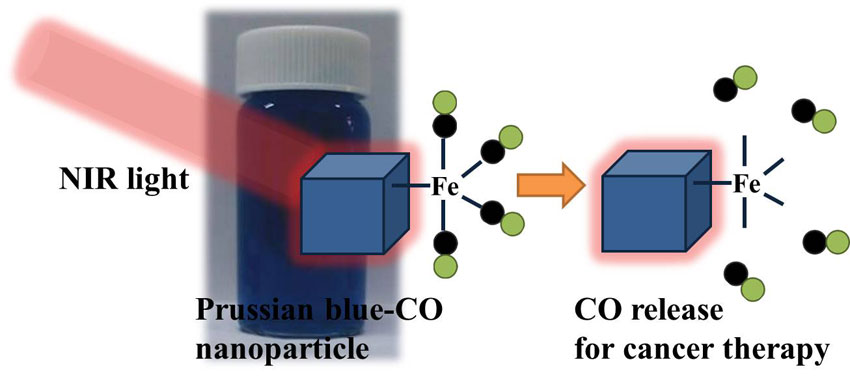
Researchers led by Professor Chen-Sheng Yeh from National Cheng Kung University in Taiwan published an article in the peer-reviewed journal, ACS Nano and proposed a near infrared light-responsive CO-delivery nanocarrier, a PEGylated iron carbonyl derivatized Prussian blue nanoparticles against malignant tumors.
The authors exposed the cyano groups CN– of the mesoporous Prussian blue nanoparticles containing Fe3+-N≡C-Fe2+ unit to coordinate iron carbonyl Fe(CO)5 through cyanide-carbonyl ligand exchange reaction to produce iron carbonyl-modified mesoporous Prussian blue nanoparticles m-PB-CO NPs. The PEGylated iron carbonyl derivatized Prussian blue nanoparticles m-PB-CO/PEG NPs was then prepared by the chelation of an amine-tailed PEG with active iron sites of iron carbonyl-modified mesoporous Prussian blue nanoparticles. The near infrared light was now applied to release carbon monoxide molecules from the iron-carbon monoxide Fe-CO coordinating bond.
The authors confirmed the successful conjugation of iron carbonyl on the Prussian blue nanoparticles using dynamic light scattering, Fourier transform infrared spectroscopy and X-ray photoelectron spectroscopy. The PEGylated iron carbonyl derivatized Prussian blue nanoparticles were also found to be stable in phosphate buffer saline of pH 7 and pH 5, serum, cysteine and glutathione solutions without carbon monoxide releases in 7 days. Its structures also remained unchanged despite its excessive dispersity.
The photothermal conversion efficiency of the Prussian blue nanoparticle with the application of near infrared laser was found to be 11%, which shows high response to near infrared application.
They also discovered that the laser intensity of the near infrared, if increased, led to an increase in temperature when observed at a laser irradiation of 808nm. Moreover, the period required for a release of a certain amount of carbon monoxide also relies on the laser intensity.
When the authors treated cells with PEGylated iron carbonyl derivatized Prussian blue nanoparticle it led to a death of 25.6% of the cells resulting from carbon monoxide toxicity at 0.3W/cm2 while laser intensity of 0.8W/cm2 led to death of 51.4% of the cells. This indicates that a higher irradiation power caused extra cancer cells damage through the additive thermal therapy.
The generated carbon monoxide could also be used to detect enhanced ultrasound echo signal. At laser intensities of 0.3 and 0.8W/cm2, enhanced ultrasound signal contrast in tumors was discovered when carbon monoxide was released while using the authors’ PEGylated iron carbonyl derivatized Prussian blue nanoparticle compared with other control groups.
Animal studies in mice bearing tumors corroborated that PEGylated iron carbonyl derivatized Prussian blue nanoparticle better suppressed the growth of tumors. Biosafety studies also indicated no carbon monoxide blood poisoning occurred while steady blood oxygen saturation was achieved.
These outcomes show that the derivatives of Prussian blue nanoparticles with metal carbonyls can be applied efficiently in biological treatments. The gas therapy can be successfully translated to nanomedicine by means of nanostructures.


Journal Reference
Wei-Peng Li1, Chia-Hao Su2, Ling-Chuan Tsao1, Chun-Ting Chang1, Ya-Ping Hsu1, Chen-Sheng Yeh*1. Controllable CO Release Following Near- Infrared Light-Induced Cleavage of Iron Carbonyl Derivatized Prussian Blue Nanoparticles for CO-Assisted Synergistic Treatment, ACS Nano 10 (2016) 11027-11036.
[expand title=”Show Affiliations”]- Department of Chemistry and Advanced Optoelectronic Technology Center, National Cheng Kung University, Tainan 701, Taiwan.
- Institute for Translational Research in Biomedicine, Kaohsiung Chang Gung Memorial Hospital, Kaohsiung 833, Taiwan.
Go To ACS Nano