Advances in Engineering Advances in Engineering features breaking research judged by Advances in Engineering advisory team to be of key importance in the Engineering field. Papers are selected from over 10,000 published each week from most peer reviewed journals.

Significance Statement
The conventional transit signal priority CTSP bears several limitations which are impeding the roll-out of the technology. One major limitation it has is negative effects on competing travel direction. When traffic signal allocates more green time to the direction of transit bus, the traffic signal coordination on the competing direction is compromised, so does its traffic progression. During peak hours, the compromised progression can take hours to recover causing tremendous additional delay. The other limitation is using “first come first serve” strategy for multiple TSP requests, which not only does not benefit transits but also causes extra bus delay compared to not having CTSP.
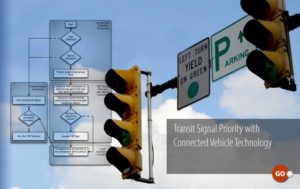
Jia Hu and colleagues discussed a newly enhanced approach, the transit signal priority with connected vehicles conflicting requests TSPCV-CR with the aim of improving the CTSP by having wide-ranging features such as green re-allocation, simultaneous accommodation of multiple buses and traffic signal-transit cooperation. These features are designed to reduce the amount green time provided to transit and minimize the adverse effect on the competing travel direction. In addition, the design of having transits adjusting speed to minimize the change in traffic signal schedule presents a very interesting (probably the first) example of coordination between Connected Automated Vehicles (CAVs) and traffic signal control.
The TSPCV-CR formulates the problem into a binary mixed integer linear program BMILP and was solved by standard branch-and-bound routine. The tool is applicable to any isolated intersection. The research work is now published in the peer-reviewed journal, Transportation Research Part C.
The authors evaluated the proposed TSPCV-CR against two other control logic cases: conventional transit signal priority CTSP and no transit signal priority NTSP. Three different scenarios of conflicting requests were considered. The first involved two conflicting requests from opposite directions, followed by two conflicting requests from competing perpendicular directions and lastly three conflicting requests from three directions.
The evaluation results showed that the TSPCV-CR is effective in minimizing both bus delay and delay per person. The TSPCV-CR had a reduced delay of total buses by 44% and 50% compared to the conventional transit signal priority and no transit signal priority, respectively when observing conflicting request from opposite directions. Moreover, the TSPCV-CR also reduced bus delay up to 57%, showing a greater advantage over conventional transit signal priority. The TSPCV-CR is more effective for the two conflicting conditions, while it was also able to show clear advantages over conventional and no transit signal priority when receiving three conflicting requests.
The results offer a great platform for consideration of the TSPCV-CR technology within the near future. It also shows the potential of the coordination between Connected Automated Vehicles (CAVs) and signal control.


Reference
Jia Hu1 , Byungkyu Brian Park2, , Young-Jae Lee3 . Transit Signal Priority Accommodating Conflicting Requests Under Connected Vehicles Technology, Transport Research Part C 69 (2016) 173-192.
[expand title=”Show Affiliations”]1 Turner Fairbank Highway Research Center, Federal Highway Administration, United States
2 Department of Civil and Environmental Engineering, University of Virginia, P.O. Box 400742, Charlottesville, VA 22904-4742, United States
3 Department of Transportation and Urban Infrastructure Studies, Morgan State University, 1700 E. Cold Spring Lane, Baltimore, MD 21251, United States.
[/expand]Go To Transportation Research Part C: Emerging Technologies