Advances in Engineering Advances in Engineering features breaking research judged by Advances in Engineering advisory team to be of key importance in the Engineering field. Papers are selected from over 10,000 published each week from most peer reviewed journals.

Significance Statement
A device in which optical properties like reflectance and absorption are controlled by the mean of electric field is known as electrochromic device. Electrochromic materials show the change in their color under application of voltage. In modern days the smart windows utilizing electrochromic phenomena conserve energy and indoor climate.
One of the limitations of the electrochromic devices is their slow response which limits their use in the applications outside of the smart windows field. Researchers from University of California, Riverside found a new way to decrease the response time of the electrochromic devices from tens of minutes to millisecond range. They proposed a nanostructured electrochromic material, thin film of semiconducting single-walled carbon nanotubes, as a new electrochromic media. The charge state of carbon nanotubes and related nanotube thin film transparency is controlled by ionic liquid polarization. The research work is now published in peer-reviewed journal, Nano Letters.
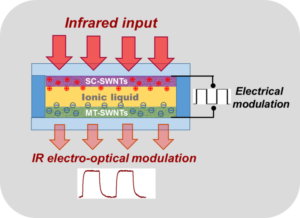
UC Riverside scientists fabricated a nanotube thin film based electro-optical modulator in which the active electrochromic layer is made of a film of semiconducting single-walled carbon nanotubes and the counter-electrode is composed of a film of metallic single-walled carbon nanotubes. With an ionic liquid utilized as an electrolyte, more than 100-fold increase of the operation speed was achieved. The modulation depth up to 6.7 dB has been demonstrated and can be further increased with increasing thickness of carbon nanotube electrochromic layer. The efficiency of the electrochromic device benefits from the high porosity and high surface area of single-walled carbon nanotube network. Such a network forms a three-dimensional electric double layer capacitor which allows fast penetrations of the ionic liquid anions and cations resulting in a fast modulation of the nanotube charge state.
Leading scientist of this project, Dr. Mikhail Itkis (University of California, Riverside), noted that utilization of carbon nanotubes as an active electrochromic media can expand areas of application of electrochromic materials, enhance their performance and functionalities in the field of smart windows, infrared modulators and shutters, and infrared imaging.

Journal Reference
Matthew L. Moser1,3, Guanghui Li2,3, Mingguang Chen2,3, Elena Bekyarova1,3, Mikhail E. Itkis1,2,3, and Robert C. Haddon1,2,3. Fast Electrochromic Device Based on Single-Walled Carbon Nanotube Thin Films, Nano Letters., 2016, 16 (9), pp 5386–5393.
[expand title=”Show Affiliations”]- Department of Chemistry, University of California, Riverside, California 92521, United States.
- Department of Chemical and Environmental Engineering, University of California, Riverside, California 92521, United States.
- Center for Nanoscale Science and Engineering, University of California, Riverside, California 92521, United States.
Go To Nano Letters