Advances in Engineering Advances in Engineering features breaking research judged by Advances in Engineering advisory team to be of key importance in the Engineering field. Papers are selected from over 10,000 published each week from most peer reviewed journals.

Significance Statement
Ceramic particles based on nitrides, carbides and borides were found to be thermodynamically stable within iron aluminide matrix. Out of the nitrides and borides, aluminum nitride and iron boride have been less investigated.
The high energy ball-milling has been used to produce composite materials with very fine microstructures through diffusion and formation of solid solutions. From previous research, aluminum-based nanocomposite with nanoparticles of boron nitride has been obtained, but the mechanical and tribological properties after the addition of boron-nitride has not been discussed.
A team of researchers at Polytechnique Montréal and Institut de recherche d’Hydro-Québec presented a work in order to enhance the mechanical and tribological properties of iron aluminide-based composite materials by dispersion of nanoscale boron nitride BN and in-situ precipitated aluminum nitride and iron boride particles in iron aluminide Fe3Al matrix using the high energy ball-milling process and thermal treatment. The work published in journal, Wear, thereafter studied the influence of heat-treatment and subsequent milling of powder mixtures on microstructure and properties of coatings prepared by high velocity oxy-fuel deposition process.
In their experiments, powder mixtures were prepared from various concentrations of iron aluminide ball-milled at 1000rpm for 10h with zero to 50mol% of boron nitride. High velocity oxy-fuel coatings were prepared on austenitic stainless steel using kerosene fuel and oxygen gas for combustion.
The wear rate of 304-type stainless steel reduced by ten times when Fe3Al coating made from pure iron aluminide milled powder was applied. The addition of boron nitride phases in iron aluminide increases micro-hardness by up to 40% in case of 30mol% of boron nitride.
The researchers achieved the lowest wear rate of 5 x 10⁻⁷mm3/Nm and highest micro-hardness of 7.8GPa for a coating prepared from iron aluminide powder milled at higher energy for 10h with 30mol% of boron nitride (C4 coating). The wear rate of high velocity oxy-fuel coatings further decreases to 2 x 10⁻⁷mm3/Nm when same powder was annealed and re-milled at high energy for 10h.
Key advances in improving the mechanical and tribological properties of the Fe3Al-based composite materials have been achieved. The findings of this study also proved that thermal spraying of the powders tested results in hard coatings with microstructures similar to that of powders and that degradation mechanism appeared to be dominated by abrasive and fatigue wear.
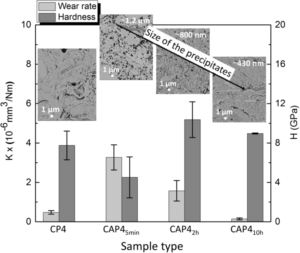 SEM micrograph of the cross-section, microhardness and wear rate of the HVOF coating prepared from as-milled powder (CP4) compared to coatings fabricated from heat-treated and re-milled powders for 5 minutes (CAP45min), 2 hours (CAP42h) and 10 hours (CAP410h).


Journal Reference
Pougoum, F1, Martinu, L1, Desjardins, P1, Klemberg-Sapieha, J1, Gaudet, S2, Savoie, S2, Schulz, R2. Effect of high-energy ball-milling on the characteristics of Fe3Al-based HVOF coatings containing boride and nitride phases, Wear 358-359 (2016) 97-108.
[expand title=”Show Affiliations”]- Groupe de recherche en physique et technologie des couches minces (GCM), Engineering Physics Department, Polytechnique Montréal, Montréal, QC, Canada H3C 3A7
- Materials Science Department, Institut de recherche d’Hydro-Québec (IREQ), Varennes, QC, Canada J3X 1S1
Go To Wear