Advances in Engineering Advances in Engineering features breaking research judged by Advances in Engineering advisory team to be of key importance in the Engineering field. Papers are selected from over 10,000 published each week from most peer reviewed journals.

Significance Statement
A number of engineering devices such as fuel cells, implement the mechanism of gas flow through porous media. Owing to their large surface area, they can be used to enhance surface reactions. Media with pore sizes that correspond to the mean free path of a gas molecule can be implemented in devices such as proton exchange membranes. However, it’s cumbersome to investigate the molecular transport through such pores in an experimental setup. In a bid to enhance the performance of the porous media, understanding their transport phenomena would be helpful.
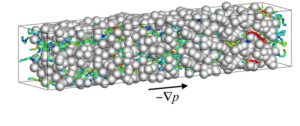
The current understanding based on continuum hypothesis is insufficient, therefore, the transport mechanism of the porous media remains not clear to many. For this reason, researchers led by professor Shigeru Yonemura from Tohoku University in Japan analyzed the governing principle of molecular transport initiated by pressure gradient through a porous medium with nanometer-scale pores. They assembled a porous medium by randomly arranging spherical particles, and then simulated pressure-driven gas flow based on the direct simulation Monte Carlo (DSMC) method. Their work is published in peer-reviewed journal, Microfluidics and Nanofluidics.
Although randomly arranged particles would cause interpenetration, the authors adopted them for the study and disregarded surface reactions. Gas flow via the media was based on the Darcy’s law. According to the law, the rate of discharge through a porous medium is directly proportional to the pressure gradient.
The authors, in their simulation, divided the computational domain into cells. They traced the behavior of molecules, hence simulating the time evolution of the flow field. Flow properties such as pressure, density, temperature, and velocity were determined in each cell.
They observed that when the dimensions of the pores were much smaller than the mean free path of gas molecules; when the Knudsen number is much larger than unity, gas molecules collided more frequently with the walls of the pores than they collided with other gas molecules. For this reason, molecule-molecule collisions are negligible in porous media with such small pores. Because of diffuse reflections at the walls, the gas molecules tend to diffuse gradually. This phenomenon is termed as Knudsen diffusion.
They performed a number of DSMC simulations of gas flow via porous media with pores from nanoscale to microscale for various porosities. The obtained results helped them develop two expressions to determine gas flow velocity. The obtained results are summarized as follows: Gas flow velocity increased with increase in the pressure gradient. This confirmed that the mechanism of gas flow through the porous medium obeyed Darcy’s law. The velocity of the gas flow estimated by conventional methods for permeability deviated largely from that obtained in the DSMC simulations as the particle size reduced from micrometer to a nanometer scale.
The authors regarded the porous medium as a bundle of tortuous capillary tubes, and then theoretically constructed expressions to estimate the pressure-driven gas flow through a porous medium with pores from nanoscale to microscale by superposing both contributions of viscous flow and Knudsen diffusion. The flow velocities obtained using these developed expressions agreed with the values obtained in the DSMC simulations in the case of porous media with an approximate porosity of 0.3-0.5.
Based on these expressions for flow velocity, the authors also obtained the theoretical expression that shows the effect of Knudsen number on permeability of porous media. It will help engineers to determine the permeability of a porous medium for low-pressure gas from its known liquid permeability.
“In the present work, the porous media represented by randomly arranged particles were used to construct our expressions. The capillary tube tortuosity τ in our expressions depends on the internal structure of porous media. However, except for the tortuosity, our expressions will be applicable to any gas with simple molecules and to any porous medium having an arbitrary internal structure with an approximate porosity of 0.3-0.5,” says Prof. Shigeru Yonemura. “Our next step is to construct a theoretical expression for capillary tube tortuosity. With this, we will be able to complete our theoretical expressions to determine the permeability and the flow rate through any porous medium with an arbitrary internal structure.”


Reference
Yoshiaki Kawagoe1, Tomoya Oshima1, Ko Tomarikawa1, Takashi Tokumasu2, Tetsuya Koido3, and Shigeru Yonemura2. A study on pressure–driven gas transport in porous media: from nanoscale to microscale. Microfluidics and Nanofluidics (2016) 20:162
[expand title=”Show Affiliations”]- Department of Nanomechanics, Graduate School of Engineering, Tohoku University, Sendai, Japan
- Institute of Fluid Science, Tohoku University, Sendai, Japan
- Honda R&D Co., Ltd., Automobile R&D Center, Advanced Research Division, Wako, Japan
Go To Microfluidics and Nanofluidics