Advances in Engineering Advances in Engineering features breaking research judged by Advances in Engineering advisory team to be of key importance in the Engineering field. Papers are selected from over 10,000 published each week from most peer reviewed journals.

Significance Statement
In order to address the ever-rising demand for microelectronics, efficient designs for micro heat sinks are necessary. Micro heat sink applications in microbiological systems, microturbines and electronic circuits have attracted much attention in the last few years. From the conventional theory, a decrease in size of a thermal-fluidic system is accompanied with an improvement in the heat transfer performance. This is however accompanied with pressure losses.
To improve the efficiency of the heat sinks, surface enhancement with pin fins should be implemented in micro channels. Major geometrical parameters in micro-pin heat sinks such as spacing, height over diameter ratio and shapes have been investigated. However, wake-micropin fin interactions are yet to be included in either the microscale or the low height over diameter ratios.
In a recent paper published in Journal of heat transfer Professor Ali Kosar and Ali Mohammadi currently a PhD student at Sabanci University in Turkey addressed this lack of information through a computational study aimed at investigating thermal and hydrodynamic characteristics of flows in micropin fin arrangements. They varied some geometrical parameters such as height to diameter ratios, horizontal and vertical spacing and examined wake-pin fin interactions as well as separation patterns.
The authors adopted a rectangular microchannel and set the dimensions of the microchannel for all cases to be the same. This was in a bid to get a better comparison in all configurations. The team utilized varying inline configurations of the circular micropin fins in the mid-section of the proposed microchannel. They set the micropin fin height to be the same as that of the microchannel and considered a number of geometric parameters, namely, micropin fin diameter, vertical and longitudinal spacing. Counting on all configurations, the authors came up with a total of ten different configurations.
The researchers considered a maximum Reynolds number of 160 in order to achieve a laminar flow regime. This was also helpful in ensuring that water remained in liquid state in all working conditions. They set the thermodynamic properties of water to vary with the temperature. All simulations were performed at five varying Reynolds numbers; ranging from 20-160.
The authors observed that vertical pitch ratio affected the pressure drop and Nusselt number. For the cases with same height over diameter ratio and the same horizontal pitch ratio (longitudinal spacing), a larger vertical pitch ratio resulted in low pressure drop and Nusselt number. For the cases with the same height over diameter ratio and the same vertical pitch ratio, a larger horizontal spacing resulted in a higher pressure drop as well as lower thermal performance index value. For the cases with the same horizontal spacing and the same vertical spacing, a larger height to diameter ratio led to a higher pressure drop as well as higher Nusselt number that was mainly responsible for the wake regions behind the micropin fins.
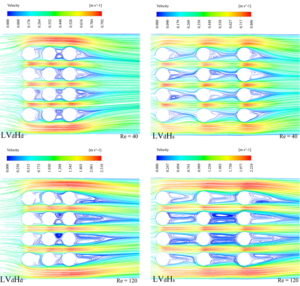
Over the selected range of operating Reynolds number, the authors observed two sets of ascending and descending trends that corresponded to various vertical pitch ratios. Increasing the Reynolds number, an extension of the wake regions was reported, which was an important factor in raising the pressure drop. Two-fold increase in the Reynolds number led to a 40% decrease in frictional factor. Height to diameter ratio and horizontal spacing of 1 and 1.5 respectively led to minimum frictional values.
This study presents the thermal and hydrodynamic attributes of single phase water flows in a microchannel with varying micropin fin configurations. Hydrodynamic performances were based on pressure drop and frictional factors while thermal performances were based on thermal performance index values and the Nusselt number.


Reference
Ali Mohammadi1 and Ali Kosar2. Hydrodynamic and thermal performance of microchannels with different in-line arrangements of cylindrical micropin fins. J. Heat Transfer 138(12), 122403 (Aug 16, 2016) (17 pages).
[expand title=”Show Affiliations”]- Faculty of Engineering and Natural Sciences (FENS Sabanci University,
Orhanli, Tuzla 34956, Istanbul, Turkey - Professor Faculty of Engineering and Natural Sciences (FENS), Sabanci University,
Orhanli, Tuzla 34956, Istanbul, Turkey
Go To Journal of Heat Transfer