Advances in Engineering Advances in Engineering features breaking research judged by Advances in Engineering advisory team to be of key importance in the Engineering field. Papers are selected from over 10,000 published each week from most peer reviewed journals.

Significance Statement
Accurate component selection and mesostructure in metal composites affect their properties to satisfy particular requirements for several applications subject to dynamic deformation, fragmentation and possible reaction. For instance, a combination of high density and high strength is necessary for penetrators. A good example for reinforcement is tungsten fibers, which have high density and strength, and can be implemented to reinforce matrix metals to increase their density.
Tungsten fibers can be used to reinforce aluminum matrix for various applications. A significant difference in the acoustic impedances between tungsten and aluminum makes their composites desirable for acoustic filters. When exposed to quasi-static compression force, aluminum matrix composites reinforced with ductile tungsten fibers configured in the axial direction exhibit buckling failure mode which is different from kinking for aluminum matrix composites reinforced with fragile alumina fibers.
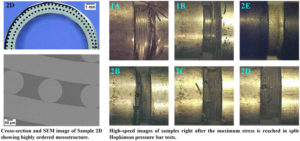
University of California San Diego researchers Professor Vitali Nesterenko, Professor Kenneth Vecchio and Dr. Po-Hsun- Chiu investigated the dynamic characteristics of aluminum alloy-tungsten fibers using split Hopkinson pressure bar. In their study, the composite tubes had periodic configuration of tungsten fibers in axial and hoop arrangements processed using Hot and Cold Isostatic Pressing methods. Their work is now published in International Journal of Impact Engineering.
The researchers developed a novel processing method allowed to synthesize fully dense aluminum tungsten tubes with a high content of tungsten fibers oriented in axial and hoop directions. However, aluminum alloy lost its hardness after Hot Isostatic Pressing. Therefore, additional heat treatment was necessary to restore its strength.
The developed method with specific pressure, soaking time, temperature and cooling under pressure helped the authors to overcome tungsten fragmentation during pressure treatment, realize the required strength and density in the composites, curtail aluminum and tungsten reactions and maintain tungsten fibers periodic alignment in tubular test pieces.
They found that samples with high hardness of aluminum matrix and samples without heat treatment attained their highest strength at the same strains. Critical strains for the fracture in quasi-static conditions were closer to the corresponding values in dynamic tests. For both conditions, stresses dropped with strains after reaching their maximum. This could be attributed to identical fracture mechanism in the two conditions irrespective of strain rate differences between them.
Specimens with higher aluminum matrix hardness posted a higher compressive (750MPa) strength although they deformed at a lower strain rate. Samples without heat treatment posted a compressive strength of 600MPa. Measured micro-hardness for heat treated specimens almost doubled compared to samples without heat treatment. Increasing the micro-hardness of the aluminum matrix after heat treatment didn’t yield a similar strength increase indicating that the principle failure mechanism was due to tungsten fibers, whose properties were not affected by the heat treatment.
This study observed the dynamic strength of tested specimens was quite high as compared to measured values in quasi-static tests indicating that compressive strength of composites specimens was sensitive to strain rate. Strain rate sensitivity was attributed to the tungsten fibers.
In contrast, the observed dynamic failure was attributed to buckling of tungsten fibers which were configured in the axial direction. This was initiated by the initial fracture of the circumferential fibers. The researchers also found that the instability of the tungsten fibers was similar for both dynamic and quasi-static tests: kinking at one face of the specimen in the direction of the incident bar and buckling in the central section.



Reference
Po-Hsun Chiu1, Kenneth S. Vecchio2, and Vitali F. Nesterenko1,3. Dynamic compressive strength and mechanism of failure of Al-W fiber composite tubes with ordered mesostructured. International Journal of Impact Engineering, volume 100 (2017), pages 1-6.
[expand title=”Show Affiliations”]- Materials Science and Engineering Program
- Department of NanoEngineering
- Department of Mechanical and Aerospace Engineering, University of California, San Diego, CA 92093-0411, USA
Go To International Journal of Impact Engineering