Advances in Engineering Advances in Engineering features breaking research judged by Advances in Engineering advisory team to be of key importance in the Engineering field. Papers are selected from over 10,000 published each week from most peer reviewed journals.

Significance Statement
Acoustic emission is transient elastic waves over a broad frequency range within a material. Of particular interest are AE events in the 100kHz-1MHz range, whose generation is normally associated with irreversible structural changes, for instance, crack initiation and its propagation, and other damage related changes. Therefore, acoustic emission detection becomes a critical non-destructive technique in monitoring structural health and durability. Compared to other electronic sensors, acoustic emission sensors based on fiber-Bragg gratings are desirable for their light weight, superior multiplexing capacity, small size, corrosion resistance, and immunity to electromagnetic forces.
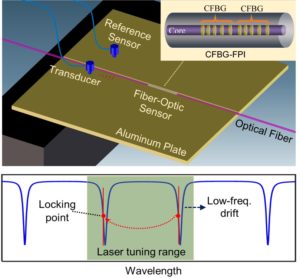
The functioning of acoustic emission sensors is based on detecting the acoustic emission induced spectral movement of the Bragg wavelength of the gratings through a demodulation mechanism. In this intensity based demodulation method, a narrow-linewidth laser is locked to the liner slope of the reflection spectrum. However, the operation of the sensors is in most cases subject to a low frequency strain stemming from temperature changes and structural deformations. The developed strain knocks the laser wavelength out of the linear range of the gratings.
In a recent paper published in Optics Letters researchers led by professor Ming Han from the University of Nebraska-Lincoln developed a fiber-optic acoustic sensor based on a chirped fiber-Bragg Grating interferometer enhanced with laser intensity demodulation and a smart control for acoustic detection under a background strain.
The laser for the proposed acoustic sensor could be locked to one of the notches within its tuning range in order to achieve the acoustic detection. If the spectral notch moved out of the tuning range owing to low-frequency background strain, a nearby notch moved into the tuning range. The laser is, therefore, tuned to that notch and then locked at its spectral slope. This is achieved by a smart feedback control unit, so the acoustic emission is monitored with minimal disruptions. This unlocking and relocking process calls for a smart control system.
The authors bonded the sensor with an aluminum cantilever beam in a bid to apply the large background strain. They attached the free end to a mechanical shaker, which initiated tensile and compressive strain to the sensor. They selected a narrow line-width laser diode because of its fast wavelength tuning.
The smart feedback control, consisting of a microprocessor and a proportional integral controller, provided a signal control to the laser controller. The authors realized that the laser was initially locked to a notch within the tuning range set to a value that corresponded to an injection current of about 70mA. They verified the locking process by a zero error signal. The microprocessor helped the authors to read out the laser power and equally adjust the locking voltage.
The authors observed that when the sensor stretched, the wavelength as well as the injection current shifted to the upper limit of the tunable range. At this time, the neighboring notch shifted into the tuning range. The authors observed that the microprocessor sent high logic signals to the logic input that opened the feedback loop, consequently unlocking the laser.
This study demonstrated the successful operation of a fiber-optic acoustic emission sensor which was based on a chirped fiber-Bragg grating sensing unit and enhanced with a feedback control that enabled acoustic emission detection at low frequency and a large background strain. They adopted a semiconductor-based laser, which had a high-speed tuning capacity through current injection.
The research was supported by the Office of Naval Research (ONR).


Reference
Qi Zhang, Yupeng Zhu, Xiangyu Luo, Guigen Liu, and Ming Han. Acoustic emission sensor system using a chirped fiber-Bragg-grating Fabry–Perot interferometer and smart feedback control. Optics Letters, volume 42, No. 3 / 2017 /, pages 631-634.
Department of Electrical and Computer Engineering, University of Nebraska-Lincoln, Lincoln, Nebraska 68588-0511, USA.
Go To Optics Letters