Advances in Engineering Advances in Engineering features breaking research judged by Advances in Engineering advisory team to be of key importance in the Engineering field. Papers are selected from over 10,000 published each week from most peer reviewed journals.

Significance Statement
Buildings account for approximately 40% of the total energy consumption in Europe. In this regard, directives have been enacted to renovate existing buildings in order to make them nearly zero-energy buildings. Therefore, there is a need to optimize building envelopes in a bid to reduce energy consumption while maintaining high their thermal and lighting comfort for the occupants.
Shading devices can help reduce heating and cooling demands in buildings during winter and summer. Interior shading devices are efficient when it comes to glare reduction, but contribute less when it comes to building thermal comfort because they block radiation after it has passed the fenestration glazing. Exterior shades, on the other hand block direct solar radiation, thereby reducing heat transmission in the building. Exterior shades therefore contribute to thermal regulation.
Motivated by research findings showing excellent performance of exterior shades, Dr. Marina Khoroshiltseva, Dr. Debora Slanzi and Professor Irene Poli from the European Center for Living Technology in Italy focused on the design of exterior shading devices. In order to handle the multi objective optimization problem, the team proposed a stochastic model with a multi objective methodology which was based on Harmony search algorithms as well as the Pareto front. This would be important to pinpoint a combination of optimal solutions. Their work is published in Applied Energy.
The team opted to design static exterior devices owing to their ability to reduce overheating and artificial lighting by blocking direct radiation at different times of the year. The devices are also cheap to fabricate, install and maintain, and these give a feasible solution. They considered installation on four windows of a flat in Madrid with southern and western orientations.
Instead of proceeding via linear combination for the multi-objective optimization, the team decided to include Pareto front values computation. Therefore, the researchers developed a multi-objective Evolutionary Design for Optimization in order to design a combination of optimal solutions that would represent the static shading devices.
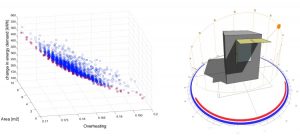
The team narrowed their optimal solutions to Pareto front solutions that achieved certain levels of overheating and affect energy demand. Proposed shape acceptance and the effect on comfort guided their solutions selection. From the selected solutions, the authors were able to present optimized design variables such as element size for each of the west and south oriented devices, and corresponding response values. They observed that the size of the south-facing fins was smaller as compared to the western fins. The lengths of fins oriented to the south as well as the top fins were almost set to 0.7m. This translated to a greater need for a shading device for the west window as opposed to the south window.
In this paper, the authors proposed a multi-objective evolutionary design method for the optimization of shading devices. They came up with a combined method where the search process was taken care of by Harmony Search algorithm and multi-objective optimization achieved by the Pareto front. The team obtained a configuration of shading gadgets with 7.84 m2 acceptable area giving 20% reduction in overheating and 15.96% energy consumption increase. However, they considered the impact on energy consumption less significant with respect to reduction in overheating.



Reference
Marina Khoroshiltseva1, Debora Slanzi,2,1 and Irene Poli2,1. A Pareto-based multi-objective optimization algorithm to design energy-efficient shading devices. Applied Energy, volume 184 (2016), pages 1400–1410.
[expand title=”Show Affiliations”]- European Centre for Living Technology, Ca’ Minich, S. Marco 2940, 30124 Venice, Italy
- Department of Environmental Science, Informatics and Statistics, University Ca’ Foscari, Cannaregio 873, 30121 Venice, Italy
Go To Applied Energy