Advances in Engineering Advances in Engineering features breaking research judged by Advances in Engineering advisory team to be of key importance in the Engineering field. Papers are selected from over 10,000 published each week from most peer reviewed journals.

Significance Statement
Light beams carrying orbital angular momentum have known a wide range of applicability, including phase contrast microscopy, particle tweezing and trapping, stimulated emission depletion microscopy, coronagraphy and telecommunications among others. In particular, orbital angular momentum of light has recently attracted a growing interest as a novel degree of freedom in order to enhance the information capacity of current optical networks, both for optical fiber transmission purposes and free-space communication. Such applicability is attainable since the potentially unbounded state space is advantageous for increasing the amount of information that can be encoded onto a single photon, which leads to enhanced spectral efficiency and information capacity. Nevertheless, the exploitation of orbital angular momentum mode-division multiplexing still presents several key issues and requires further optimization and tests mainly in the optical and infrared range before it can be applied commercially. In particular, crucial parts of an optical link are represented by the multiplexer and the demultiplexer, that is by the optical techniques exploited to prepare a collimated superposition of modes at the transmitter and to separate them at the receiver, respectively.
In a recent paper published in Optics Letters, Gianluca Ruffato and colleagues at University of Padova in Italy reported an efficient fully optical configuration for the demultiplexing of the orbital angular momentum modes based on the already known log-pol optical transformation. They aimed at designing an optical solution that could combine the basic demultiplexing functions on a single miniaturized diffractive mask.
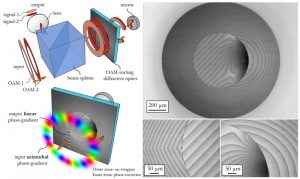
The researchers employed that demultiplexing technique for the orbital angular momentum sorting of perfect vortices. An optical layout was prepared which basically consists of a sequence of two optical elements: the phase corrector and the unwrapper. The two optical components were integrated into a single diffractive optical element in order to improve the miniaturization level and simplify alignment operations.
The research team noted that for efficient excitation and stable propagation of orbital angular momentum modes along either commercial or special ring fibers it was necessary to manipulate and excite annular intensity distributions with predetermined radius and width, irrespective of their orbital angular momentum content. They found that perfect vortices were best placed to excite optical vortices whose ring dimensions could be adjusted and controlled independently of the orbital angular momentum value. Since those beams present a narrow doughnut intensity distribution, the central region of the illuminated optical element is left unexploited. This led to the integration of the second element designed for phase correction in the non-illuminated central region. The optical device was realized in a diffractive form of a modulo-2π relief. This realization was noted to avoid bulky refractive elements and to provide a higher miniaturization level, mainly when short focal lengths were required.
The work presented here shows the realization of an efficient fully optical configuration for the demultiplexing of orbital angular momentum modes based on a log-pol optical transformation. The exploitation of perfect vortices is advantageous since it enables the control of both radius and width of the generated ring-shaped beam and also makes it independent of its orbital angular momentum value. However, the same setup can work with common high-order beams, provided the inner zone is not illuminated at the first incidence. The integration into a single optical element improves the miniaturization level and simplifies the alignment operations. The inner zone can be made reflective, thus maintaining the original direction of the input beam without the need of a beam-splitter. The presented optical elements are promising for adaption into optical platforms and processing of orbital angular momentum channels in either optical fiber transmission or in free space.
The nanofabrication steps were performed by Dr Michele Massari with the 100-KeV electron-beam lithography facility in use at the Laboratory for fabrication of Nanodevices (LaNN), under the direction of prof. Filippo Romanato. The laboratory provides a nanofabrication center devoted to research and technology transfer to the industrial level, with applications in the telecom field, microscopy, biosensing, optoelectronics and photonics.



Reference
Gianluca Ruffato1,2, Michele Massari1,2, Filippo Romanato1,2,3. Compact Sorting of Optical Vortices by Means of Diffractive Transformation Optics. Optics Letters Volume 42 (2017) No. 3
[expand title=”Show Affiliations”]- Department of Physics and Astronomy “G. Galilei,” University of Padova, via Marzolo 8, 35131 Padova, Italy
- Laboratory for Nanofabrication of Nanodevices, c.so Stati Uniti 4, 35127 Padova, Italy
- CNR-INFM TASC IOM National Laboratory, S. S. 14 Km 163.5, 34012 Basovizza, Trieste, Italy
Go To Optics Letters