 Advances in Engineering Advances in Engineering features breaking research judged by Advances in Engineering advisory team to be of key importance in the Engineering field. Papers are selected from over 10,000 published each week from most peer reviewed journals.

Significance Statement
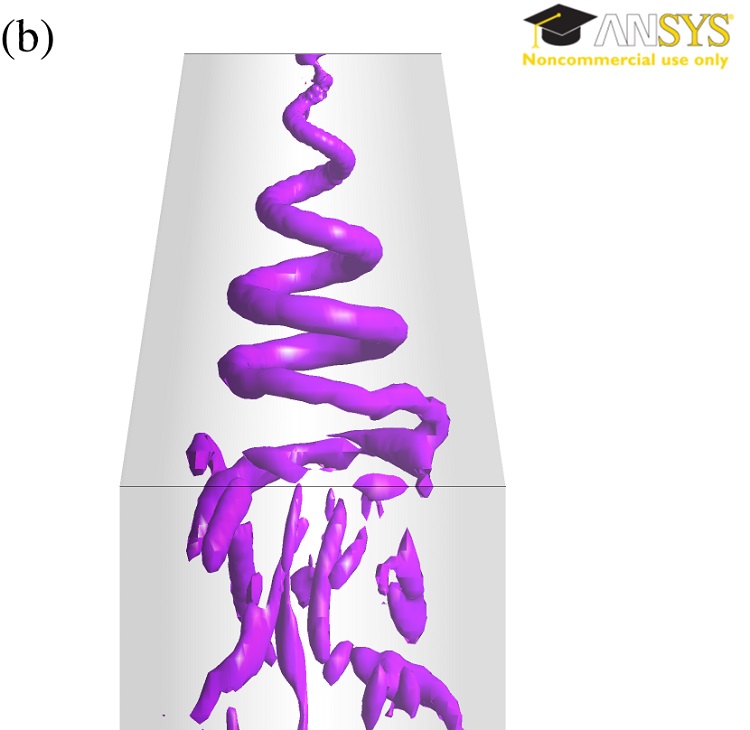
Recent studies on draft tube surge have shown that Francis-type hydroturbines operating at off-design conditions are laden with numerous undesirable effects in the form of violent pressure variations caused by helical vortices generated in the draft tube. The helical vortex, called a vortex rope, revolves around the axis of the draft tube and hence is called a “precessing” fluid structure with high vorticity. At off-design conditions, hydroturbines are characterized by high swirl levels at the inlet of the draft tube. Also, a shear layer forms between a centrally stalled region typical of diminished axial velocities and the surrounding vicinity with substantially high axial flow velocities. A combination of these two effects may at times yield a region of pressure lower than the vapor pressure of water thereby leading to cavitation.
The vortex rope manifests itself by means of high amplitude and low frequency pressure fluctuations that are nearly periodic in nature. These fluctuations are extremely intense and induce severe vibrations and noise in the draft tube thereby disrupting the functioning of the turbine and reducing its efficiency, which calls for increased maintenance.
Pennsylvania State University researchers Dr. Girish Rajan and Professor John Cimbala analyzed the vortex rope extensively to gain information that may be used in its mitigation and minimization of its harmful effects on the turbine. They were also interested in knowing the conditions under which a vortex rope would be classified as weak or strong and estimated the critical state at which a transition would be expected. Their work is now published in Journal of Fluids Engineering.
The researchers started by investigating swirling flows in the simplified draft tube of a scaled model Francis turbine operating at constant head with its runner rotating at constant speed. They then considered four discharge coefficients for the numerical analysis. Later on, they used a three-dimensional, unsteady, Navier–Stokes solver with the detached-eddy simulation model and the realizable k–є model to analyze the vortex rope formed at different discharge coefficients. The dominant amplitude of the pressure fluctuations at a fixed points on the draft tube periphery and the size of the vortex rope were obtained for the individual cases.
The authors of this paper observed that the dominant amplitude of the pressure fluctuations at a fixed point in the draft tube increased by 13 times and the length of the rope increased by 3.4 times when the operating point of the turbine shifted from a discharge coefficient of 0.37 to 0.34. The analysis enabled them to more easily comprehend how strong a vortex rope gets as the operating point of the turbine shifts from its best efficiency point. It was also noted that pressure was not a suitable parameter for visualizing the vortex rope. The other chosen parameters (described in the paper) depicted the rope more prominently, and the structures of the vortex rope that were obtained using these parameters were nearly identical to one another when comparing both large-scale and small-scale features.
The perturbation analysis presented in this research includes the formulation of a Sturm-Liouville (SL) system, and the identification of a critical discharge coefficient, above which the solutions to the SL system are oscillatory and non-oscillatory otherwise. The results of this work are promising and have the potential to help in deciding the range within which the turbine may be operated, so that the undesirable effects of the vortex rope are minimal.



Reference
Girish K. Rajan, John M. Cimbala. Computational and Theoretical Analyses of the Precessing Vortex Rope in a Simplified Draft tube of a Scaled Model of a Francis Turbine. Journal of Fluids Engineering February 2017, Volume 139.
Department of Mechanical Engineering, Pennsylvania State University, University Park, PA 16802.
Go To Journal of Fluids Engineering