Advances in Engineering Advances in Engineering features breaking research judged by Advances in Engineering advisory team to be of key importance in the Engineering field. Papers are selected from over 10,000 published each week from most peer reviewed journals.

Significance Statement
With the recent development of NEMs and MEMs technologies, high heat generation has emerged to be a critical issue. Therefore, for further advances in these systems, the development of a thermal interface material with high heat conductivity is imperative. For this reason, fluids dispersing metal nanoparticles, for instance copper and silver, are being identified as potential candidates for application as thermal interface materials with high heat transfer attributes. Their thermal conductivity potential has been investigated theoretically and experimentally.
Dr. Yuhiro Iwamoto and colleagues from Nagoya Institute of Technology in Japan developed a water-based magnetic suspension dispersing silver nanowires and their thermal conductivity measurements and analysis in the absence and presence of an external magnetic field using the hot-wire method. Other researchers contributed to this study were from Doshisha University and The University of Shiga Prefecture. The work is now published in peer-reviewed journal, Experimental Thermal and Fluid Science.
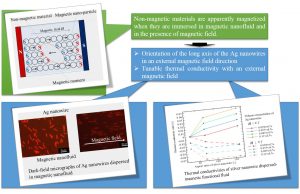
In their work, a mixture of silver nanowires and water-based magnetic suspension were applied as test fluids for thermal conductivity. Silver nanowires with unique dimensional attributes were realized using the polyol approach with suitable modifications. The silver nanowires produced using polyol process was suspended in water-based magnetic suspension. Thermal conductivity improvement under external magnetic fluid may count on the orientation of the silver nanowires in the tests fluid. In this paper, dark field microscopy approach was adopted to visualize the dynamic behavior of silver nanowires in nanowire dispersed magnetic functional fluid.
The authors observed that when an external magnetic field was imposed on the magnetic suspension, the magnetic moments of the magnetic nanoparticles dispersed in the suspension align themselves in the magnetic field. However, the surfaces of non-magnetic particles of bodies dispersed in the magnetic suspension and exposed to an external magnetic field becomes magnetically charged owing to the magnetization of their surroundings and finally become as magnetic materials.
Thermal conductivity analyses using the fluid dispersing silver nanowires suggested that an enhancement of 7% would be realized by dispersing 0.11% of silver nanowires. This behavior was due to the alignment of the long axis of the silver nanowires in the external magnetic field direction by applying the dark field microscopy measurements. A -7% decreased in thermal conductivity under an external magnetic field applied perpendicular to the temperature gradient direction suggested that these fluids could be used in thermal storage application. Enhancement in thermal conductivity is confirmed by using silver nanowires with high aspect ratio and volume concentration.
This study successfully developed a novel silver nanowire dispersed-magnetic functional fluid was developed and demonstrated its capacity as heat transfer material.




Reference
Yuhiro Iwamoto, Atsushi Yoshioka, Takuya Naito, Jhon Cuya, Yasushi Ido, Ryo Okawa, Balachandran Jeyadevan, and Hiroshi Yamaguchi. Field induced anisotropic thermal conductivity of silver nanowire dispersed-magnetic functional fluid. Experimental Thermal and Fluid Science, volume 79 (2016), pages 111-117.
Go To Experimental Thermal and Fluid Science