 Advances in Engineering Advances in Engineering features breaking research judged by Advances in Engineering advisory team to be of key importance in the Engineering field. Papers are selected from over 10,000 published each week from most peer reviewed journals.

Significance Statement
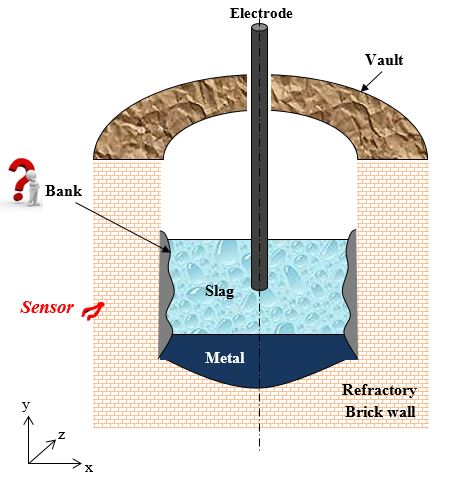
Material processing that requires elevated temperatures and high-power density is mainly done in melting furnaces such as the electric arc furnace. Such processes include the smelting of copper, steel, nickel calcine, pre-reduced iron ores and recycling of scrap metals among others. During smelting, a solid layer called bank/ledge is formed on the inner surface of the refractory brick walls. This phase change material bank actively protects the inner lining of the furnace walls from chemical attacks from the molten hostile material thereby maintaining its integrity and prolonging its life. Adversely, too thick a bank is quite detrimental to the furnace output since it diminishes the smelt volume. Consequently, a challenge is therefore presented where industries are expected to operate the furnace by maintaining a bank of optimum thickness that protects the inner wall and yet does not hamper the furnace production.
Predicting the thermal behavior of banks inside the electric arc furnaces is a challenging undertaking. The ledge growth rate depends on the intrinsic heat transfer processes prevailing inside the molten bath as well as how the furnace is designed and ran. Measurements of the banks using probes are impractical if not dangerous. Simulation of heat transfer and flow circulation using modern Computational Fluid Dynamics tools is feasible but would guzzle both time and resources. An opportunity is therefore presented for the implementation of the next most promising alternative; inverse heat transfer approach.
Mohamed Hafid and Marcel Lacroix at University of Sherbrooke in Canada proposed an inverse heat transfer procedure for simultaneously predicting: first, the time-varying lateral heat flux and the thermal contact resistance and secondly, the time-varying lateral heat flux and the erosion of the refractory brick wall. They aimed at justifying the adaptability of the inverse procedure as an alternative for furnace maintenance. Their work is now published in Applied Thermal Engineering.
Foremost, the two researchers developed a non-isothermal solid-liquid phase change process. The Levenberg-Marquardt-algorithm combined with the Broyden-Method was adopted as the inverse procedure technique was seen to rest upon them. They then elaborated the finite-volume model of melting in the furnace. Data on the thermal diffusivity of the brick walls was then collected. They then determined the characteristics of the brick wall and examined the temperature sensors. Biot number on the inverse prediction and the erosion of melting furnace were eventually investigated.
The authors of this paper observed that, by using thermocouple embedded in the brick wall to collect temperature data, the inverse technique was able to predict the time-varying thickness of the protective bank that covers the inner lining of the furnace wall. Also, the thermal contact resistance between the inner lining and the protective bank together with the possible erosion of the refractory brick wall could be predicted.
The aforementioned procedure herein presents a technique with astronomical industrial adaptability potential, for monitoring and maintaining furnaces. Both the ledge thickness and wall erodibility can be controlled and predicted using the inverse technique method. This study also presents a crucial recommendation on where to position embedded sensors for optimal performance and operation. The inverse procedure therefore passes as an alternative for furnace maintenance due to its life lengthening potential among other positive stated features.



Reference
Mohamed Hafid, Marcel Lacroix. Inverse heat transfer prediction of the state of the brick wall of a melting furnace. Applied Thermal Engineering volume 110 (2017) pages 265–274.
Faculté de génie, Université de Sherbrooke, Sherbrooke, Canada
Go To Applied Thermal Engineering