Advances in Engineering Advances in Engineering features breaking research judged by Advances in Engineering advisory team to be of key importance in the Engineering field. Papers are selected from over 10,000 published each week from most peer reviewed journals.

Significance Statement
The structure of amorphous semiconductors, such as tantalum oxide, show different kinetic and electrical characteristics compared with the crystalline structures, and even then, there is a huge variation in properties within the same amorphous material structure which is not properly understood at the nanoscale level. Some of the differences include reduced leakage currents, grouping of electrons between the interface of nanodomains, and increased density of faulty electronic states.
In a recent paper published in Applied Surface Science Professor A.C Cefalas and colleagues demonstrated that the surface structure of semi-conductive layers of amorphous tantalum oxide at the nanoscale level is closely connected with both the thermal and electric properties, and that it regulates the stability of electric current.
Analyzing conductivity maps it was evident that when positive voltages are low, most layer areas are non-conductive with a small portion displaying low-conductivity, while at increased voltages the conductivity becomes saturated. In most layer areas, there is negligible current at negative voltages. An analysis showed that there was a diverting I-V response for different amorphous tantalum oxides, and the average threshold conductive voltage was approximately 3.4V. Most areas remained non-conductive which was evidence that there was no continuity and surface homogeneity.
The research team interestingly observed that some points responded to only positive or negative bias voltages, and other points responded to both positive and negative voltages as a result of either interactive or non-interactive electron Coulombic trapping sites from impurities or oxygen vacancies. From the electrostatic force microscopy phase shift spectrum, the authors observed no phase contrast at zero voltage but at higher voltages there was a substantial phase shift contrast. This is an indication that induced electric charges at increased bias voltages are widely dispersed and separated by a potential barrier between adjacent conductive channels. A mapping of the bias voltages and phase differences indicates zero phase difference at zero voltage which confirms that the surface of the amorphous tantalum oxide is non-polarized.
From the scanning force, thermal and electrical microscopy analysis, the authors noted a concealed spatial gradient degeneracy of observables as a result of the occurrence of opposite algebraic spatial gradients signs along opposite conductive paths, which ceases for increased path length where the spatial profile gradient approaches zero. The entropic and electric current linking at the nanoscale elevates the degeneracy of the gradient through either amplified or dumping current fluctuations which is because surface morphological gradients reflect the electron distribution gradient on the surface.
The study demonstrated that structural features of the amorphous tantalum oxide regulate the directional stability of current at the nanoscale level, and they are correlated with the thermal and electric responses along the conductive paths.
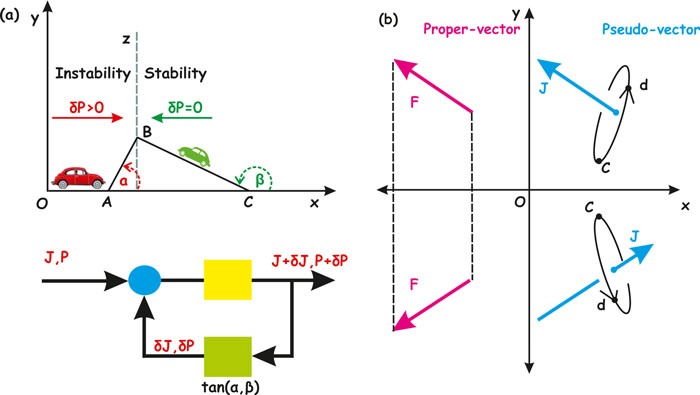
It was also evident that for long conductive paths, the I-V curves exhibit bidirectional current stability while there were different I-V curve stability responses for short conductive paths, because of the unique transformation properties of the current density and the surface profile gradient pseudo-vectors upon reflections that are different for those of proper vectors. Moreover, the interaction between entropic and electric production currents together with the symmetries of surface profile gradients at the nanoscale level affected the current stability response.








Reference
A.C. Cefalas, Z. Kollia, N. Spyropoulos-Antonakakis, V. Gavriil, D. Christofilos, G. Kourouklis, V.V Semashko, V. Pavlov, E. Sarantopoulou. Surface profile gradient in amorphous Ta2O5 semi conductive layers regulates nanoscale electric current stability. Applied Surface Science 396 (2017) 1000-1019.
Go To Applied Surface Science