Advances in Engineering Advances in Engineering features breaking research judged by Advances in Engineering advisory team to be of key importance in the Engineering field. Papers are selected from over 10,000 published each week from most peer reviewed journals.

Significance Statement
Dual-phase steels are generally used in the automotive industry owing to their combination of good ductility and high strength in reducing car weight, fuel consumption, and carbon emissions. These properties result from microstructure mainly composed of soft polygonal ferrite as well as hard martensite phase. In-depth understanding of the mechanical behavior of these steels is important in the course of forming processes and in service. A number of studies have been focused on plastic deformation of steel. Unfortunately, the evaluation to analyze quantitatively the mechanical behavior to establish the local deformation modes around a number of microstructural elements as observed by the stress-strain curve remains insufficient irrespective of the advancement in microstructural characterization using up-to-date optical, electron, atomic and x-ray imaging devices.
Recently a constitutive relation analysis has been developed based on the formulation of a functional relationship between the amount of energy needed to form slipped areas to be consistent with the imposed strain and equated with the amount of stored work. Professor Shigeo Saimoto at Queen’s University in Canada in collaboration with Dr Ilana Timokhina at Deakin University and Professor Elena Pereloma at University of Wollongong in Australia developed a new method for better characterization of structure–strength–ductility changes. Their research work is published in JOM.
The authors realized the limitation of characterization of strength and structure by correlating the structure with x-ray, electron, or even atomic imaging technologies to the bulk mechanical tensile parameters of plastic yielding and yield stress response. This is due to the fact that structure parameters embedded in the stress-strain data cannot be identified without an analyzable constitutive relation.
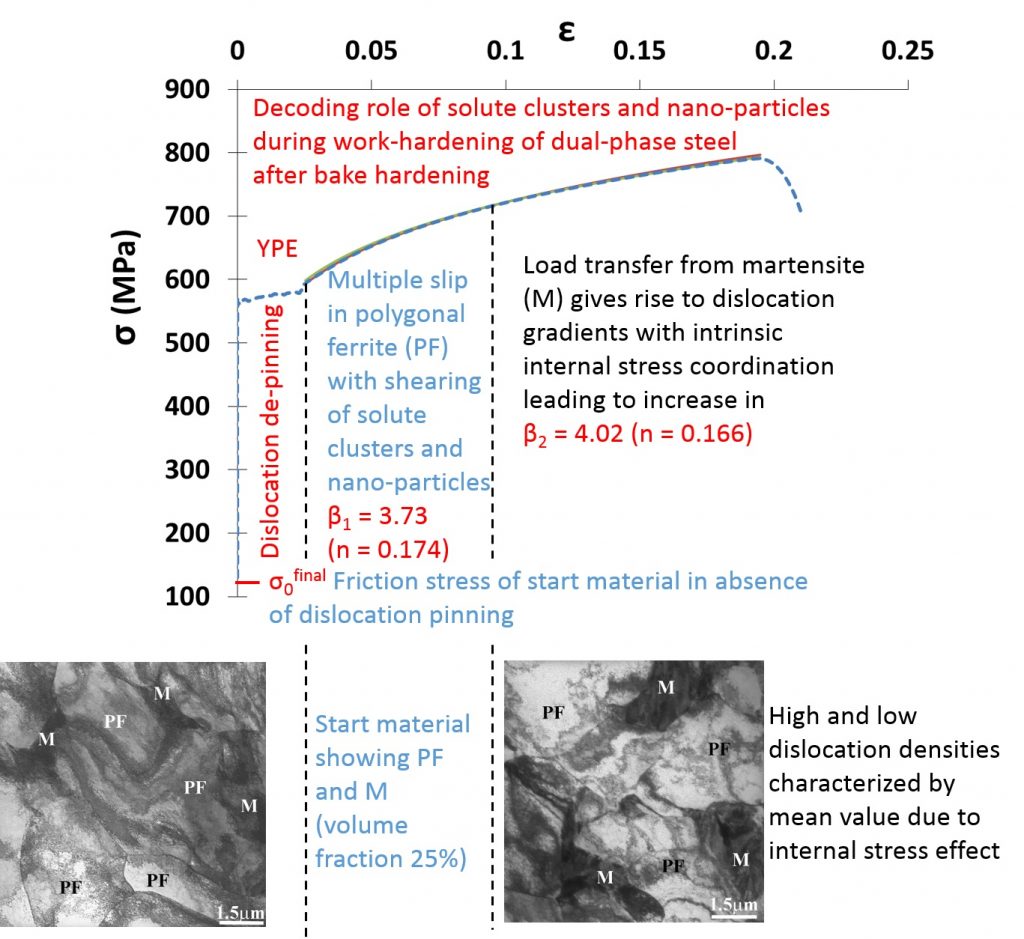
Fortunately, a new functional slip-based constitutive formulation with accurate digital fitting parameters can replicate the measured data with a minimum of two loci. For this reason, the research team sought the possibility of identifying the mechanical response because of a number of microstructural components. The mean slip distance, which was the key parameter, could be calibrated from the initial work-hardening slope at 0.2% strain from which all the fit parameters could be generated.
The application of the resulting constitutive relations analyses to dual-phase steel products indicated that stress-strain loci revealed additional parameters that correlated to the TEM and APT observations. The new parameter was the determination of friction parameter by back-extrapolation of the initial fit locus to define the stress at which dislocations could have initiated its percolation pre-yield process in case the yield point was absent.
The analysis presented separated the yielding from the post yield point elongation plastic processes, and friction stress defined the stress generating the heat in dislocation movement. The shape change was therefore correlated to the mean slip distance. The authors also observed that the evolving work hardening processes appeared to quickly change in the diffuse neck zone and correlate to the start microstructure. Their study therefore concluded that the constitutive relations analysis is more precise and improved approach that can be applied for materials testing examination.



Reference
Saimoto, I.B. Timokhina, and E.V. Pereloma. Constitutive Relations Analyses of Plastic Flow in Dual-Phase Steels to Elucidate Structure–Strength–Ductility Correlations. JOM, Vol. 69, No. 7, 2017.
Go To JOM