Advances in Engineering Advances in Engineering features breaking research judged by Advances in Engineering advisory team to be of key importance in the Engineering field. Papers are selected from over 10,000 published each week from most peer reviewed journals.

Significance Statement
The promising future of nanoparticles and nanostructured materials is already being realized today through applications such as in sensors and as catalysts which, nonetheless, require the immobilization of nanoparticles on solid surfaces. Such surfaces can be efficiently realized by adsorption using dispersion drying or the layer-by-layer technique. The mechanical stability of such layers have been observed to be limited since the nanoparticles are only bound by feeble chemical or physical interactions. In this regard scholars have sought to embed nanoparticles using higher stability approaches such as a polymer melt. However, the production of polymer parts by hot pressing is not very efficient since melting in a hot press is time consuming. Moreover, the quality of the resulting embedding varies due to manual processing.
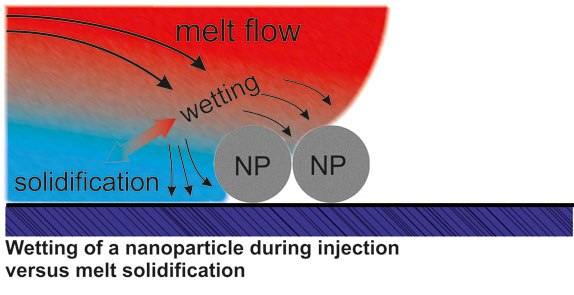
Jürgen Nagel and colleagues at the Leibniz Institute for Polymer Research (Leibniz-Institut für Polymerforschung) in Germany proposed a study on the use of nanoparticles of equal size and different functionalization for immobilization on the surface of a flowing polymer melt during injection moulding. Their main aim was to investigate whether there was an influence of the surface modification on wetting and embedding of particles in the polymer melt under the special conditions of injection moulding. They also hoped to find out if rapid cooling dominated the structure formation. Their research work is now published in Colloids and Surfaces A.
The research team commenced their empirical procedures by utilizing silica nanoparticles of identical size, roughly 200 nm, but having varying surface functionalities including: plain unmodified particles with silanole groups as well as amino- and hydrocarbon modified particles. They then deposited the layers of the particles onto a surface of a glass substrate. The team then brought the particles into contact with a polycarbonate melt at a temperature of around 3000C i.e. by injection moulding.
The authors observed that particles with polar surfaces were more embedded than those with non-polar surfaces. The team also noted that the immobilized polar particles exhibited a higher adhesion, when tested with an adhesive tape, while on the other hand, the non-polar particles could be removed easily by peeling off the adhesive tape. This clearly indicate that the embedding and the bond strength exhibited by the immobilized nanoparticles are dependent on the type of surface functionalization of the nanoparticles.
The approach presented in their study for the fabrication of nanostructured polymer surface can be probably realized for various polymer-nanoparticle combinations and for arbitrary size of parts and surface areas. The embedding of the nanoparticles in the polymer matrix can be controlled by the surface properties. Wetting by the melt is a dominant factor, despite the fast freezing of the melt on contact with the cold objects. The research work reported by Jürgen Nagel et al revealed that surface properties have a larger influence on embedding of nanoparticles than thermal conditions due to cooling. Therefore, embedding and the accessible part of the surface of embedded nanoparticles can be controlled by melt-nanoparticle interface properties. This may be used for related works and applications.

Reference
Jürgen Nagel, Felix Kroschwald, Cornelia Bellmann, Simona Schwarz, Andreas Janke, Gert Heinrich. Immobilization of Different Surface-Modified Silica Nanoparticles on Polymer Surfaces Via Melt Processing. Colloids and Surfaces A volume 532 (2017) pages 208–212.
Go To Colloids and Surfaces A