Advances in Engineering Advances in Engineering features breaking research judged by Advances in Engineering advisory team to be of key importance in the Engineering field. Papers are selected from over 10,000 published each week from most peer reviewed journals.

Significance Statement
Until in the recent past, the solubility of oxygen in aluminum has been considered to be less than 1 atom in 1035-1040 aluminum atoms. This is however equivalent to less than 1 atom of oxygen in the entire world supply of aluminum since the metal was extracted. On the contrary, it has been known that actual form of the oxygen in aluminum is entirely aluminum oxide. This paradox has then been taken to show that the oxide in the metal may not have occurred by chemical reaction between oxygen in solution and the metal, but could have been incorporated mechanically.
It is now known that the surface film of oxide on the liquid metal, arising from contact with air, is entrained into the bulk metal during casting. This entrainment process results in the form of double films that are very detrimental to the mechanical properties. Similar populations of incorporated double oxide films, known as ‘bifilms’, can be observed in other consolidation processes including spray forming and powder metallurgy. Bifilms seem to be important: recent studies taking account of bifilms is beginning to be able, for the first time, to fully explain fracture in metals.
A number of experimental studies have been carried out in an attempt to establish the oxygen content in liquid aluminum saturated by alumina. Unfortunately, unreliable results have been reported so far owing to unclear experimental conditions. This could be attributed to the very low oxygen content in liquid aluminum that normally falls below analysis limits, or could be referenced to the fact that suspended alumina particles from other sources as described above lead to inaccurate analysis.
Youn-Bae Kang at the Pohang University of Science and Technology in South Korea in collaboration with John Campbell at University of Birmingham in the UK demonstrated that the solubility of oxygen in liquid aluminum (in terms of mole fraction) is low, in the region of only 10-7 but is vastly greater than the 10-35 and 10-40 values as mentioned previously. Therefore, this non-trivial revision in oxygen solubility necessitates a re-examination of the current assumptions. It then becomes interesting to speculate on the form this newly discovered source of alumina will take and if it will have an impact on the existing alumina bifilm theory. Their study provides an examination of this speculation. Their research work is published in Metallurgical and Materials Transactions A.
Thermodynamic computation that will provide a precise estimate for the oxygen content is based on sophisticated solution thermodynamics and supporting experimental data. However, thermodynamic modeling of deoxidation equilibria is complex owing to the strong interaction between the deoxidizing agent and oxygen. The conventional method assumes random mixing between the elements implementing a large number of adjustable parameters, but normally fails to explain the phenomena.
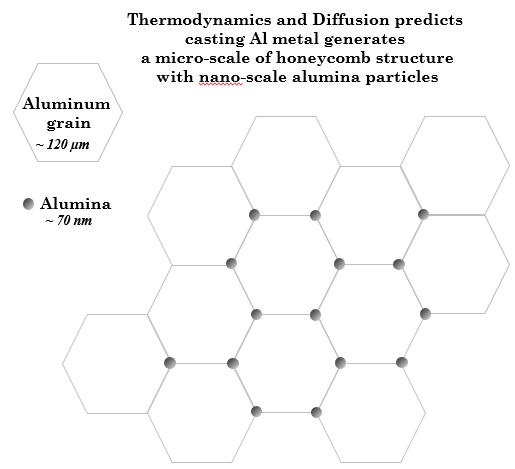
When liquid metal solidifies, the advancing solidification front can take a cellular, planar, or dendritic morphology. In these circumstances, with an almost pure aluminum with a small concentration of oxygen which is highly segregated, it is to be expected that the aluminum will freeze on an almost planar front. The oxygen will be rejected ahead of the front and will build up there forming a steady-state sideways displacement where its additional concentration will gradually lower the freezing point of the alloy.
The consequence would be the formation of a domed hexagonal array of cells, dimpled at the corners of the hexagons where the oxygen concentration increases to form alumina. The almost planar front, partially indented by the hexagonal cellular network of segregated regions would be the structure anticipated of a eutectic solidification where the amount of second phase is quite small. The experimental confirmation of this structure, its fine alumina strings coalescing under the action of interfacial tension, mixed together with the normally present population of entrained alumina bifilms, is not expected to be easy.


Reference
Youn-Bae Kang and John Campbell. Distribution of Alumina in Aluminum Prediction Based on Thermodynamic and Diffusion Analysis. Metallurgical and Materials Transactions A, 2017, Volume 48, Issue 6, pp 2697–2700
Go To Metallurgical and Materials Transactions A