Advances in Engineering Advances in Engineering features breaking research judged by Advances in Engineering advisory team to be of key importance in the Engineering field. Papers are selected from over 10,000 published each week from most peer reviewed journals.

Significance
Comprehensive measurements of snow avalanches have indicated that the principle mechanism for entrainment and growth of an avalanche is by frontal ploughing into a layer of fresh snow. Amount of available materials as well as the structure of the snow pack are the primary factors that have been identified to affect avalanche flow dynamics. Entrainment has been found to occur at, or very close to the flow front, and basal erosion by the flowing body being significantly less.
The entrainment process is responsible for avalanche build up, therefore becoming more destructive as compared to the initial release. Snow may be deposited at the rear, base and sides, in a similar fashion as the eroding materials. Therefore, there is a subtle balance that dictates if there will be an overall avalanche growth or decay. Deposition is also responsible for critical qualitative changes in flow dynamics, for instance the formation of static levees at avalanche flanks leaving a trail in the deposit. The avalanche flow could also rapidly stop when the inclination changes and the avalanche decays away by mass deposition.
In a move to investigate the effects of erosion and subsequent deposition experimentally, University of Manchester research team, Andrew Edwards, Sylvain Viroulet and Nico Gray in collaboration with Peter Kokelaar at University of Liverpool performed small-scale analogue experiments on a rough inclined plane designed with static erodible carborundum grains layer. Their research work is published in Journal of Fluid Mechanics.
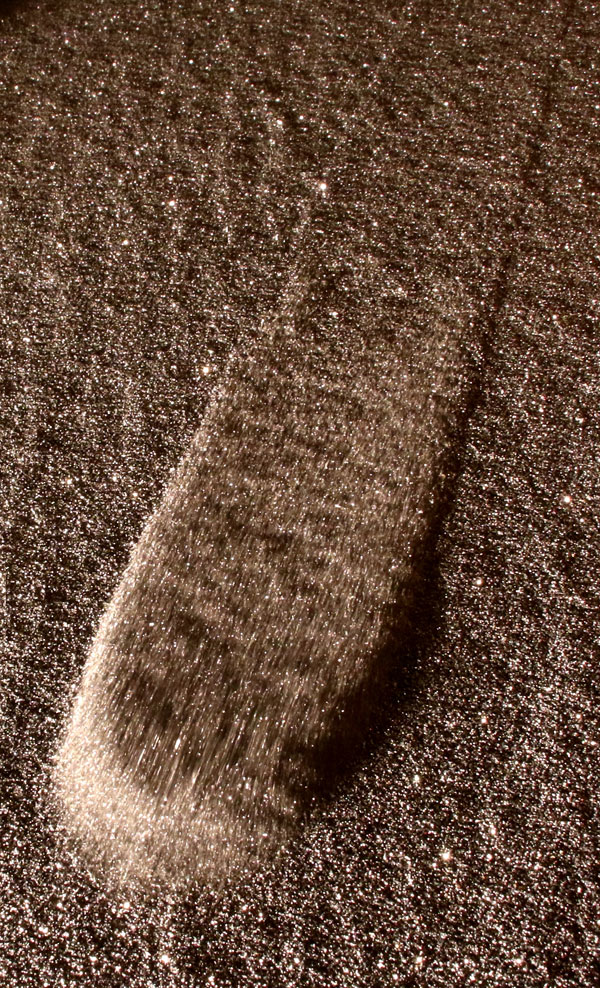
The research team prepared the static layer by slowly closing down a flow from a hopper at the summit of the slope. This left behind a uniform layer at a selected slope inclination. Owing to the hysteresis of the rough bed friction law, this layer could be inclined to higher angle on condition that the thickness did not exceed the initial height, which could be considered as the maximum depth that could be held static on the rough bed. The authors then triggered an avalanche on top of the static layer by releasing a selected volume of the carborundum grains.
The researchers observed three behaviors depending on the slope inclination as well as the static layer depth. For initial deposit depth greater than Hstop, they observed that the avalanche rapidly grew in size by entraining more grains progressively at the sides and front, while depositing just a few particles at the tail and base. This left behind a trough eroded to a depth below the initial deposit surface and whose maximal areal extent had a triangular shape. However, the release on a shallower slope with Hstop deposit thickness led to net deposition. In this case, the avalanche left behind a levee-flanked channel whose floor lay above the level of the initial deposits and narrowed downstream.”
Therefore, it is possible to produce avalanches having an ideal balance between deposition and net erosion. Granular flow problems entailing erosion and deposition are challenging due to the fact that there is no accepted method of modelling the phase change between moving and static particles. However, it was shown in their study that by integrating Forterre’s and Pouliquen extended friction law with the depth-averaged rheology of Edwards and Gray, it was possible to come up with a 2-Dimensional shallow-water-like avalanche model capturing quantitatively all the experimentally observed behavior.
The developed model will have important practical applications for modeling the initiation, growth and decay of snow avalanches for assessing hazards and risk mitigation.




Reference
A. N. Edwards, S. Viroulet, B. P. Kokelaar and J. M. N. T. Gray. Formation of levees, troughs and elevated channels by avalanches on erodible slopes. Journal of Fluid Mechanics, Volume 823 (2017), pages 278–315.
Go To Journal of Fluid Mechanics