 Advances in Engineering Advances in Engineering features breaking research judged by Advances in Engineering advisory team to be of key importance in the Engineering field. Papers are selected from over 10,000 published each week from most peer reviewed journals.

Significance
Friction reduces energy efficiency in many engineering devices. Friction torque reduction at oil lubricated interface has been seen to be surface texturing as observed in bearings and seals. Application of textured surface on bearing lubrication has been under extensive research due to the known beneficial effects it has on tribological performance. To alter the surface topology of textured bearings, identical geometries have been introduced on the supporting surface. To this regard, the hydrodynamic behavior of such fluid film bearings have thus been improved. In the past, studies based on numerical modelling have elaborated the application of texture patterns on the stator surface of thrust bearings. Therefore, to get the best bearing performance, the texture patterns on the stator surface must be optimized. Introducing dimples to the stator surface has been seen to play the trick. Unfortunately, based on previous published work, there is no standard approach to optimize the texture pattern. Moreover, little has been done concerning the size of the dimple both systematically and quantitatively.
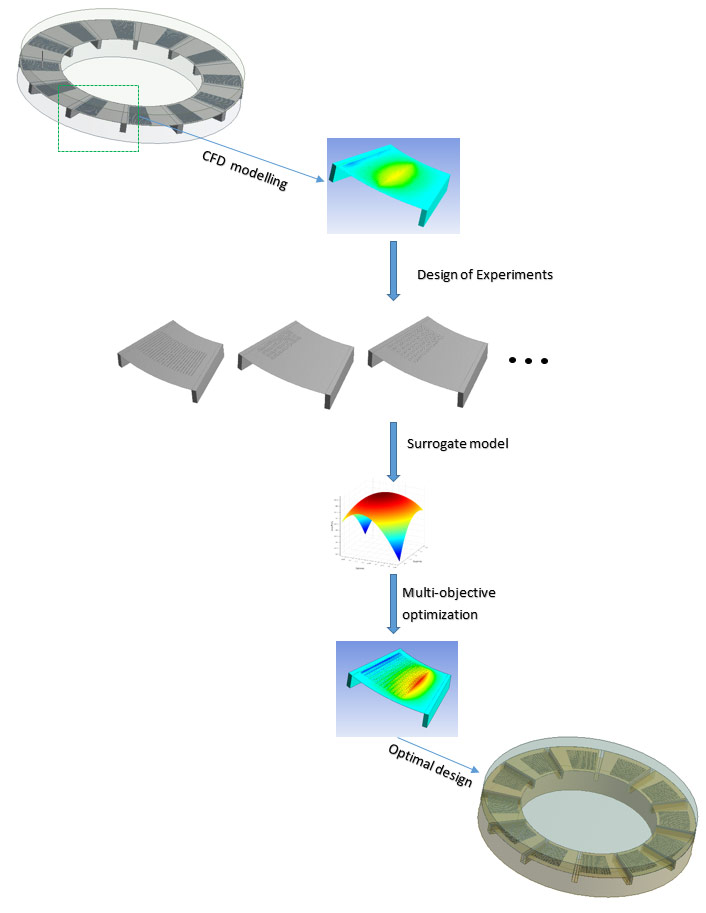
Research conducted by Gen Fu and Dr. Alexandrina Untaroiu at Virginia Tech in the USA analyzed the influence of texture geometry on the performance of parallel thrust bearings and optimize the performance at a typical operating condition. In their work, they employed a basic approach where they combined the optimization algorithm and 3D computational fluid dynamics simulation. The main objective of their optimization process was to achieve the maximum load capacity with minimal friction, while the total computational time was reduced by using statistical methods. Their research work is currently published in Journal of Engineering for Gas Turbines and Power.
The methodology employed in their study involved the construction of a 3D computational fluid dynamics model which facilitated analysis of the effects of dimple geometry on the performance of a parallel thrust bearing. In addition to this, the two researchers also employed DOE technique so as to identify the relationships between dimple geometry parameters and bearing performance and multi-objective optimization technique was conducted based on the surrogate model generated by regression method. Load capacity and friction torque were considered as the main indicators of bearing performance.
The authors observed that the effects of the cavitation model were strongly dependent on the operating conditions of the bearing despite having predicted a higher load capacity of the thrust bearings having elliptical dimples. In addition, reverse flow pattern was observed at the bottom of the dimples. Overall, the statistical significance and accuracy of both load capacity and friction torque as employed for the regression model were confirmed.
Gen Fu and Alexandrina Untaroiu successfully presented a novel optimization approach for finding the optimal partially texture geometry with elliptical dimples, which can maximize the loading capacity and minimize the friction torque. It has been seen that the friction torque increases as the circumferential extension of the textured area increases. This implies that the shape of the dimples has a crucial effect on the performance of the textured thrust bearings. This process can therefore be considered as a standard approach for future research.

Reference
Alexandrina Untaroiu, Gen Fu. An Optimum Design Approach for Textured Thrust Bearing with Elliptical-Shape Dimples Using Computational Fluid Dynamics and Design of Experiments Including Cavitation. Journal of Engineering for Gas Turbines and Power 2017, Volume 139 / 092502-1.
Go To Journal of Engineering for Gas Turbines and Power