Advances in Engineering Advances in Engineering features breaking research judged by Advances in Engineering advisory team to be of key importance in the Engineering field. Papers are selected from over 10,000 published each week from most peer reviewed journals.

Significance
The past decade saw the discovery of a phenomenon called photonic nanojet in which a jet-like light wave with a subwavelength beam waist could be obtained with quite simple geometry. Such discovery can be credited to the everlasting desire amongst scientists to manipulate the flow of light. These scientific conquests have seen the development of nano-optical systems and state-of-the-art micro-fabrication techniques necessary to fabricate materials and devices. Since its discovery, the photonic nanojet effect has been extensively studied with various potential applications developed and demonstrated. Measures to improve the performance of photonic nanojets have also been proposed, with the most recent one being tuning of the photonic nanojets by use of an external stimuli, where, liquid crystals/phase change materials can be utilized. Unfortunately, for such tunable photonic nanojet systems, not much has been done to elucidate the effects due to effective refractive indices control.
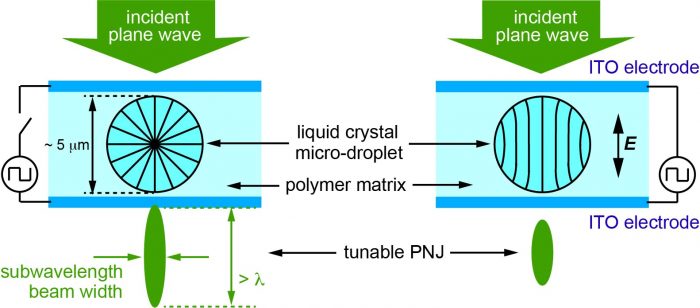
Professor Tatsunosuke Matsui and Kazuya Tsukuda from Mie University in Japan reported direct experimental observation of electrically tunable photonic nanojets generated from self-assembled liquid crystal microdroplets, formed by dispersing nematic liquid crystals in polymer matrix. They purposed to show what they believed to be the first direct imaging of such a tunable photonic nanojet, utilizing a self-assembled liquid crystal microdroplet. Their work is published in the research journal, Optics Letters.
They utilized nematic liquid crystals and polydimethylsiloxane to obtain the liquid crystal microdroplets. The researchers employed their home built laser-scanning confocal microscope system to undertake direct observations of the photonic nanojets. The team then introduced the mixture by a capillary action into the cell, which consisted of two glass slides coated with indium-tin-oxide as electrodes for voltage application. The team then applied heat onto the sample. Later, optical measurements were carried.
The authors observed that the photonic nanojets from a self-assembled liquid crystal microdroplet showed better performances, such as longer propagation length and higher brightness, than those from the silica microsphere in the air, which might be attributed to a better index contrast in E7 nematic liquid crystal and polydimethylsiloxane polymer matrix. Additionally, they realized that some of the fundamental properties of the photonic nanojets, such as beam length and the intensity enhancement, could be tuned by applying external voltage due to the field-induced reorientation of liquid crystal molecules in the microdroplet.
Tatsunosuke Matsui and Kazuya Tsukuda study presented the first ever experimental observations from a tunable photonic nanojet generated from a self-assembled liquid crystal microdroplet. The researchers have shown that their device can be operated with low applied voltage of a few volts, just as in the liquid crystal display devices. Therefore, such electro-tunable photonic nanojets from self-assembled liquid crystal microdroplets may open the way for the development of novel types of micro-optical devices for optical data storage, spectroscopy, super-resolution microscopy, optical lithography amongst other fields.

Reference
Tatsunosuke Matsui, Kazuya Tsukuda. Direct imaging of tunable photonic nanojets from a self-assembled liquid crystal microdroplet. Volume 42, Number. 22 ǀ November 15 2017 ǀ Optics Letters.
Go To Optics Letters