Fair comparison of complexity between a multiband CAP and DMT for data center interconnects

Significance 

The current globalization of cloud services has elicited the need for high-speed optical links for data center interconnects over a single fiber. Such advances can be credited to advanced modulation formats, in combination with coding and digital signal processing that have enabled technologies to handle such enormous quantities of data traffic. Normally, the limiting connection distance obligated by inter-data center connects is basically up to 80 kilometers single-mode fiber. Similar coherent systems are presently viable to offer efficient data transmission, however, their applicability may cease in the near future. This is due to the fact that they may not be able to adapt to the stringent requirements on cost, power, and footprint. To this end, direct detection schemes have emerged as potential low-cost solutions by upscaling from and leveraging the ecosystem of short-reach transceivers for a wavelength division multiplexing link. Unfortunately, presently undertaken complexity comparison studies on the main direct detection schemes have only considered short reach scenarios of not more than 10 kilometers.

Jinlong Wei at Huawei Technologies Düsseldorf GmbH in Germany in collaboration with Christian Sánchez at Aston University and Ilias Giacoumidis at Dublin City University & SFI CONNECT Research Centre conducted pioneering detailed analysis and fair comparison of the transceiver complexity of a 56 Gb/s multi-band carrierless amplitude and phase (CAP) and discrete multi-tone (DMT) for 80 kilometers intensity modulation and direct detection dispersion compensation fiber-free single-mode fiber link. They managed to reveal the major parameters that impact the system complexity for the two direct detection links and advice on the important implementation rules. Their work is currently published in the research journal, Optics Letters.

The research team initiated their experiments by setting up the 56 Gb/s multiband CAP and DMT systems which was comprised of transceiver digital signal processing and optics.The researchers then used the digital-to-analogue convertor output to drive the Mach–Zehnder modulator. After transmission over a dispersion compensation fiber-free 80 km single-mode fiber, combined variable optical attenuator and a pre-amplifier, erbium-doped fiber amplifier, were then used to load optical noise onto the received signal. Eventually, the detected signal was converted into a digital signal by an analogue-to-digital converter with the same sampling rate of digital-to-analogue convertor, before undergoing offline signal processing.

The authors observed that the time domain square-root raised cosine-matched filters and IFFT/FFT took the majority of the complexity for the multi-band CAP and DMT, respectively. Additionally, IFFT/ FFT implementation was noted to be more efficient when compared with time domain square-root raised cosine filter implementation, from a complexity point of view. The multi-band CAP was also seen to depict a strong complexity sensitivity to the sub-band count.

Wei, Sánchez and Giacoumidis study presented a thorough and detailed analysis with fair comparison of digital signal processing complexity that has been conducted for a 56 Gb/s multi-band CAP and DMT over 80 kilometers dispersion compensation fiber-free single-mode fibers. The analysis reported helped conclude that the two schemes actually bring about comparable complexity with similar optical signal-to-noise ratio performance. Therefore, the choice of the multi-band CAP sub-band count and finite impulse response filters and the DMT and inverse fast Fourier transform size makes substantial impact on the system complexity/performance, and trade-off must be considered.

IFFT/ FFT  –  inverse faster Fourier transform and fast Fourier transform
multi-band CAP and DMT for data center interconnects-Advances in Engineering
CEEOALAN Project


About the author

Dr Elias Giacoumidis is a Marie-Curie Research Fellow at Dublin City University & SFI CONNECT Research Centre of Ireland. His current collaborative project with Xilinx-Ireland tackles the “capacity crunch” in optical fiber communications harnessing energy-efficient optical and digital technologies (Project EPIC: Energy-efficient and Phase-Insensitive Coherent Communications).
He has previously worked for various prestigious optical communications research groups including Heriot-Watt University, University of Sydney CUDOS (deputy project leader), Aston University, Telecom-ParisTech, Athens Information Technology centre and Bangor University (PhD scholarship). He has authored/co-authored about 100 papers that appeared in international peer-reviewed journals and top conferences with more than 1000 citations from Google-Scholar.
His research involves balanced theoretical and experimental exploration in high-capacity optical transmission systems with specialization in key modern signal processing techniques such as OFDM, CAP, PAM-8 etc. and nonlinear photonics (e.g. Brillouin amplifiers) for next-generation local, access and long-haul optical networks.

Dr Giacoumidis is the principal investigator of the world’s-first cost-effective direct-detected optical Fast-OFDM transmission system. He was the first to implement digital-based machine learning for fiber nonlinearity mitigation in multi-carrier coherent optical communications. Dr Giacoumidis is a member of IEEE and OSA and was nominated an outstanding reviewer of 2016 for the IEEE/OSA Journal of Lightwave Technology.

Weblinks: Marie-Curie ProjectGoogle-ScholarLinked-In

About the author

Christian Sánchez received his PhD degree in 2014, focused on the study of optical OFDM for optical access networks. Afterwards, he started a post-doctorate at Aston University, in the Aston Institute of Photonic Technologies (AIPT) research group, where he has been working on digital-signal processing for spatial-division multiplexing communication systems and on optical phase-conjugation for its employment in optical networks. From 2016 to 2018 he kept working at AIPT as a Marie Curie Research Fellow, having contributed to conferences such as ECOC and OFC, as well as to prestigious scientific journals in the field of photonics (IEEE/OSA journal Lightwave technology, OSA Optics Express and Optics Letters).

About the author

Dr. Jinlong Wei is currently a senior researcher at Huawei Technologies Dusseldorf GmbH, European Research Center, Munich, Germany. Prior to it, he was awarded an intra-Europe Marie Curie fellowship and worked as a Marie Curie fellow and senior engineer at ADVA Optical Networking SE, Germany (2014 to 2016). He received a PhD from Bangor University, UK in 2010 and worked there afterwards as a post-doc before joining the Centre for Photonics Systems, University of Cambridge, UK as a research associate in 2011.

Dr. Wei’s research interests include advanced modulation formats and signal processing covering applications from in-house visible optical interconnects to data center (DC), access, Metro and long-haul networks with emphasis on cost- and energy-efficient innovations. He has participated in about 10 European national and international projects and realized a number of world-first system demonstrations with his colleagues. These include a real time 40 Gb/s lane rate PAM-4 based access network (published as a PDP in ECOC2015), a real time 400 Gb/s inter-DC connection optical link, the fastest real time optical OFDM PON system in 2010, an optical hybrid  carrierless amplitude and phase modulation/quadrature amplitude modulation (CAP/QAM) link, and a 128×128 optical hybrid switch.

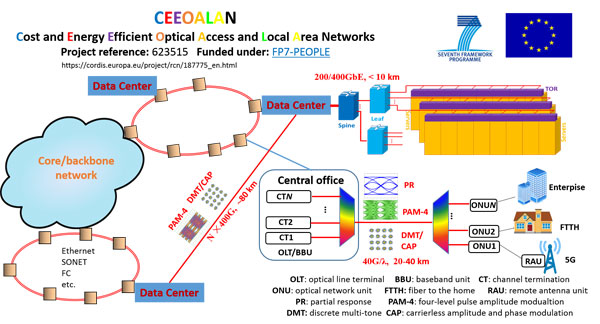
The results have been reported by leading media such as BBC, Reuters, Yahoo, BussinessWire etc. This reported work is in part subject to his previous Marie Curie project CEEOALAN (cost and energy efficient optical access and local area network) under EU FP-7 with grant number 623515. The project aimed to identify and demonstrate low-cost and -energy direct detection-based modulation formats for very high speed short- and medium-haul optical links. Modulation formats under investigation include PAM, partial response (Duobinray as an example), CAP and DMT, by using existing commercial components with relatively low bandwidths. This project generated strong impact to both the academia and the industry.

Dr. Wei has authored or co-authored more than 120 international journal/conference papers, including over ten invited such as IEEE/OSA Journal of Lightwave Technology and OFC2017, and holds several US/Europe patents. His work has been cited by the community over 1500 times according to Google Scholar Citations. He has been contributing to the next generation 100 Gigabit Ethernet study within IEEE802.3. He has served as a session organizer or a technical committee member of several international conferences. He has been actively serving as a reviewer for over ten international journals in the field of optical communications and won the 2016 outstanding volunteer of IEEE/OSA Journal of Lightwave Technology.
Dr. Wei is a senior member of IEEE and a member of IEEE Photonics society. He holds an honorary research fellowship of Bangor University, UK since 2018.

Weblinks: CEEOALAN project web,  Google Scholar Citations:

Reference

J. L. Wei, C. Sanchez, and E. Giacoumidis. Fair comparison of complexity between a multiband CAP and DMT for data center interconnects. Volume. 42, No. 19 / October 1 2017 / Optics Letters.


Go To Optics Letters
Check Also

Modular Hardware Paths for Scalable Quantum Information Processing

Significance  Image credit: Science. 2025 Dec 4;390(6777):1004-1010. doi: 10.1126/science.adz8659. Reference Awschalom DD, Bernien H, Hanson …