Advances in Engineering Advances in Engineering features breaking research judged by Advances in Engineering advisory team to be of key importance in the Engineering field. Papers are selected from over 10,000 published each week from most peer reviewed journals.

Significance
The move to reduce the use of fossils fuels as the source of energy has been embraced globally. Fossils fuels are the primary causes of global warming and pollution experienced today, which has become a threat to human and environment existence. As a result, renewable energy such as the solar energy has been proposed as an alternative. The high demand for solar energy and advancement of nanotechnology has attracted several researchers which have been directed towards achieving its high conversion and harvesting efficiency. The inefficiency of most currently available and traditional solar rectifiers such as conventional nanoantenna have contributed to the switch to using more efficient techniques like the broadband nanospiral antenna.
Theoretically, the working of nanoantenna is based on optical frequency. The nanoantenna especially the one used in this experiment can be best described simply as a voltage source connected in series to its own impedance. In calculating the efficiencies, various parameters are taken into consideration. They include effective area wavelength, the antenna impedance, polarization, and radiation. The nanoantenna used in solar energy collection should have a broad wavelength for the inclusion of the visible and infrared, an efficient impedance matching between the rectifier and the used nanoantenna which will help in minimizing reflection. Furthermore, the active area has to be large enough while the radiation should be randomly polarized. Therefore, it can be generally said that the effective harvesting efficiency depends on the several individual efficiency components.
Researchers at Wuhan University, School of Electronic Information in China led by Professor Huotao Gao investigated the use of broadband nanospiral antenna for efficient harvesting and collection of solar energy. The ideas were to improve the present conventional nanoantennas such as solar rectenna. Also, the effects of the parameters and condition required for the efficient collection of the solar energy were investigated. Their research work has been published in the journal, Optics Express.
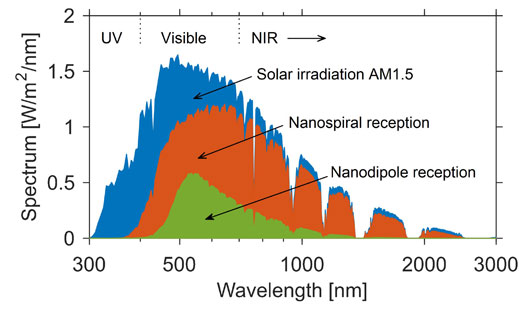
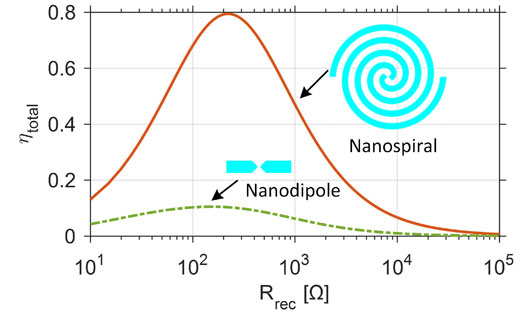
The authors observed 80% harvesting efficiency for a resistance of 200 ohms rectifier coupled with a nanospiral. However, when the same conditions were applied for a nanodipole, the efficiency was as low as 10%. On the other hand, the reception of the solar radiation improved significantly for a suitable wavelength.
The Huaqiao Zhao and colleagues study successfully showed the merits of full-spectrum in reception, conversion, and harvesting of solar energy. The higher efficiency produced by the nanospiral rectenna as compared to its counterpart that is nanodipole is attributed to its properties such as impedance, polarization and broadband characteristics. Another advantage of nanospiral compared to nanodipole is its simplicity that is coupling with a high diode resistance. Generally, the application of the solar rectenna is a future game-changing technology which will aim at promoting the use of clean and renewable technology. The study will, therefore, advance the reception, conversion, and harvesting of solar radiation thereby encouraging the use of solar energy. Being a renewable source of energy, it is environmentally friendly and thus will help in environmental conservation.


Reference
Zhao, H., Gao, H., Cao, T., & Li, B. (2018). Efficient full-spectrum utilization, reception and conversion of solar energy by broad-band nanospiral antenna. Optics Express, 26(2), A178.
Go To Optics Express