Advances in Engineering Advances in Engineering features breaking research judged by Advances in Engineering advisory team to be of key importance in the Engineering field. Papers are selected from over 10,000 published each week from most peer reviewed journals.

Significance
Current global population explosion is presently overstressing the available fresh water resources due to increased need for domestic and irrigation water. This therefore makes the reuse of treated municipal wastewater a critical issue. From the published plethora of literature concerning the matter in hand, only 5% of treated wastewater is reused worldwide despite reuse being highlighted in Sustainable Development Goals as a critical issue. Reuse of treated wastewater for crop irrigation can contribute positively to mitigating water stress in water scares arable areas. Membrane filtration followed by disinfection has of late been seen to be a reliable and effective technology for producing reclaimed municipal effluents that comply with the laid out standards of reuse. To this note, reuse of agro-industrial wastewater becomes significantly important especially where the economy of a region depends on irrigated agriculture. Unfortunately, this matter has not been dealt with exhaustively.
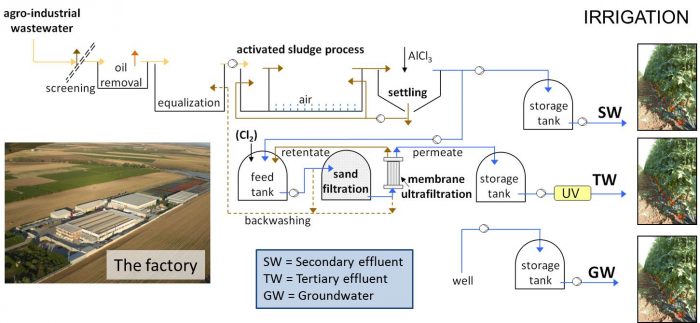
A team of researchers led by Dr. Alfieri Pollice from the Water Research Institute at the Italian National Research Council assessed the suitability of agro-industrial effluent reuse for irrigation. To this end, the team hoped to conduct a long term case study so as to test the full-scale tertiary treatment based on membrane ultrafiltration and ultraviolet disinfection at an agro-industrial site in Apulia (Italy). Their research work is now published in Journal of Cleaner Production.
The researchers utilized wastewater and stream produced at a vegetable canning factory, from which the treated effluents were used for field scale irrigation tests. They then proceeded to investigate the variability of the wastewater quality and its effects on treatment process performances and reclaimed water quality. Eventually, the research team undertook an economic evaluation of the full scale tertiary treatment.
The authors observed that the adopted technologies effectively removed suspended solids and the faecal indicator Escherichia coli was also seen to be below the local standards as stipulated for wastewater reuse in irrigation. Additionally, the research team noted that the use of treated agro-industrial wastewater had no inhibitory effects on the growth of tomato and broccoli, where neither resulted in any faecal contamination of crops.
The Alfieri Pollice and colleagues study has presented an in-depth assessment of the suitability of reusing treated agro-industrial effluents for the irrigation of horticultures. Generally, it has been seen that reuse of treated wastewater for irrigation is a suitable practice to close the water cycle in the agro-industrial sector. Moreover, this is critically significant in areas where the sustainability of agriculture and transformation activities heavily rely on the water available for irrigation. In conclusion, the practice demonstrated here avoids the discharge of pollutants into water bodies, therefore, reducing the environmental impacts of agro-industrial productions.
Water reclamation and multiple, cascade uses of water resources are no longer an option, but rather a must in many parts of Mediterranean Europe, where the increased competition for the limited natural water pose serious risks on the survival agriculture and related economic activities.

Reference
Pompilio Vergine, Carlo Salerno, Angela Libutti, Luciano Beneduce, Giuseppe Gatta, Giovanni Berardi, Alfieri Pollice. Closing the water cycle in the agro-industrial sector by reusing treated wastewater for irrigation. Journal of Cleaner Production, volume 164 (2017) 587-596
Go To Journal of Cleaner Production