Advances in Engineering Advances in Engineering features breaking research judged by Advances in Engineering advisory team to be of key importance in the Engineering field. Papers are selected from over 10,000 published each week from most peer reviewed journals.

Significance
Rules on wastewater quality disposed to receiving water bodies from municipal wastewater treatment plants are becoming stringent day by day. Municipal wastewater is a significant source of nitrogen loading in the receiving bodies and has been seen to contribute to eutrophication. Postdenitrification biofilters (DNFs) offer considerable solution as tertiary nitrogen removal equipment of high efficiencies and minimal environmental impact. These biofilters denitrify nitrogen in effluent into nitrogen gas under anoxic conditions, utilizing organic substrates as the electron donor. Effluent nitrogen includes both inorganic and organic nitrogen. Understanding the removal characteristics of dissolved organic nitrogen (DON) and its significance in terms of supporting tertiary life such as bacterial and algae which are the fundamental organisms responsible for the wellbeing of any operational municipal wastewater treatment plant has become a topic of great research interest. Unfortunately, most researchers mainly focus on the on the performance of DNFs for the removal of dissolved inorganic nitrogen, whereas little is known about the DON and bioavailable DON (ABDON).
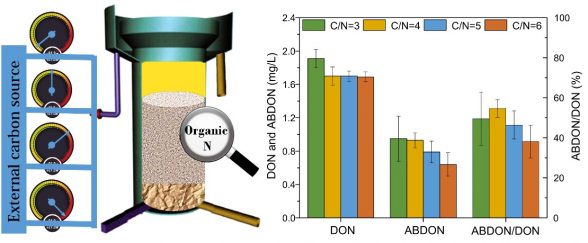
Researchers led by professor Hongqiang Ren from the State Key Laboratory of Pollution Control and Resource Reuse at Nanjing University in China investigated the effect of the carbon-to-nitrogen (C/N) ratio on the removal characteristics of DON and ABDON in the pilot-scale DNFs treating real secondary effluent. They purposed to unveil more details on the influence of the DNFs on the removal of DON. The study determined the benefit of high C/N ratios during the DNF process in terms of controlling the DON forms that readily stimulate algal growth. Their work is currently published in the research journal, Environmental Science & Technology.
The research method employed entailed commenced by describing the Pilot-Scale of the DNF with regard to how they were operated and their working mechanism. Next, samples to be used were gathered and prepared, continuous operation of the DNF for the specified samples was done and acclimatized denitrifying bacteria obtained. The team then proceeded to determine the DON and the bioavailability of DON after which they determined their chemical composition. Eventually, they undertook statistical and wastewater analysis where chromatography was employed in analyzing the nitrites and nitrates present.
The authors observed that DNFs effluent DON accounted for 31−39% of the effluent total nitrogen. Again, it was seen that the maximum effluent DON and ABDON concentrations both occurred in DNF operated at a carbon-to-nitrogen ratio of 3. The researchers also noted that no significant difference in effluent DON concentrations in DNFs at carbon-to-nitrogen ratios of 4, 5, and 6; however, effluent ABDON and DON bioavailability significantly decreased with carbon-to-nitrogen ratios.
The Hongqiang Ren and colleagues study has presented the effect of the carbon-to-nitrogen ratio on the removal characteristics of DON and ABDON and their impacts in the receiving water body. It has been seen that optimizing external carbon addition not only improves the DNF process efficiency but also saves chemical costs and reduces secondary pollution. Altogether, this study has amplified and elucidated on the benefit of a high carbon-to-nitrogen ratio during the DNF process in terms of controlling the DON forms that readily stimulate algal growth. The results of this study provided a solution to control the eutrophication and would be helpful for the researchers and engineers working on municipal wastewater treatment plants.


Reference
Haidong Hu, Kewei Liao, Jinju Geng, Ke Xu, Hui Huang, Jinfeng Wang, Hongqiang Ren. Removal Characteristics of Dissolved Organic Nitrogen and Its Bioavailable Portion in a Postdenitrifying Biofilter: Effect of the C/N Ratio. Environ. Sci. Technol. 2018, volume 52, pages 757−764
Go To Environ. Sci. Technol