Advances in Engineering Advances in Engineering features breaking research judged by Advances in Engineering advisory team to be of key importance in the Engineering field. Papers are selected from over 10,000 published each week from most peer reviewed journals.

Significance
Concrete is one of the most commonly used materials for structural components constructions. Cement forms the major component in concrete. Production of cement is associated with emissions of carbon dioxide gases which leads to about 5-7% of the global greenhouse gases emissions. Therefore, enhancing durability for the long life of the concrete structures is considered a significant move in the reduction of the greenhouse gas emissions.
Generally, most of the failures in concrete structures are as a result of the surface deterioration due to their susceptibility to external harmful ions. Surface-densification can enhance surface protection through applications of coating materials. They can be classified into organic or inorganic surface treatments. Organic materials have side effects such as short lifespan while inorganic materials are of essential benefits as they use coating materials with similar properties as the matrix. Even though there are several inorganic agents, the use of nanoSiO2 as a surface treatment agent has attracted many researchers due to its properties such as its ability to resist aggregation.
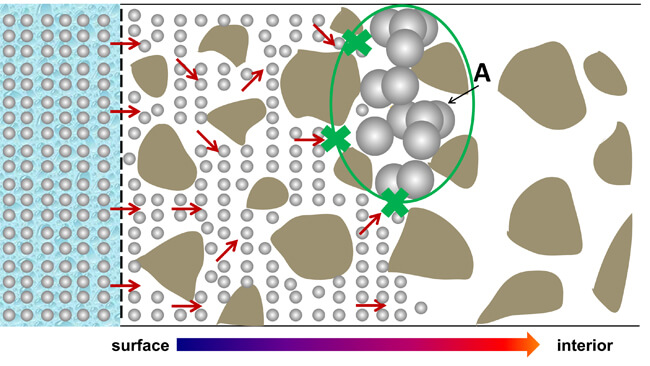
Dr. Yue Gu at Hohai University, Professor Wei She and Professor Jiaping Liu from Southeast University in collaboration with Dr. Qianping Ran who is Chief Engineer of Jiangsu Sobute New Materials Co. Ltd and the Chief Scientist of State Key Laboratory of High Performance Civil Engineering Material and Dr. Xin Shu from Nanjing University investigated the use of nanoSiO2-polycarboxylate superplasticizer (NS@PCE) as surface treatment agents for cementitious materials. Additionally, the mechanisms and effects of the nanoparticles surface treatment process were studied. The surface treatment process was investigated by measuring dispersion stability, water absorption ratio, mercury intrusion porosimetry and pozzolanic reactivity. On the other hand, surface-treatment effects on the nanoparticles were explained through a proposed hypothesis utilization the two properties of the nanoparticles which were, dispersity and pozzolanic reactivity. Their research work is published in, Construction and building materials.
The research team observed that NS@PCE could be effectively used as surface treatment agents. For instance, it was effective in reducing the water absorption rate while different NS@PCE had gone through different influences on the surfaces of the cementitious materials.
The authors used two distinct properties, pozzolanic reactivity and disparity, of NS@PCE to describe their refining pore performance. Disparity described the ability to resists aggregation in cement pore solutions during nanoparticle transportation while pozzolanic reaction rate provided the necessary information concerning the density rate of the nanoparticles fillers. The two properties were generally affected by the stability of the cement pore solution. Consequently, surface chemical states of the cementitious materials enabled the NS@PCE treatment agent to densify the surface.
NS@PCE exhibit flexible chemical structures that enable the design of various NS@PCE for surface treatment applications. However, an average shell-core ratio is suitable for NS@PCE with similar shell chemical structures. This is because higher shell-ration results to lower pozzolanic reactivity which may not be effective for surface densification. The study would lead to the application of NS@PCE for surface treatment of cementitious materials thus increasing their life. As such, structural failures and repairs will reduce significantly leading to the decrease in concrete use, which is also a way of reducing the rate of greenhouse gases emissions.



Reference
Gu, Y., Ran, Q., She, W., Shu, X., & Liu, J. (2018). Effects and mechanisms of surface-treatment of cementitious materials with nanoSiO2@PCE core-shell nanoparticles. Construction and Building Materials, 166, 12-22.
Go To Construction and Building Materials