Advances in Engineering Advances in Engineering features breaking research judged by Advances in Engineering advisory team to be of key importance in the Engineering field. Papers are selected from over 10,000 published each week from most peer reviewed journals.

Significance
Numerical aperture is defined as the product of the refractive index of the medium via which light traverses and the sine of the angle under which it is focused. Numerical aperture of any lens is significantly important in that it determines its ability to focus light and its resolving proficiency. Large numerical apertures are desirable for applications that require small light-matter interaction volumes or considerably large angular collections. In the past, in order to achieve large numerical apertures, precision bulk optics that were expensive and specialty items had to be utilized. Recently, meta-surfaces that allow the lens designer to avert these issues during the production of high-numerical apertures lenses in an ultra-flat fashion have been developed. Unfortunately, so far, the application of meta-surfaces is limited to numerical apertures on the same order of magnitude as traditional optical components.
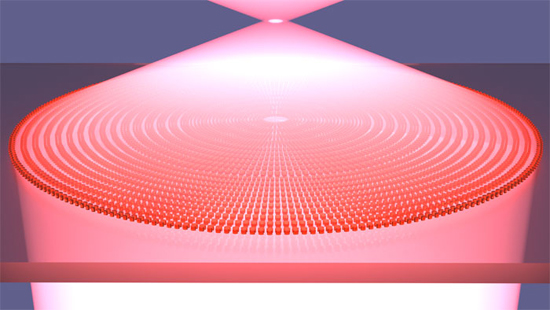
Recently, a team of researchers led by Arseniy Kuznetsov from the Data Storage Institute and now working for the Institute of Materials Research and Engineering (Agency for Science, Technology and Research, A*STAR) in Singapore has developed a novel approach that yields in a diffraction-limited flat lens with a near-unity free-space numerical aperture and subwavelength thickness, operating with un-polarized light at 715 nm. In order to achieve this goal, the researchers developed a novel design concept, which allowed them to create arrays of nanoantennas, which can bend the incoming light at very large angles, up to 82 degrees. Their work is currently published in the research journal, Nano Letters.
The research technique employed commenced with full wave numerical simulations of the diffraction efficiencies of regular arrays of nano-antennas using a finite element method- based commercial software. Each part of the lens was designed and simulated to bend light at different angles towards the focus. Then it continued with sample fabrication where thin films of amorphous silicon were deposited on fused silica substrates via chemical vapor deposition. Next, the samples were patterned using single-step electron beam lithography and subsequently etched via reactive ion etching in an inductively coupled plasma system using chlorine gas. The research team then proceeded to conduct optical measurements in order to characterize the diffraction efficiencies in transmission of uniform arrays of silicon disks.
The research team observed that the novel approach employed resulted in a diffraction-limited flat lens with a near-unity numerical aperture (NA > 0.99) and subwavelength thickness (∼λ/3), operating with un-polarized light at 715 nm. Additionally, the research team noted that the diffractive elements could efficiently bend light at angles as large as 82°, thereby representing a step beyond traditional optical elements and existing flat optics, circumventing the efficiency drop previously associated with the standard, phase mapping approach. To demonstrate the lens performance the team applied it in a confocal configuration to map color centers in sub-diffractive diamond nanocrystals.
The Ramón Paniagua-Domínguez and colleagues study presented novel concepts in which nano-antennas with tailored scattering patterns were used to engineer the redistribution of the diffracted energy in periodic arrays. Their new research has potential to find important applications in the field of optical gratings, where a precise control of energy distribution is vital. Furthermore, the associated flat lens design, with a near-unity numerical aperture, may be useful in a wide range of applications requiring high-resolution focusing, such as photolithography. Altogether, this work represents a clear-cut example of how resonant nano-antennas may help to overcome the limitations of phase mapping approaches to diffractive optics and how meta-surface concepts may lead to truly subwavelength-thick flat optical devices that break the limitations of their traditional counterparts.











Reference
Ramón Paniagua-Domínguez, Ye Feng Yu, Egor Khaidarov, Sumin Choi, Victor Leong, Reuben M. Bakker, Xinan Liang, Yuan Hsing Fu, Vytautas Valuckas, Leonid A. Krivitsky, and Arseniy I. Kuznetsov. A Metalens with a Near-Unity Numerical Aperture. Nano Letters. 2018, volume 18, pages 2124−2132
Go To Nano Letters