Advances in Engineering Advances in Engineering features breaking research judged by Advances in Engineering advisory team to be of key importance in the Engineering field. Papers are selected from over 10,000 published each week from most peer reviewed journals.

Significance
Most open channels are often encroached with dense populations of submerged and emergent riparian vegetation. As a consequence, the vegetation has a toll on the flow velocity within the channel. On the other hand, since the vegetation offer the largest roughness element, it responds to the flow dynamics by altering its morphology through bending, thereby becoming more streamlined when subject to drag. Subsequently, the alteration in morphology modifies how the flow velocity is vertically distributed and further alters the overall resistance and flow conveyance. Presently, a plethora of literature regarding this matter exists. However, in submerged vegetated open-channel flow, the drag force experienced by different segments along the plant stem differs distinctively because of variation in flow velocity, and turbulent momentum along the vertical profile as bending deformation of the vegetation canopy varies, which further complicates the estimation of drag coefficient and Manning’s n for the bulk flow. Additionally, it is still unclear how the vegetation reconfiguration, flow characteristics, drag, and the total resistance interact with each other.
Professor Tsung-chow Su from Florida Atlantic University in collaboration with Dr. Yan-Hong Li from Shanghai Jiaotong University and Dr. Liquan Xie from Tongji University investigated the bending features of the submerged flexible canopy and the associated variations in time-averaged mean flow and turbulence characteristics through a series of indoor experiments, and further induce semi-empirical resistance formulas for drag coefficient and Manning’s n. Their work is currently published in the research journal, Journal of Hydraulic Engineering.
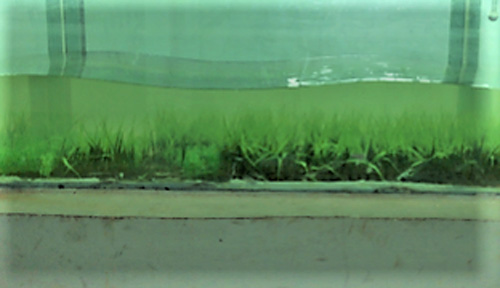
The research method employed commenced with the determination of dependence of bending angle and vertical displacement on the Cauchy Number: the coefficient that accounts for the slenderness of the plant stem and discriminates the bending degree of the cantilevered stem column. Next, using an indoor water plume, the researchers conducted 27 tests under the cross-combinations of three bulk flow velocities, three vegetation elastic moduli, and three vegetation stem thicknesses. Lastly, the total drag force experienced by the vegetation stem was accurately calculated based on the measured vertical profiles of flow velocity and the second order turbulent momentum in front of an individual plant. By so doing, they were able to estimate of the overall drag coefficient for bulk flow.
The authors observed that the bending deformation of vegetation contributed to the transfer of flow momentum downward deep into the canopy, which further decreased the drag. The researchers also noted that the Cauchy number was an important parameter in the estimation of flow resistance. Furthermore, the bending angle and the vertical displacement were also seen to be dependent on the Cauchy number and its square respectively when subject to small deformation configurations.
Yan-Hong Li, Liquan Xie, Tsung-chow Su study presented an empirical investigation of the bending deformation features of the submerged flexible vegetation canopy and its effects on flow and resistance characteristics in open-channel flow. The results presented directed that the bulk flow drag coefficient and Manning’s n were both power law functions of the Cauchy number. Altogether, the results obtained in their study are expected to provide a foundation to obtain more accurate evaluations of flows resistance in vegetated open-channel flow and offer greater applicability for river engineering.



Reference
Yan-Hong Li, Liquan Xie, Tsung-chow Su. Resistance of Open-Channel Flow under the Effect of Bending Deformation of Submerged Flexible Vegetation. Journal of Hydraulic Engineering, 2018, volume 144(3): 04017072
Go To Journal of Hydraulic Engineering