Advances in Engineering Advances in Engineering features breaking research judged by Advances in Engineering advisory team to be of key importance in the Engineering field. Papers are selected from over 10,000 published each week from most peer reviewed journals.

Significance
Rapid advancement in technology in conjunction with the expansion of the global desalination market has led to the improvement of seawater desalination processes. For instance, the stiff market competition has forced most manufacturers to develop new efficient processes and materials for better recovery. Currently, reverse osmosis processes and thermally driven technologies are the global desalination leaders. However, their use varies depending on the feed water quality and different parts of the world.
Reverse osmosis processes, for example, operates at low concentration hence their dominance in brackish water treatment can be observed clearly. The major components of the process include an intake system, pretreatment facility, high-pressure pumps, membrane filters and brine disposal and post-treatment facilities. In most cases, the process feed quality for the seawater reverse osmosis (SWRO) is measured by soluble salt saturation levels and the concentration of the suspended particles. The indicators used for desalination processes are turbidity and silt density index (SDI) with operation limits of 1 and 4 respectively. Operation near the limits may result in several operational complications such as biofouling, colloids agglomeration fouling of the seawater organic matter etc.
Despite the continued increase in the application of the SWRO processes globally and the improved recovery over the past decade, its reliability in the Gulf cooperation council (GCC) countries is still a challenge. For instance, the percentage of recovery and continuous fresh water supply in these countries are still unresolved. Therefore, researchers have been looking for alternative methods for maximum reliability and recovery and have identified thermally driven systems and hybrid membranes as promising candidates.
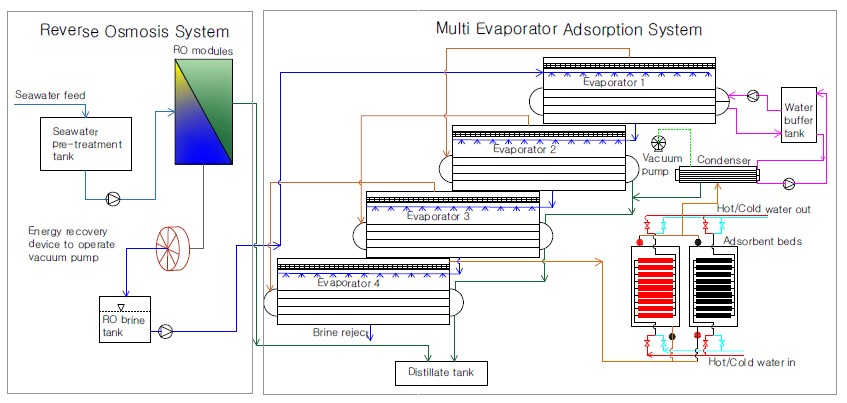
Recently, researchers Dr. Muhammad Wakil Shahzad, Dr. Muhammad Burhan and Professor Kim Choon Ng at King Abdullah University of Science and Technology (Water Desalination and Reuse Centre) in Saudi Arabia proposed a tri-hybrid system to improve the overall recovery of the seawater desalination processes. This innovative tri-hybrid cycle can achieve the highest recovery of about 81% with the lowest possible energy consumption. Their research work is now published in the research journal, Desalination.
The research team utilized WinFlow and IMSDesign commercial software to perform the membrane processes recovery simulations. The softwares are developed by the membrane manufactures. Furthermore, the simulation of the developed model was conducted in FORTRAN for further verification.
The authors successfully observed that the proposed tri-hybrid model was capable of achieving the highest overall recovery with the lowest specific energy consumption standing at 81% and 1.76 kwhelec/m3. Thus, it is more economical as compared to the current conventional reverse osmosis processes.
According to the authors, for a reverse osmosis system, retentate concentration in the range of 45000ppm-60000ppm and final brine rejection concentration varying between 166000ppm-222000ppm could be obtained. Therefore, after the 30% recovery from the membrane processes, the multi-evaporator thermally driven adsorption system could still recover 51% of fresh water from the pretreated reverse osmosis rejected brine. Thus, the proposed method is a promising solution for enhanced recovery of the seawater desalination processes, especially in the GCC countries.

Reference
Shahzad, M., Burhan, M., & Ng, K. (2017). Pushing desalination recovery to the maximum limit: Membrane and thermal processes integration. Desalination, 416, 54-64.
Go To Desalination