Advances in Engineering Advances in Engineering features breaking research judged by Advances in Engineering advisory team to be of key importance in the Engineering field. Papers are selected from over 10,000 published each week from most peer reviewed journals.

Significance
Recently, studies involving perovskite solar cells have attracted significant attention amongst researchers. This is attributed to their unique photoelectric properties, high solar conversion efficiency and low processing cost thus making them promising candidates for commercial photovoltaic technology applications. Normally, perovskite solar cell with high-quality perovskite absorber film, larger gain size, fewer defects and excellent electron and hole transport materials exhibit high efficiency and excellent performance. Therefore, considerable efforts have been made to improve the mentioned device aspects.
The power conversion efficiency of a solar cell generally depends on the electron transport layer (ETL). However, owing to the numerous limitations of the conventional materials used in the fabrication of the ETL such as the TiO2 material, fullerenes and their derivatives are currently preferred. Due to their excellent electron transport properties, they are capable of achieving high electron mobility and high-power conversion efficiency.
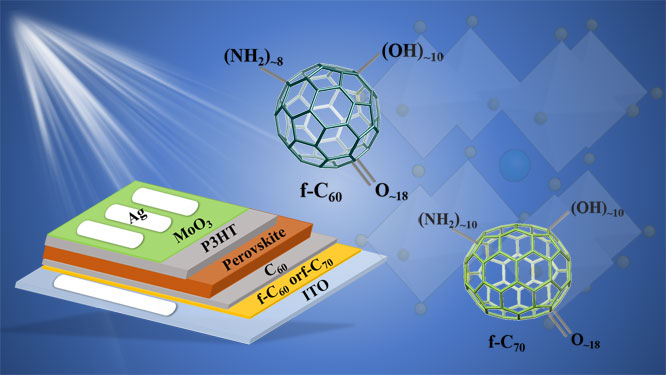
A team of researchers at the Soochow University (College of Chemistry, Chemical Engineering and Materials Science) in China Tiantian Cao and colleagues prepared two novel water-soluble fullerenes derivatives f-C60 and f-C70 for use as an electron transport layer in the perovskite solar cells. They purposed to enhance the power conversion efficiency of the perovskite solar cells. Their work is published in the research journal, Journal of Material Chemistry A.
The authors used a simple one-step process for preparing the fullerenes derivatives f-C60 and f-C70. Eventually, X-ray photoelectron spectroscopy was used to characterize the two derivatives to determine their molecular formulae.
The research team observed that the f-C60 and f-C70 layers significantly enhanced various aspects of the perovskite solar cells. For instance, the resulting cells showed efficient charge transport, improved crystallinity of the perovskite film and low charge transport resistance. Furthermore, power conversion efficiency of 16.97% and 16% was obtained for devices with f-C60/C60 ETL and f-C70/C60 ETL respectively. This represented an overall 24% increase as compared to the bare C60 ETL devices.
The suitable work function of the two fullerenes derivatives reduced the energy band gap between the ITO and the C60 ETL hence resulting in an increase in the open circuit voltage, circuit current density, and reduced leakage current for the two devices. The enhancement in the mentioned parameters was also a result of the efficient electron extraction and reduced charge transport resistance induced by the insertion of the fullerene derivatives (f-C60 and f-C70). However, it was also noted that devices with f-C60/C60 ETLs performed better than those with f-C70/C60 due to the better electron mobility of the former leading to even distribution in the functionalized groups.
The Ning Chen and colleagues study is the first to successfully utilize fullerene derivative f-C60 and f-C70 as ETLs in perovskite solar cells. Owing to the excellent results obtained, water-soluble fullerene derivatives are promising materials for applications as ETL materials in perovskite solar cells for enhanced performance.


Reference
Cao, T., Huang, P., Zhang, K., Sun, Z., Zhu, K., Yuan, L., Chen, K., Chen, N., & Li, Y. (2018). Interfacial engineering via inserting functionalized water-soluble fullerene derivative interlayers for enhancing the performance of perovskite solar cells. Journal of Materials Chemistry A, 6(8), 3435-3443.
Go To General Material Chemistry