Advances in Engineering Advances in Engineering features breaking research judged by Advances in Engineering advisory team to be of key importance in the Engineering field. Papers are selected from over 10,000 published each week from most peer reviewed journals.

Significance
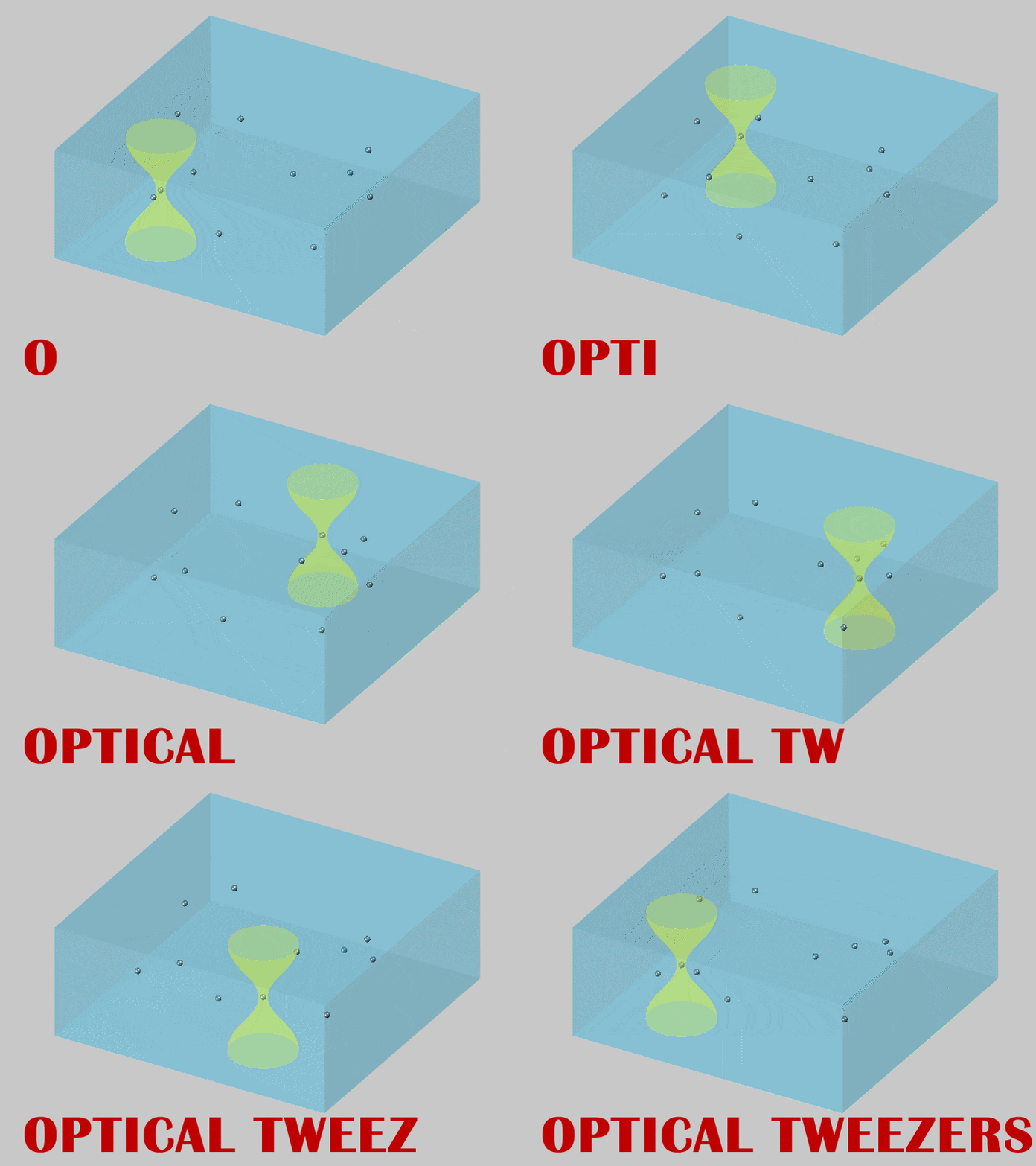
Since their inception in the early ‘70’s, optical tweezers have been utilized in the precise measurements of small forces and displacements. Optical tweezers provide a noncontact technique of 3D positioning that is applicable to the field of micro- and nano-manipulation and assembly. For such applications, the capability to manipulate particles over comparatively long distances at high velocity is critical in determining the overall process efficiency and throughput. In order to maximize manipulation speeds, it is necessary to increase laser power, which is often supplemented by undesirable heating effects due to material absorption. In an effort to avoid this consequence, most researchers have focused primarily on trapping large dielectric microspheres using slow movement speeds at low laser powers, over relatively short translation distances.
Recently, Jeffrey Melzer (PhD candidate) and Dr. Euan McLeod at University of Arizona advanced nanoparticle manipulation past the well-studied region in which maximum lateral movement speed is linearly proportional to laser power. Additionally, they investigated the fundamental limits imposed by material absorption, thus quantifying maximum possible speeds attainable with optical tweezers. Their work is currently published in the research journal, ACS Nano.
The authors observed that gold and silver nanospheres of diameter 100 nm were limited to manipulation speeds of ∼0.15 mm/s, while polystyrene spheres of diameter 160 nm could reach speeds up to ∼0.17 mm/s, over distances ranging from 0.1 to 1 mm. Additionally, they noted that when the laser power was increased beyond the values used for the maximum manipulation speeds, the nanoparticles were no longer stably trapped in 3D due to weak confinement as a result of microbubble formation, heating, enhanced Brownian motion and material absorption.
The study presented an elaborate demonstration of the fastest recorded manipulation speeds using optical tweezers in water for both dielectric and metallic nanoparticles. Their work established that optical tweezers can be fast enough to compete with other common, serial rapid prototyping and nanofabrication approaches. As a result, optical tweezers have the potential to offer the throughput needed for nano-assembly approaches that could rival prevailing fabrication technologies, with added advantages of biological compatibility and material non-specificity.


Reference
Jeffrey E. Melzer and Euan McLeod. Fundamental Limits of Optical Tweezer Nanoparticle Manipulation Speeds.. ACS Nano 2018, volume 12, page 2440−2447..
Go To ACS Nano