Advances in Engineering Advances in Engineering features breaking research judged by Advances in Engineering advisory team to be of key importance in the Engineering field. Papers are selected from over 10,000 published each week from most peer reviewed journals.

Significance
Tectonic movements and various geological transformations result in discontinuities in the rock mass whose distributions determine the structural characteristics of the rock. The stability of geotechnical structures depends on these characteristics. Conventional manual excavation and drilling techniques have been used for structural detection of continuities in deep rock mass due to their simplicity and reliability. Unfortunately, its use is limited especially for weak rock mass as it produces inaccurate characteristics of the discontinuities.
Presently, the use of borehole imaging technology for detecting structural planes in borehole walls has increased thanks to the advancement in technology. It overcomes the limitations of the traditional conventional methods. Generally, it is based on the optical principles enabling observation of the interior of boreholes. It is developed through four stages that can be categorized as an analog model for the first two stages (borehole photography and borehole camera) and digital model for the last two stages (panoramic borehole photography and panoramic borehole camera). The first two stages allow for qualitative observation, description, and analysis while the last stages allow for precision and complete analysis of the same. The digital model has overcome some of the challenges posed by the analog model.
Despite the significant improvement of borehole imaging, both the analog and digital modes still experience problems that affect the image quality and the accuracy of the analysis. This includes the assumption that the borehole wall is a cylindrical surface with a constant diameter and cross-sectional area. Consequently, the difficulty in achieving true three-dimensional imaging due to planar imaging problem is a great challenge. To this note, researchers have been looking for alternatives to overcome the challenges in the hope of achieving a true three-dimensioning borehole imaging.
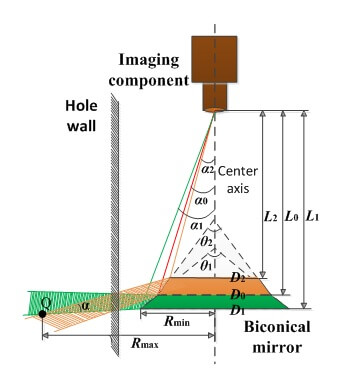
Chinese Academy of Sciences researchers: Professor Chuanying Wang, Associate Professor Zengqiang Han, Assistant Professor Xianjian Zou and Dr. Yiteng Wang in collaboration with Associate Professor Sheng Zhong from Sichuan University developed a panoramic stereopair imaging system for boreholes. The technique utilizes the biconical mirror imaging technology. They analyzed biconical mirror imaging principle and derived the stereopair imaging formulas. Their main objective was to develop an imaging system and processing platform to overcome the initial problems to realize a true three-dimensioning imaging for borehole walls. Their work is published in International Journal of Rock Mechanics and Mining Sciences.
The authors observed the accuracy and correctness of the developed borehole panoramic stereopair imaging technique from the experiments conducted in the indoor boreholes. For instance, it enabled accurate identification of fine structures in the walls of the boreholes through reconstruction of difference images from the obtained stereopair images.
According to the authors, the study presents a new borehole imaging technology owing to its originality, practicality and high level of innovation. Furthermore, the system successfully overcomes the challenges of past borehole imaging technologies and in particular by allowing accurate measurement and description of hole-wall shapes. Therefore, the borehole panoramic imaging system will advance exploration and testing of boreholes during drilling operations.






Reference
Wang, C., Wang, Y., Zou, X., Han, Z., & Zhong, S. (2018). Study of a borehole panoramic stereopair imaging system. International Journal of Rock Mechanics and Mining Sciences, 104, 174-181.
Go To International Journal of Rock Mechanics and Mining Sciences