Advances in Engineering Advances in Engineering features breaking research judged by Advances in Engineering advisory team to be of key importance in the Engineering field. Papers are selected from over 10,000 published each week from most peer reviewed journals.

Significance
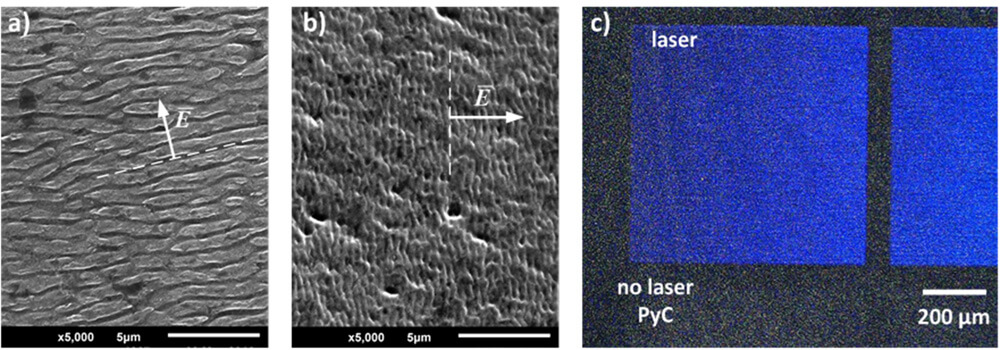
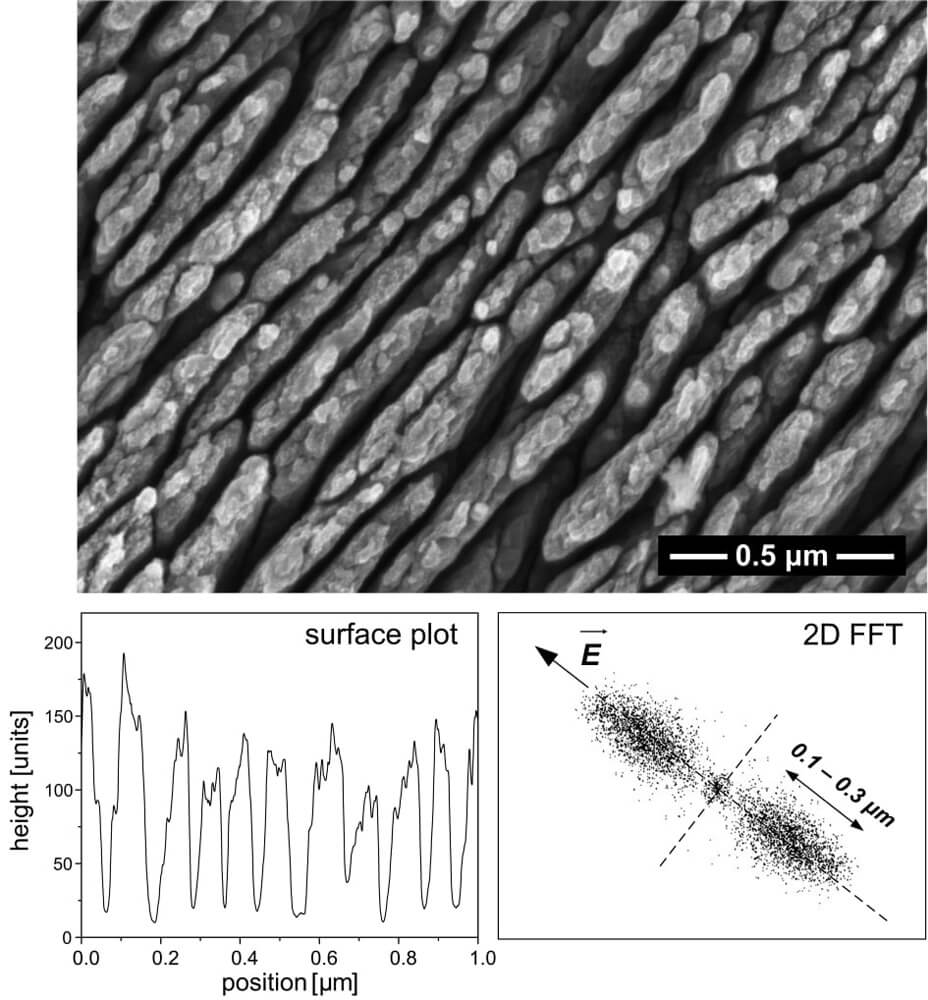
Laser-induced periodic surface structures (LIPSS) can be obtained on a wide range of materials like metals, polymers, and semiconductors. They are periodic patterns referred also as ripples with amplitudes corresponding to the laser wavelength that self-organize under laser irradiation. Ripples can be categorized as low spatial frequency LIPSS (LSFL) with size comparable to laser wavelength and high spatial frequency LIPSS (HSFL) with size several times smaller than laser wavelength. The latter can be obtained only under ultra-short pulse laser irradiation(1015-1012 s). Even though LIPSS have been known for over 50 years, phenomenon of their formation is still not fully explained.
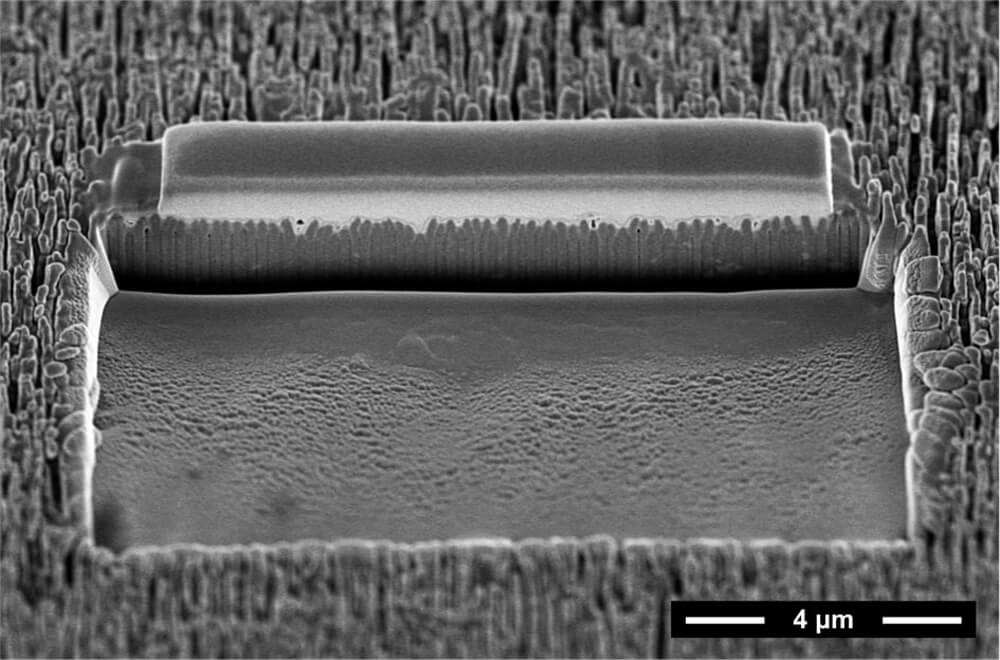
Laser-induced periodic surface structures can have numerous applications. They can be used to fabricate nature-inspired micro- and nanopatterns with interesting properties such as superhydrophobicity or self-cleaning effect (lotus effect). It can be useful to obtain them on pyrolytic carbon, a material widely used as coating material for the various blood-contacting prosthesis such as the artificial heart valve. They could possibly further decrease the risk of blood clots. Until recently, among carbon-based material LIPSS were only examined on graphite and diamond, and only on small areas. Homogenous modifications on large areas are a key development to the growing applications demand of laser-induced periodic surface structures.
Recently, a group of researchers at Wroclaw University of Science and Technology Dr. Bogusz Stepak, Paulina Dzienny, Dr. Arkadiusz Antończak, Piotr Kunicki and Dr. Teodor Gotszalk in collaboration with Dr. Volker Franke at Fraunhofer-Institute for Material and Beam Technology investigated the use of laser-induced periodic surface structures for structuring the surface of an artificial heart valve made of pyrolytic carbon. The authors obtained both type of LIPSS. The group investigated also the process parameters associated with the transition between those two classes of nanostructures. Also, they defined the parameters favorable for homogenous structuring of entire area if heart valve leaflets. Their work is published in the research journal, Applied Surface Science.
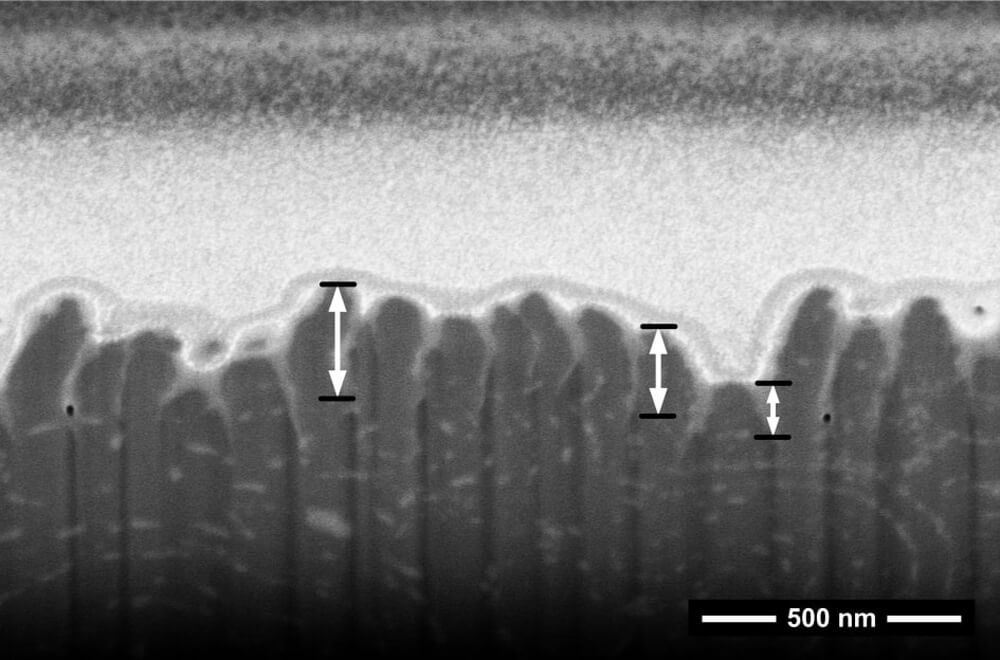
The authors obtained a period range of 70 nm – 150 nm and a depth of about 100 nm for the high spatial frequency LIPSS which can be highly desirable for medical applications. It was necessary to use energy dispersive X-ray spectroscopy and Raman spectroscopy to examine the modified surfaces and in turn determine the changes in structure and the elemental surface composition. They observed some interesting side effects such as dust and shell-like layers in some of the parameters. Furthermore, laser-modified surfaces exhibited higher oxygen and silicon concentration as compared to the reference surface. The oxidation of surface was stronger in case of HSFL.
The authors successfully examined the possibility of using the periodic surface nanostructure to functionalize the surface of an artificial heart valve made of materials like pyrolytic carbon. This was attributed to altering the various laser irradiation parameters like pulse separation to obtain a desirable conditions. Therefore, the study has laid a foundation that will be used in future investigations to access the suitability of the method in the medical field to further improve the properties of medical implants.
Acknowledgement: This research has been supported by Faculty of Electronics, Wrocław University of Science and Technology (grant no. 0402/0119/17).

Reference
Stępak, B., Dzienny, P., Franke, V., Kunicki, P., Gotszalk, T., & Antończak, A. (2018). Femtosecond laser-induced ripple patterns for homogenous nanostructuring of pyrolytic carbon heart valve implant. Applied Surface Science, 436, 682-689.
Go To Applied Surface Science