Advances in Engineering Advances in Engineering features breaking research judged by Advances in Engineering advisory team to be of key importance in the Engineering field. Papers are selected from over 10,000 published each week from most peer reviewed journals.

Significance
Recent advancement in technology has seen improvement in the application of slow light in various fields including photonic integrated circuits. In particular, controlling light propagation has attracted significant interest among researchers. Different approaches have been developed to slow down light in photonic integrated circuits. Most of these approaches are based on coupled cavities like rings, photonic crystal resonators, and photonic crystal waveguides. These approaches lead to significantly wider bandgaps with low group velocity dispersion, following from linear photonic dispersion in the spectral region. Unfortunately, this feature requires a complex design thus resulting in propagation and insertion losses, and preventing applications in actual devices.
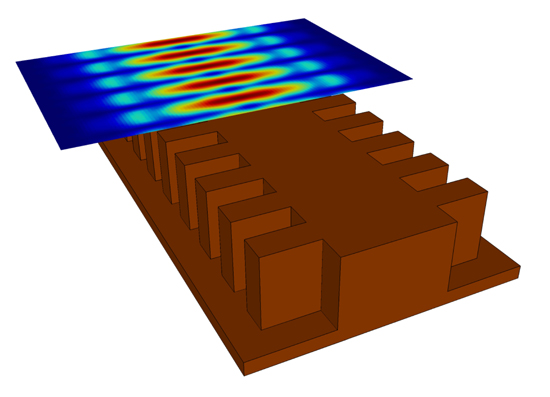
Recently, University of Pavia researchers: Marco Passoni, professor Dario Gerace and professor Lucio Claudio Andreani in collaboration with Dr. Liam O’Faolain at Cork Institute of Technology performed detailed systemic analysis of group index and photonic bands in silicon grating waveguides. Their main objective was to optimize the band-edge slow light performance in integrated structures, and in particular Rib-waveguide structure, based on the geometrical parameters. Their work is published in the research journal, Optics Express.
Briefly, the authors utilized numerical methods and perturbation theory to showcase their work because they enable investigation of a large parameter space. Considering the fact that in a periodic structure the dispersion of light near the photonic band is flat, one-dimensional periodic structures were used. Besides, these structures are easy to fabricate, exhibit low propagation losses and insertion losses that can be significantly reduced to fit the experiment requirements. Consequently, tapering was used to achieve the insertion losses and identification of parameter regions.
The authors observed that the slow light bandwidth increased significantly from 3 nm to 10 nm by decreasing the silicon thickness from 150 nm to 50 nm and by reducing the waveguide internal width in the cladding region. Additionally, at zero internal waveguide width, the maximum slow light bandwidth is achieved. However, despite the reduction in the internal width, there is no interference with the performance of the adiabatic paper. This is attributed to the fact that shorter tapers enhance the transmission capacity in nearly all the regions. As such, the authors confirmed that waveguide width of about 100nm is an optimal requirement to realize maximum slow light bandwidth as well as a structure that can be connected to a standard silicon waveguide by an adiabatic paper.
Due to the accuracy and reliability of the obtained results, the study will advance the efficient implementation of various devices based on slow light in Rib-waveguide. This is because slow light reduces the required length and power dissipation, while maintaining the required bandwidth. For example, Mach-Zehnder modulators constructed based on these results will achieve a significant increase in the group index while maintaining a simple waveguide structure with very low losses level. The analyses enable complete simulation of the device, in view of improved design and comparison with experimental results. The developed analysis can be extended to more complex structures like electro-optical Mach-Zehnder modulators, with the goal of realizing more efficient devices with reduced energy dissipation.

Reference
Passoni, M., Gerace, D., O’Faolain, L., & Andreani, L.C. (2018). Optimizing band-edge slow light in silicon-on-insulator waveguide gratings. Optics Express, 26(7), 8470
Go To Optics Express