Advances in Engineering Advances in Engineering features breaking research judged by Advances in Engineering advisory team to be of key importance in the Engineering field. Papers are selected from over 10,000 published each week from most peer reviewed journals.

Significance
Two-dimensional perovskite nanoplatelets have been drawing much attention owing to their excellent properties which are favourable for device integration. In particular, cesium lead halide perovskite nanocrystals, a novel class of semiconductor materials with promising applications in optoelectronics. Moreover, the intentional incorporation of transition metal ions as dopants offers exciting opportunities to endow perovskite nanocrystals with novel optical, electronic, and magnetic functionalities. In line with this, numerous synthetic techniques have been developed for transition metal ion doped II−VI group semiconductor nanocrystals. Unfortunately, previous research has revealed that doping manganese ions into the perovskite nanocrystals is difficult; most likely due to the large size mismatch between the manganese ions dopant and the lead ions. Consequently, low doping efficiencies are achieved despite the high concentrations of dopants precursor introduced into the synthesis. Therefore, it is imperative that a novel strategy for efficient incorporation of dopants in advanced-shaped perovskite nanocrystals be developed.
Recently, a team of researchers at Syracuse University: Zhi-Jun Li, Elan Hofman, and Andrew Hunter Davis led by Dr. Weiwei Zheng from the Department of Chemistry in collaboration with Dr. Robert W. Meulenberg and Alex Khammang at Maine University, as well as Dr. Joshua T. Wright at Illinois Institute of Technology developed a simple solvothermal technique for efficient doping of manganese into 2D cesium lead chloride (Mn:CsPbCl3) perovskite nanoplatelets. In particular, they improved the doping efficiency through diffusion doping under solvothermal conditions. Their work is currently published in the research journal, Chemistry of Materials.
In brief, the research method employed commenced with the preparation of lightly doped 2D cesium lead chloride nanoplatelets under normal pressure and a relatively low temperature (120 °C). Next, the researchers synthesized heavily manganese doped cesium lead chloride nanoplatelets under solvothermal conditions at 200 °C in a Teflon-lined stainless-steel autoclave. They then characterized the resultant samples using transmission electron microscopy, powder X-ray diffraction analysis, electron paramagnetic resonance peak and X-ray absorption fine structure analysis.
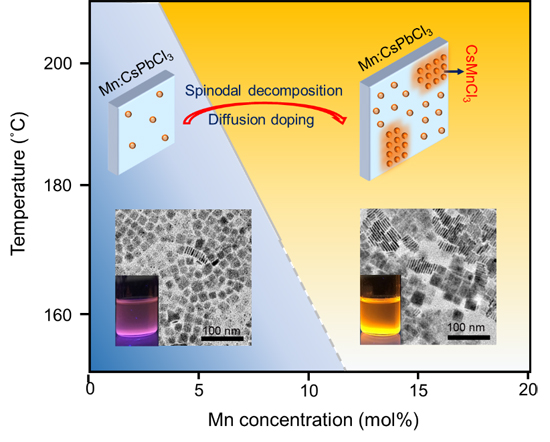
The authors observed that the manganese doping efficiencies were strongly dependent on the solvothermal reaction temperature and time, which was further seen to affect the optical properties of the 2D manganese doped cesium lead chloride perovskite nanoplatelets. Additionally, they found a new cesium manganese chloride (CsMnCl3) phase with complete dopant substitution by spinodal decomposition with extended solvothermal treatment. Compared to manganese doped cesium lead chloride perovskite nanoplatelets, pure cesium manganese chloride perovskite nanoplatelets gave rise to shorter manganese photoluminescence lifetime, which was consistent with the short Mn−Mn distance within cesium lead chloride perovskite nanoplatelets.
“This new doping strategy offers a unique platform to investigate the change in structure and phase of doped 2D perovskite NCs and could offer new possibilities for property engineering of doped nanocrystals.” Zheng told Advances in Engineering.
In summary, Dr. Weiwei Zheng and his colleagues successfully demonstrated a facile solvothermal method for efficient diffusion doping in 2D manganese doped cesium lead chloride perovskite nanoplatelets. Further, the researchers here demonstrated the formation of a new cesium lead chloride perovskite phase by spinodal decomposition without significantly altering the morphology and size of host perovskite nanocrystals. This ability to incorporate a new phase by spinodal decomposition provided a novel understanding of doping inside quantum-confined nanocrystals. Altogether, their study offers an efficient strategy for doping inside nanocrystals as well as new insights on the dopant concentration-dependent structural and optical properties of perovskite nanocrystals.


Reference
Zhi-Jun Li, Elan Hofman, Andrew Hunter Davis, Alex Khammang, Joshua T. Wright, Boris Dzikovski, Robert W. Meulenberg, Weiwei Zheng. Complete Dopant Substitution by Spinodal Decomposition in Mn Doped Two-Dimensional CsPbCl3 Nanoplatelets. Chemistry of Materials. 2018, volume 30, page 6400-6409.
Go To Chemistry of Materials