Advances in Engineering Advances in Engineering features breaking research judged by Advances in Engineering advisory team to be of key importance in the Engineering field. Papers are selected from over 10,000 published each week from most peer reviewed journals.

Significance
Hydropower projects such as dams are generally susceptible to various technical challenges caused by complex geological conditions. Among the challenges, corrosion prevention and energy dissipation are the dominant ones. Unfortunately, the present design relies majorly on the dam flood discharge which makes it difficult to achieve the desired design requirements because the energy dissipation and flood discharge configuration are limited by on-site field conditions. To this note, other flood discharge facilities have been developed to overcome various challenges. A good example is an annular vortex weir spillway. However, the factors influencing the discharge coefficient at the inlet and the swirling intensity have not been fully explored.
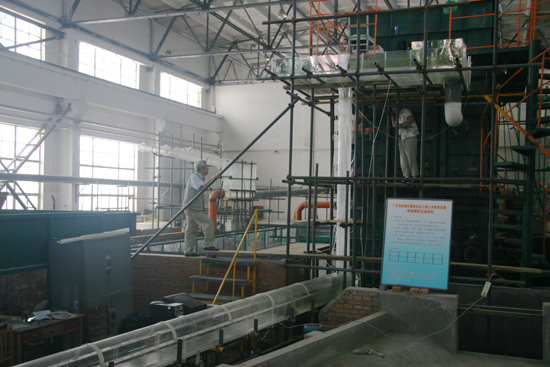
A group of researchers at China Institute of Water Resources and Hydropower Research: Professor Zhi-Ping Liu, Professor Xin-Lei Guo, Professor Qing-Fu Xia, engineer Hui Fu, Professor Tao Wang, and Professor Xing-Lin Dong designed an internal energy dissipation shaft flood discharge tunnel with vortex flow. The shaft spillway comprised of an inlet structure that included an annular weir, swirling-flow-generating piers and a vertical as well as an outlet structure. Besides, the proper design was ensured by a discharge coefficient equation-based on the dimensionless weir head thus giving way for model experimental and numerical simulations. Their aim was to investigate the main factors influencing the discharge coefficient at the inlet including the pier weir angle, the number of piers, pier height and pier head. Furthermore, hydraulic characteristics such as the air core distribution, pressure profiles, flow patterns among others were determined and compared with the measured experimental data. The work is published in Journal of Hydraulic Engineering..
From the experimental results, the authors observed that the flow around the inlet was divided into two regions. This included submerged-flow region at the pers and free-flow swirling region found near the pier. In the submerged region, linear flow growth rate with the relative dimensionless weir head was noted with approximately constant discharge coefficient of about 0.223. This was attributed to the automatic regulation of the inflow angle to enhance discharge capacity under the inertial forces in the underwater swirl piers. This also explains the ability of the vertical flow shaft to maintain a flow state without inhaling water under the working flood discharge condition.
The research team successfully designed a vortex shaft drop tunnel with a new inlet which exhibited a high level of energy dissipation. Thus, the study provides the basis for understanding the flow characteristics of water and particularly the self-regulating under water swirl piers. It was necessary to investigate the hydraulic parameter characteristic of the designed inlet. The similarity in the computational results and the numerical simulation results both in values and patterns confirmed the practicality and effectiveness of the analysis. The numerical simulation model resulted in significant differences between the air entrainment attributed to whether or not the air compressibility as taken into consideration. This may have influenced the model predictions for the entrainment air in one way or the other.








Reference
Liu, Z., Guo, X., Xia, Q., Fu, H., Wang, T., & Dong, X. (2018). Experimental and Numerical Investigation of Flow in a Newly Developed Vortex Drop Shaft Spillway. Journal of Hydraulic Engineering, 144(5), 04018014.
Go To Journal of Hydraulic Engineering