Advances in Engineering Advances in Engineering features breaking research judged by Advances in Engineering advisory team to be of key importance in the Engineering field. Papers are selected from over 10,000 published each week from most peer reviewed journals.

Significance
Well-designed colloidal particles are essential in current industrial setups owing to the vast applications they have in terms of controlling product appearance. Such an attribute is achievable through manipulation of shape, composition and particle size; the attributes that control how the particle interacts with light.
Of course visual product appearance is essential in food industry. Research has shown that color and other appearance attributes create the first impression and primary perception of the consumer toward the food product. Presently, titanium dioxide is the most used white food colorant. However, concerns have been raised regarding the toxicity of nanosized titanium dioxide. Therefore, to avert a potential crisis, development of a natural, bio-based class of materials to use in the synthesis of colloidal particles would be highly desirable. In line with this, prolamins have shown promising attributes and bring along many advantages for the aforementioned purpose. In particular, zein- a group of highly hydrophobic proteins derived from corn- has shown promising attributes. Unfortunately, no research has been undertaken to assess on the usability of zein as a white colorant in food applications to serve as an all-natural and edible replacement for the inorganic titanium dioxide.
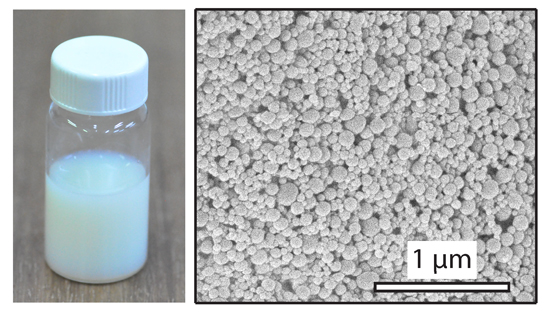
Recently, a team of researchers at Utrecht University: Frankje de Boer (PhD candidate), Rutger Kok (PhD candidate), Professor Arnout Imhof and Professor Krassimir P. Velikov investigated the possibility of using zein as an alternative white colorant for wet food products such as mayonnaise, dressings and beverages. Particularly, they assessed the whiteness of zein particles in a suspension with no excessive components. Their work is currently published in the research journal, Soft Matter.
In brief, the researchers commenced the experimental work by first, purifying zein so as to remove colored impurities. Next, they synthesized white zein nanoparticles using anti-solvent precipitation. The particle shape, charge and size of the zein nanoparticles were then measured. They then quantified the synthesized nanoparticles as white colorant by measuring their scattering properties. Lastly, the optical properties of concentrated suspensions were determined.
The authors observed that the refractive index of the zein particles was 1.49 ± 0.01. In addition, they noted that the transport-mean free path of light determined experimentally and theoretically, was in agreement with the transport-mean free path calculated from the model. In fact, the measured value was seen to be better than 30%. All in all, the results obtained showed that it was possible to model the scattering behavior of suspensions of zein particles.
In summary, the study by Utrecht University scientists presented the successful synthesis of white zein colloidal particles using the anti-solvent precipitation technique. Generally, it was seen necessary to increase the concentration of zein particles in the test solution so as to match opacity to that of titanium dioxide. Altogether, these particles have the potential to be an all-natural edible alternative for titanium dioxide as white colorant in wet food products.




Reference
F. Y. de Boer, R. N. U. Kok, A. Imhof K. P. Velikov. White zein colloidal particles synthesis and characterization of their optical properties on the single particle level and in concentrated suspensions. Soft Matter, 2018, volume 14, page 2870.
Go To Soft Matter