Advances in Engineering Advances in Engineering features breaking research judged by Advances in Engineering advisory team to be of key importance in the Engineering field. Papers are selected from over 10,000 published each week from most peer reviewed journals.

Significance
In a general sense, the mechanism of dilatancy is the volume change observed in a body when it is subjected to shear displacements. The term “dilatancy” was originally introduced by Osborne Reynolds (1885) to denote a particular type of behaviour exhibited by a collection of particles in contact with one another. Since then, this concept has taken a key role in development of rock mechanics and geotechnical engineering (e.g. critical state soil mechanics) with important practical significances in earthquake engineering (e.g. liquefaction, fault rupture propagation).
Dilatancy is a distinctive feature of granular materials but the contribution of this phenomenon in defining the shear strength has been recognized also for concrete (i.e. aggregate interlock). Although this mechanism has already been observed for masonry by various researchers, it has received comparatively little attention in this field. This aspect is particularly important when refined numerical models are used. When brick units, mortar joints and unit-mortar interfaces are explicitly modelled (i.e. micro-modelling) the mortar joints generally require the definition of the parameters related to dilatancy. Since experimental investigations focused on the characterization of this phenomenon are rather limited for masonry, the mechanical parameters related to dilatancy are generally assumed in an arbitrary way. This problem has proved to be relevant in the definition of the unifying approach for the interpretation of the direct hear tests of masonry specimens.
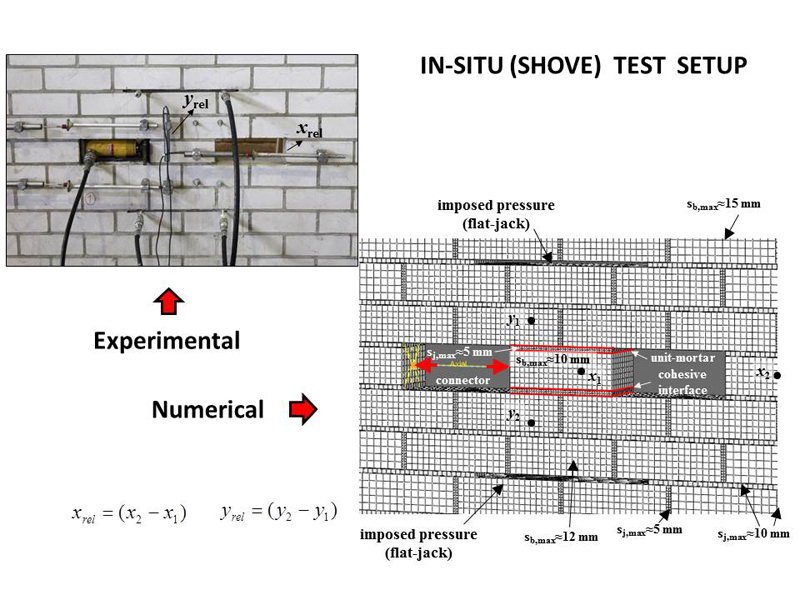
In Europe, the triplet test has been adopted as the standard laboratory procedure for the characterization of the initial shear strength under zero compressive load. Alternatively, an equivalent in-situ test can be used for the same purpose but for existing structures only; this test is called the ‘shove’ test. Unfortunately, significant differences have been observed when the strength parameters determined through laboratory-simulated shove tests are compared with those obtained via triplet tests. So far, research has attributed these discrepancies to the difficulty of estimating the compressive stress that act on the mortar joints under investigation of the shove test. To be specific, the actual compressive stress induced by the flat-jacks on the tested bed joints has been seen to be influenced by the removal of the adjacent units. As a resolve, many opt to estimate the compressive stress acting on the mortar joints in the shove test. In addition, the dilatancy normally experienced along the bed joint during the shear failure process has also been postulated to generate, under certain boundary conditions, a local increase of the normal compression stress. This way, estimation becomes difficult and therefore, the problem ought to be understood so as to overcome this shortcoming. Consequently, this has prompted much research.
Recently, in a multidisciplinary research collaboration Dr. Guido Andreotti from the European Centre for Training and Research in Earthquake Engineering – EUCENTRE in collaboration with Dr. Francesco Graziotti and Prof. Guido Magenes at University of Pavia developed a numerical tool that would be implemented in Abaqus so as to derive reliable values for the compressive shear test. Additionally, they focused in their study on normal dilatancy as it has been previously seen to influence the compressive stress of the mortar joints. Their work is currently published in the research journal, Engineering Structures.
In brief, the research method employed entailed the application of a detailed micro-modelling approach to develop a numerical model capable of accurately simulating the triplet test and the shove test. To actualize this model, the researchers used units and mortar joints with continuum elements and cohesive interface elements, with zero thickness, for the unit-mortar interfaces. Lastly, modifications were implemented on the standard constitutive laws available for continuum elements within the general-purpose software as they were not adequate to model accurately the mechanism of dilatancy.
The authors observed that using their modified model, experimental results of several triplet tests and shove tests were reproduced numerically. The researchers noted that the calibration of the dilatancy angle controlled the expansion of the masonry samples. Moreover, a good agreement between the experimental tests and the numerical simulations was observed, and served as the first encouraging result as regards the reliability of the proposed model. Further, it was shown that the dilatancy angle controlled the expansion of the masonry samples and increased the shear strength of the mortar joints with two different mechanisms: (a) increase in mobilized friction; (b) local increase of normal stress in mortar joints.
In summary, the study presented a novel numerical approach implemented in Abaqus with the sole purpose of interpreting the phenomena involved in the failure of a mortar bed joint. They realized that method they had advanced allowed the quantification of the amount of shear strength and compressive stress generated by the mechanism of dilatancy. Altogether, utilization of the numerical technique presented in this article has potential to be further exploited through additional parametric analysis and numeric-experimental comparison to develop a sufficiently general reference for an update of the criteria for the execution and interpretation of the shove test, which is commonly used for in-situ evaluation of bed joint shear strength.
According to the authors of the paper: The dilatancy mechanism (expansion due to shearing) has a key role in unifying the interpretation of the direct shear test of different disciplines.



Reference
G. Andreotti, F. Graziotti, G. Magenes. Detailed micro-modelling of the direct shear tests of brick masonry specimens: The role of dilatancy. Engineering Structures, volume 168 (2018) page 929–949.
Go To Engineering Structures