Advances in Engineering Advances in Engineering features breaking research judged by Advances in Engineering advisory team to be of key importance in the Engineering field. Papers are selected from over 10,000 published each week from most peer reviewed journals.

Significance
Refrigeration is widely used from many areas in industry to households, with applications ranging from preservation of food to noise reduction in ultra sensitive cameras. The performances of refrigerators are continuously evolving due to rapid technological growth. In cryogenics, the impressive evolution of closed cycle refrigerators (cryocoolers) makes it possible nowadays to reach temperatures down to a few degrees (Kelvin) above absolute zero. Unfortunately, cryocoolers experience several drawbacks that limit their normal capabilities. Periodic fluctuations of refrigerator surface temperature are the most severe problem experienced in closed-cycle cooling. To this note, researchers have been looking for alternative solutions to overcome it.
Among the available solutions, the addition of thermal capacitance and resistance along the cooling path is the most used. Even though effective for reducing fluctuations, such dampers still suffer from some downsides, e.g. in cases where a longer cooling time is not acceptable. At present, a mathematical model of the dynamical response of cryocoolers suitable for the design and optimization of dampers is not available. In fact, cryocoolers are analyzed statically with numerical models, due to their complexity. This means that they cannot be used for linear dynamic systems approaches such as the transfer function analysis. Therefore, a dynamic model of the thermal response of a cryocooler will be of great importance. As such, proper understating of the thermophysical mechanisms surrounding the cryocoolers operation in dynamic regime is of significant interest.
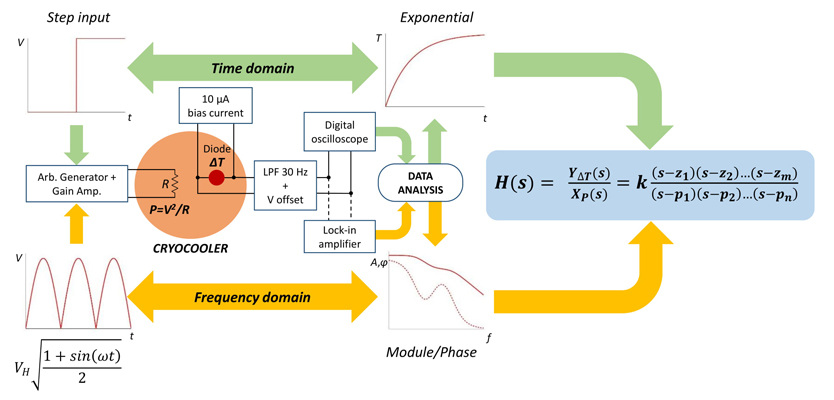
Italian researchers: Dr. Andrea Sosso and PhD student Paolo Durandetto, working for the EURAMET QuADC project, performed an experimental analysis of the input/output response of a Gifford-MacMahon cryocooler, considered as a dynamic linear system over a temperature range defined around one setpoint. They used different techniques in time and frequency domain. Additionally, they integrated these different methods to overcome some measurements difficulties, such as those related to fitting the transient response in output signals and system noise. In the end, they were able at deriving the parameters of the system with desired accuracy as well as estimating the measurement’s uncertainty, providing the model of the thermal behavior of a refrigerator with time-dependent inputs for effective analysis of cryocoolers and design of temperature controllers. Furthermore, the cryocooler model could be used in applications like design and simulation of thermal dampers and for stabilizing the cooler temperature. The work is published in the research journal, International Journal of Refrigeration.
The Sosso-Durandetto study proved successful in the analysis of a linear dynamical model of a Gifford-MacMahon cryocooler. Considering the feasibility of the study, the analysis can be extended to investigate the thermodynamic properties of cryocoolers. As such, the authors are optimistic that the study will lead to the design of better temperature controllers which will further advance the operation of future cryorefrigerators for different applications.


Reference
Sosso, A., & Durandetto, P. (2018). Experimental analysis of the thermal behavior of a GM cryocooler based on linear system theory. International Journal of Refrigeration, 92, 125-132.
Go To International Journal of Refrigeration