Advances in Engineering Advances in Engineering features breaking research judged by Advances in Engineering advisory team to be of key importance in the Engineering field. Papers are selected from over 10,000 published each week from most peer reviewed journals.

Significance
The complex nature of turbulent flows is mainly due to various momentum and energy transfer mechanisms between structures (eddies) of wide ranges of temporal and spatial scales. The case of wall-bounded turbulence is even more complex due to the fact that the presence of the wall introduces an inhomogeneity in the wall-normal direction, which significantly affects the size of the turbulent structures. Experimental measurements are among the main approaches capable of accurately studying the physics of turbulent boundary layers (TBLs) existing in wall-bounded turbulent flows. However, the errors and uncertainties involved in such measurements can potentially influence our conclusions regarding the physics of TBLs. This clearly shows the necessity of employing appropriate techniques for assessing the uncertainties.
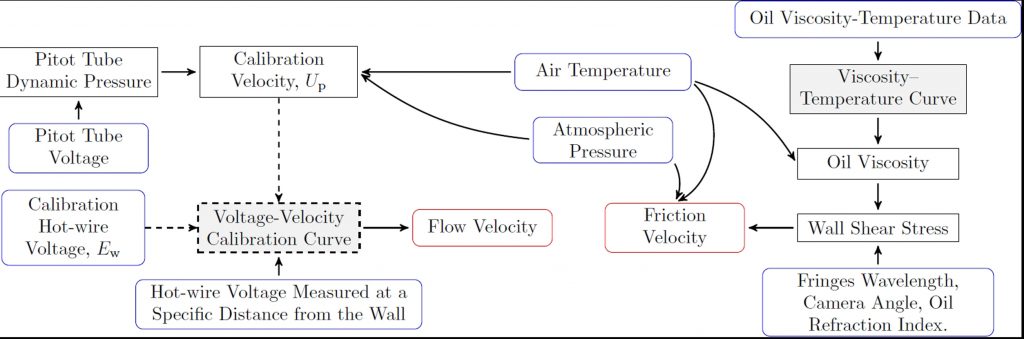
The particular focus here is on two experimental techniques employed to determine the inner-scaled mean velocity profile: the oil film interferometry and the hot wire anemometry. The former is used to measure the wall-shear stress while the latter is employed to measure the velocity profile. Generally, the measured quantities of interest from the combination of these two techniques can be used to estimate parameters in different models developed for wall-bounded turbulence, such as the laws of the wall. Therefore, uncertainties in the measurement of the velocity and wall shear stress can propagate into the models and impact the parameters and hence quantities predicted by the models. In order to efficiently identify and assess the uncertainties involved, the general mathematical and statistical techniques developed in the framework of Uncertainty Quantification (UQ) can be exploited.
In a recent research paper published in European Journal of Mechanics-B/Fluids, Uppsala University scientists, Dr. Saleh Rezaeiravesh and Dr. Mattias Liefvendahl, in collaboration with Dr. Ricardo Vinuesa and Professor Philipp Schlatter at the Linné FLOW Centre, KTH Stockholm investigated different sources of uncertainty in both oil-film interferometry and hot-wire anemometry measurements. They employed both statistical and classical methods to perform UQ forward (uncertainty propagation) and inverse (parameter estimation) problems. As a complement to forward problems, local and global sensitivity analyses were conducted where the latter was shown to be more informative and led to the ranking of the most influential factors on the measured quantities.
In inverse problems, the model parameters were estimated by Bayesian inference and non-linear least squares methods. Through comparison between the mean values of the parameters, the authors verified the usability of the uncertainty quantification in studying practical problems that involve the estimation of different uncertain parameter from the measured data. More importantly, it is shown that by accurately accounting for the uncertainties of the measured data, the Bayesian inference can lead to less uncertain model parameters.
As another way of reducing the systematic uncertainty due to the use of inaccurate methods, the authors show that considering correlations between the observed data samples and also between the estimated parameters can significantly reduce the overall uncertainty. Applying these modifications, relative errors of 0.44%, 0.22% and 0.23% in the measured wall-shear stress, viscous length scale, and friction velocity respectively were obtained, which were significantly lower than those obtained in other wall-bounded turbulence experiments. Based on the results of the global sensitivity analysis, whether or not the correlations were considered, the most sensitive factors were found to be the wire voltage in hot-wire anemometry measurements and the fringe velocity in the oil-film interferometry.
Considering the utmost importance of the wall-bounded turbulent flows in engineering designs, the significant role of employing detailed uncertainty quantification techniques for assessment of the accuracy of the measured quantities of these flows is well comprehended. The use of such techniques is not limited to laboratory experiments, and has to be considered as a necessary part of the numerical simulations of the turbulent flows on supercomputers as well.
“To quantify the accuracy should be a necessity for any high quality measurement, be it from experiments or simulation. For laboratory data, this is already quite established, but such modern techniques also make it possible for large-scale simulations in the fastest supercomputers available today.” Said Saleh Rezaeiravesh.




Reference
Rezaeiravesh, S., Vinuesa, R., Liefvendahl, M., & Schlatter, P. (2018). Assessment of uncertainties in hot-wire anemometry and oil-film interferometry measurements for wall-bounded turbulent flows. European Journal of Mechanics – B/Fluids, 72, 57-73.
Go To European Journal of Mechanics – B/Fluids