Advances in Engineering Advances in Engineering features breaking research judged by Advances in Engineering advisory team to be of key importance in the Engineering field. Papers are selected from over 10,000 published each week from most peer reviewed journals.

Significance
Ferroelectric nanocomposites possess great potential as promising materials for the development of advanced electronic devices with improved performance. Owing to high permittivity of ferroelectric crystals, such composites are superior for applications in electric energy storage devices, providing much higher energy densities than commercial polymer capacitors. Since the permittivity of ferroelectrics strongly depends on the intensity of an applied electric field, ferroelectric–dielectric composites are also suitable for applications in tunable electronic elements such as microwave varactors.
Ferroelectric nanocomposites have been widely fabricated by intruding various ferroelectrics into the pores of dielectric matrices, such as silica glass and aluminum oxide. Experimental studies of the structure and physical properties of thus obtained nanocomposites showed that embedded nanocrystals usually exhibit modified ferroelectric behavior. Furthermore, dielectric measurements revealed that ferroelectric–dielectric composites might demonstrate strong enhancement of permittivity at high temperatures. However, physical effects responsible for specific polarization states and peculiar dielectric properties of ferroelectric nanocomposites are still poorly understood, which hampers their optimization necessary for successful device applications.
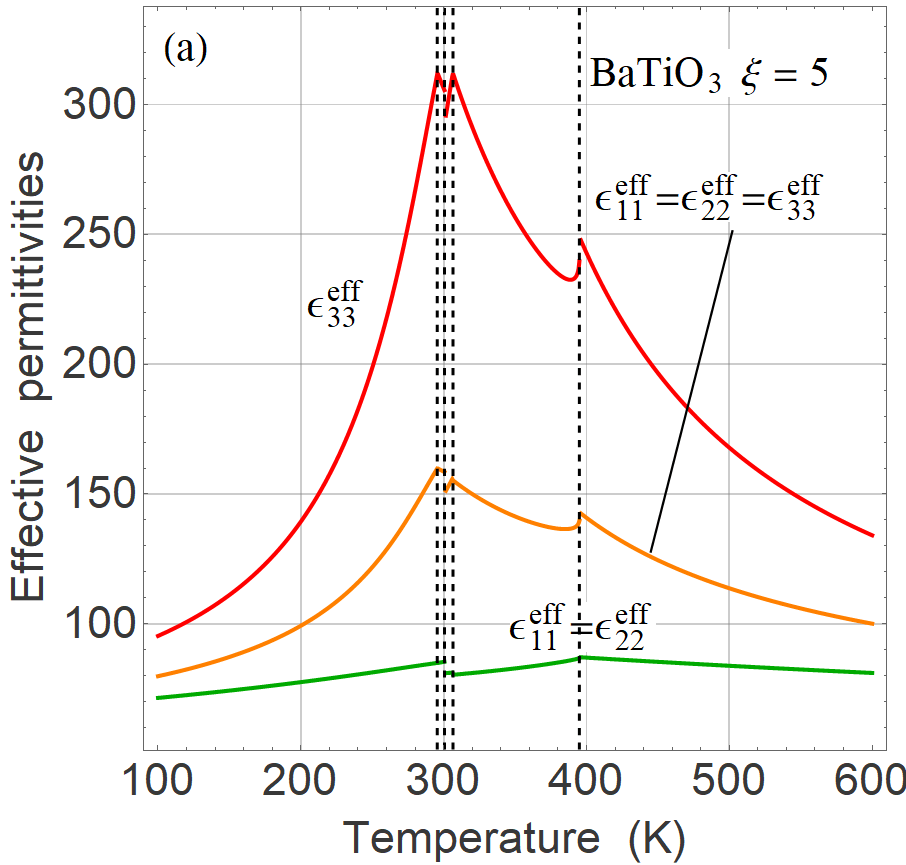
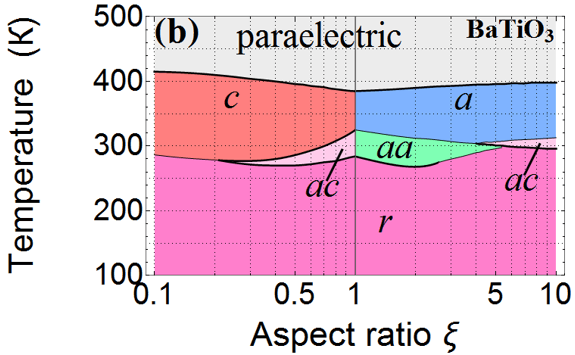
Attempting to fill this lacuna, a group of researchers at Ioffe Institute in Russia – BSc Andrei I Nikitchenko, MSc Andrei V Azovtsev (currently a PhD candidate), and Dr. Nikolay A Pertsev – developed a nonlinear thermodynamic theory of ferroelectric–dielectric composites, which was published in the Journal of Physics: Condensed Matter [1, 2]. In contrast to previous studies, the authors took into account the mechanical effect of the matrix on the phase states and dielectric responses of ferroelectric inclusions. First, they calculated “shape-temperature” phase diagrams of spheroidal BaTiO3 and PbTiO3 nanocrystals embedded into rigid matrices generating tensile or compressive thermal stresses inside the nanocrystals [1]. The constructed phase maps demonstrated that the joint effect of thermal stresses and matrix-induced elastic clamping of ferroelectric inclusions gives rise to several important features in the polarization behavior of BaTiO3 and PbTiO3 nanocrystals. Furthermore, the results obtained for equilibrium polarization states of ferroelectric inclusions enabled the authors to calculate the intrinsic permittivities of BaTiO3 and PbTiO3 nanocrystals with the account of the mechanical effect of surrounding glass matrix. Then these permittivities were used to evaluate the macroscopic dielectric responses of BaTiO3–glass and PbTiO3–glass composites comprising randomly oriented or similarly aligned spheroidal ferroelectric nanoinclusions [2]. The problem was solved in the Maxwell Garnett approximation by deriving generalized relations allowing for both shape and dielectric anisotropies of ferroelectric nanocrystals in the description of the electrostatic effect of low-permittivity matrix on electric-field-induced polarization changes in ferroelectric inclusions.
The numerical calculations performed for BaTiO3 and PbTiO3 nanocrystals embedded into silica and potassium silicate glasses revealed a pronounced mechanical matrix effect on their intrinsic permittivities. Although the depolarizing field arising inside ferroelectric nanocrystals surrounded by a low-permittivity matrix suppresses their actual dielectric responses, the effective permittivities of nanocomposites can be much higher than the matrix dielectric constant even at a low volume fraction of ferroelectric material. Most importantly, the theory predicts that BaTiO3–K2O-SiO2 composites with needle-like or disc-shaped inclusions should exhibit a broad dielectric peak around room temperature, which is associated with shifted structural phase transitions in strained BaTiO3 nanocrystals. This result demonstrates that strain engineering of ferroelectric composites represents an efficient tool for the enhancement of their dielectric responses. Overall, the developed theory provides useful guidelines for the fabrication of high-performance ferroelectric nanocomposites suitable for applications in advanced electronic devices.



References
[1] Nikitchenko, A., Azovtsev, A., & Pertsev, N. (2018). Phase diagrams of ferroelectric nanocrystals strained by an elastic matrix. Journal of Physics: Condensed Matter, 30, 015701.
[2] Nikitchenko, A., Azovtsev, A., & Pertsev, N. (2018). Dielectric properties of ferroelectric nanocomposites: effects of thermal stresses and filler shape anisotropy. Journal of Physics: Condensed Matter, 30, 435301 Go To Journal of Physics: Condensed Matter