Advances in Engineering Advances in Engineering features breaking research judged by Advances in Engineering advisory team to be of key importance in the Engineering field. Papers are selected from over 10,000 published each week from most peer reviewed journals.

Significance
Cement is the most used material in buildings and structural constructions thanks to its cost-effective, availability and efficiency. Considering the current trends, the demand for cement materials is expected to increase due to the increase in population and demand for infrastructure. Unfortunately, the resulting construction wastes have led to environmental degradation going against the current global policies about environment protection.
To this note, efficient techniques for minimizing the wastes resulting from cement as well as associated effects is highly desired. Recent studies have shown that recycling will be the best alternative. For instance, different approaches including using cement wastes as inert aggregates in concrete pore filling and using recycled cement aggregate to manufacture concrete products have been developed.
However, regardless of the great improvements in using the waste cement, mechanical recovery of the hydrated cement is still missing. Therefore, researchers have been looking for alternatives and have identified the use of modified graphene as a promising solution due to its capability of improving the durability and mechanical properties of the concretes. However, the effects of graphene oxide on the recovery of waste cement are yet to be fully explored.
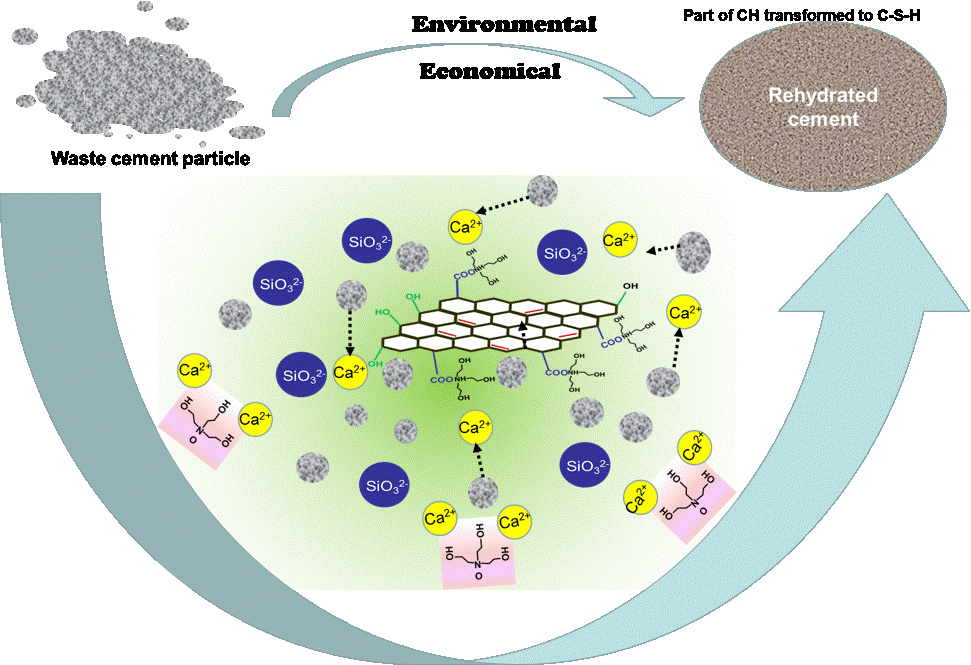
To this end, Tianjin University scientists: Dr. Miaomiao Hu, Professor Jintang Guo, Mr. Pengpeng Li, Miss Jinjie Fan and Professor Yakai Feng from the Department of Polymer Science and Engineering investigated the recovery of cement through rehydration process. In particular, a Tris(2-hydroxyethyl) amine-Graphene Oxide was fabricated to enable micro- mechanical recovery of waste cement in the presence of sodium silicate. They improved the micromechanical properties and refined the microstructure of waste cement. Their work is currently published in the research journal, Construction and Building Materials.
Briefly, the experimental work involved reacting the Tris(2-hydroxyethyl) amine-Graphene Oxide with the resulting products of the activities of the carboxylic and epoxy groups on the graphene oxides. Next, several techniques including X-ray diffraction, Raman spectra, and atomic force microscope were utilized to characterize the rehydrated sample. Eventually, the mechanical properties of the recycled cement were improved by quickly and efficiently extracting the solid calcium during the rehydration process.
The authors observed that rehydrated cement exhibited an increase in mechanical properties. This was attributed to the transformation of the CH to the C-S-H gel in sodium silicate due to the fast extraction of calcium from the hydrated cement. Consequently, a decrease in the pore size of the rehydrated cement was noted due to the addition of the Tris(2-hydroxyethyl) amine-Graphene Oxide. Furthermore, it was worth noting that the properties of the recycled cement depended majorly on the structural elements and more so at the micro- and nanoscale.
In summary, Tianjin University scientists successfully investigated the effects of graphene oxide on the recovery of waste cement. In general, positive results have been obtained including improved mechanical properties of the rehydrated cement indicates that graphene oxide is an excellent tool in the mechanical recovery of waste cement. Therefore, the study will reduce the associated environmental impact of the cement wastes as well as pave way for future advancement in recycling cement wastes.


Reference
Hu, M., Guo, J., Li, P., Fan, J., & Feng, Y. (2018). Micromechanical recovery of waste cement via efficient rehydration under the effect of Tris(2-hydroxyethyl) amine-Graphene Oxide (TEA-GO). Construction and Building Materials, 188, 470-479.
Go To Construction and Building Materials