Advances in Engineering Advances in Engineering features breaking research judged by Advances in Engineering advisory team to be of key importance in the Engineering field. Papers are selected from over 10,000 published each week from most peer reviewed journals.

Significance
Presently, rigorous climate change and global warming have compelled policymakers and relevant stakeholders to come up with rules and regulations to promote environment conservation and energy saving. For instance, the development of other electricity generating methods is highly desirable to reduce the overdependence on fossils fuels, which is among the leading environmental pollutants. The current advancement in thermoelectric technologies has led to the direct conversion of heat into electricity. This has approved useful in numerous application such as automobile and geothermal industries.
Generally, the conversion of heat into electricity in the thermoelectric materials is based on the Seebeck effects. However, the difficulty in accurately determining the thermoelectric parameters have remained a challenge thus hindering proper quantification of the thermoelectric modules’ performance as well as the development of more efficient fabrication methods. As such, several techniques such as steady-state method have been developed to evaluate different properties of the thermoelectric modules. However, regardless of the remarkable achievements, characterization of the temperature-dependent parameters have not been fully explored.
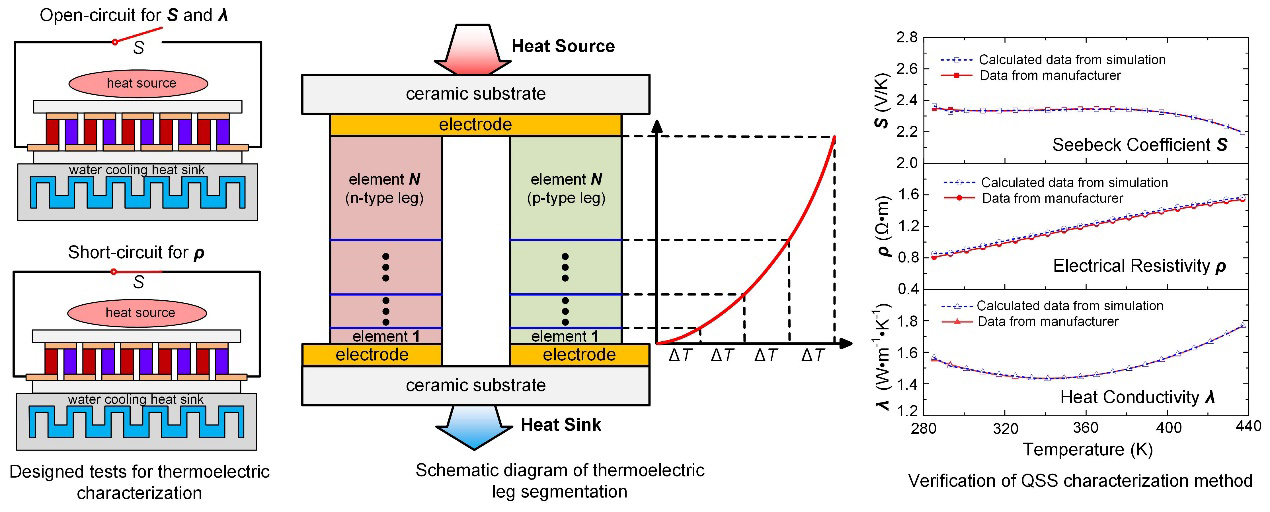
To this note, a group of Xi’an Jiaotong University researchers Dr. Hailong He, Ms. Weiwei Liu, Professor Yi Wu, Professor Mingzhe Rong, Mr. Peng Zhao, and professor Xiaojun Tang from the State Key Lab of Electrical Insulation and Power Equipment proposed a new method for characterization of temperature-dependent thermoelectric parameters. The main focus was to improve on efficiency and accuracy so as to develop high-performance thermoelectric devices for electricity generation. Fundamentally, the proposed method was based on the quasi-steady state method implemented using both short circuit and open circuit tests. Their work is currently published in the research journal, Energy Conservation, and Management.
Briefly, the authors commenced their experimental work by exploring all the thermoelectric and irreversible effects such as Seebeck and Peltier effects which are relevant for modeling thermoelectric couples. Next, a three-dimensional model was designed using COMSOL software to enable simulation and test analysis for validating the effectiveness of the proposed method. Consequently, the authors validated the time-saving concept by comparing the modeling of both single and compete thermoelectric modules. Eventually, the overall efficiency and effectiveness of the new model were verified by comparing the test and simulations results.
The authors observed that both the simulated and experimental results exhibited good agreement thus validating the effectiveness and feasibility of the newly proposed numerical model. For instance, the overestimated heat flow was recorded as 12.6% due to the measurement uncertainties while a corresponding similarity for the electrical output and NRMSE was recorded as slightly less than 2%.
In summary, the research team successfully developed an efficient method for characterizing temperature-dependent parameters for thermoelectric modules. To actualize their study, they introduced the quasi-steady state method to enhance the accuracy and time saving in calculating thermoelectric parameters. Both good correlations were observed for the calculated thermoelectric parameters through simulation and those provided by the manufacturer. Therefore, the study provides essential information for estimating and enhancing the performance of thermoelectric modules such as thermoelectric generators both for small and large scale.



Reference
He, H., Liu, W., Wu, Y., Rong, M., Zhao, P., & Tang, X. (2019). An approximate and efficient characterization method for temperature-dependent parameters of thermoelectric modules. Energy Conversion and Management, 180, 584-597.
Go To Energy Conversion and Management