Advances in Engineering Advances in Engineering features breaking research judged by Advances in Engineering advisory team to be of key importance in the Engineering field. Papers are selected from over 10,000 published each week from most peer reviewed journals.

Significance
Despite immense progress in the field of optics, to date, the majority of optical devices are designed to perform a single operation on an electromagnetic field, with high efficiency. Although incorporating multiple functionalities in the same physical object is possible, it generally comes at the expense of efficiency and fidelity of the individual functions. If highly efficient multi-functional optical devices could be designed reliably, they may provide the means for major breakthroughs in optical communications, optical and quantum computing, computer vision, imaging, scientific instrument design, and a host of other fields. The emergence in recent years of highly tailorable artificial media, such as metamaterials, has provided the optical design community with the ability to fabricate devices with exquisite control of scattering behavior, with access to unprecedented scattering responses and exquisite control over their spatial distribution. At this time, what is lacking is a general design approach that is able to leverage the vast palette of material optical properties, by producing specifications for highly efficient multi-functional optical devices.
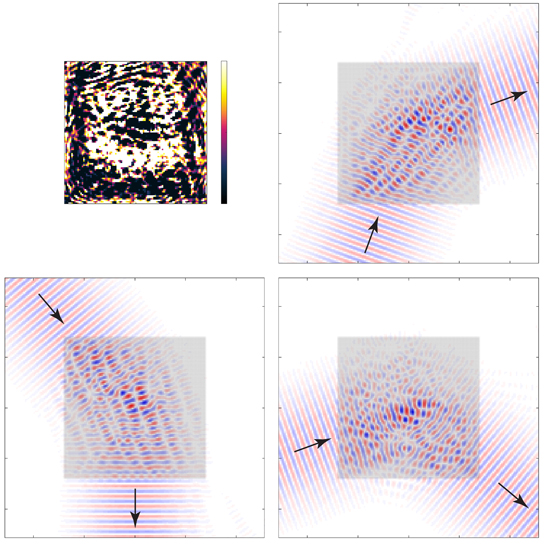
In a recent publication, Roberto Zecca (Ph.D. candidate), Dr. Daniel Marks, and Prof. David Smith from the Center for Metamaterials and Integrated Plasmonics and Department of Electrical and Computer Engineering at Duke University developed a novel optical design method that generates highly efficient multi-functional devices. The method, based on the electromagnetic variational principle, applies to artificial media that can be described as collections of point dipoles, as most metamaterials are. In the paper, the authors demonstrated three devices, two of which multi-functional, that all displayed efficiencies above 95%. Their work is currently published in the research journal Optics Express.
The design method combines the electromagnetic variational principle with adjoint-state techniques and with the discrete-dipole approximation (DDA), a very computationally efficient physical model for metamaterial elements. Instead of directly solving the design problem, which in general is a very challenging task, the method starts from an initial guess at the optical scattering properties of the device and uses successive iterations to improve on the guess, until a satisfactory efficiency is reached. If the desired device is multi-functional, the method takes all functions (input-output wave pairs) into account at the same time, designing a medium that implements all functions concurrently.
In summary, Duke researchers successfully devised an iterative design method for artificial media that can be described as collections of electromagnetic dipoles. Their revolutionary approach was achieved through the combination of the variational formulation of electromagnetism and the discrete-dipole approximation. Altogether, the novel approach showed promise as a candidate for the design of electromagnetic devices able to encode a large number of functions in the same volume.



Reference
Roberto Zecca, Daniel L. Marks, and David R. Smith. Variational design method for dipole-based volumetric artificial media. Volume 27, Number 5 | 2019 | Optics Express 6512.
Go To Optics Express